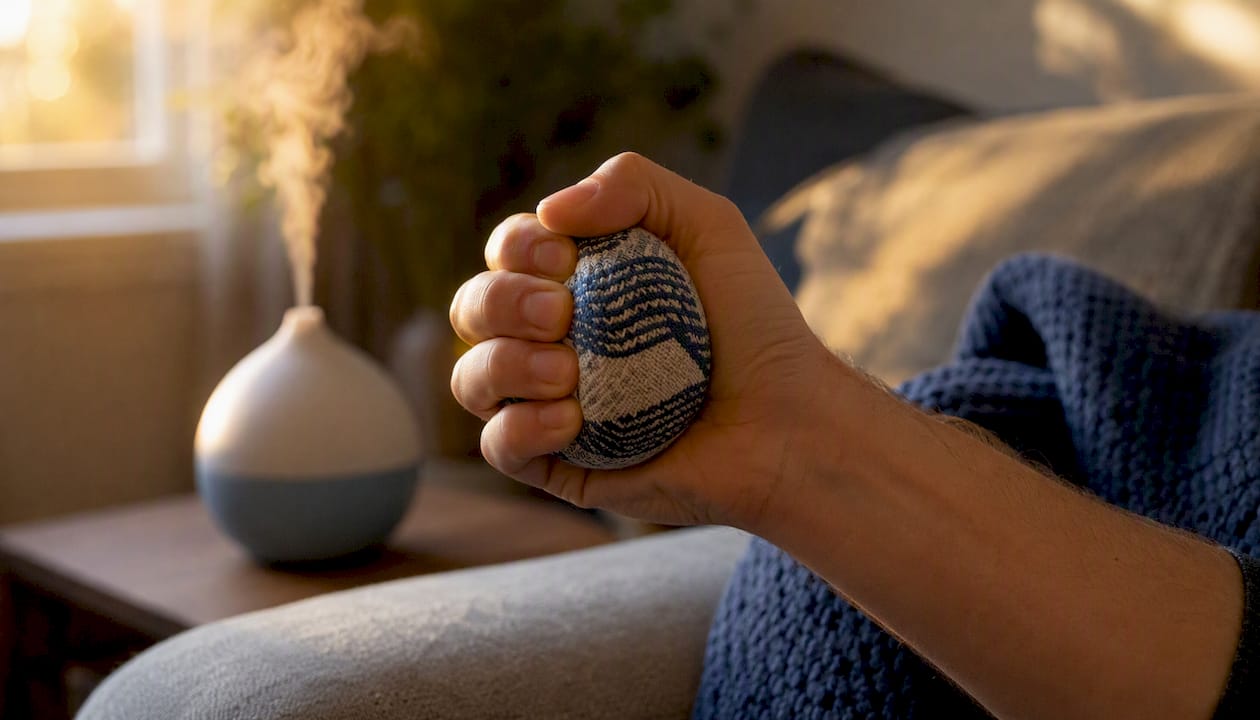
Stress ball exercises are short, tactile grounding routines that use squeezing, breath timing, and texture focus to pull your mind out of anxious spirals and back into your body. They work in under a minute. If you need something right now, try one of these:
- Steady squeeze (30 seconds): Grip firmly for several seconds, release slowly, repeat.
- Inhale-squeeze-exhale release (45 seconds): Squeeze as you breathe in for a few counts, hold briefly, release as you breathe out slowly.
- Palm roll (60 seconds): Roll the ball between both palms, noticing texture and temperature.
Use the steady squeeze before a meeting, the breath release during a stressful commute, and the palm roll at bedtime to slow a racing mind.
Key Takeaways
Stress ball exercises work by pairing tactile grounding with paced breathing, giving the mind a concrete sensory anchor that interrupts anxious thought loops within minutes.
| Point | Details |
|---|---|
| Start with short microbreaks | Use 30 to 90 second squeeze-hold-release or breath-synced routines for sudden tension. |
| Pair touch with breath | Synchronizing squeeze timing with inhale and exhale counts improves the calming effect. |
| Save longer routines for transitions | Use the 5-minute reset or 10-minute wind-down before high-stakes moments or bedtime. |
| Know the limits | These exercises suit mild, situational anxiety, not chronic conditions requiring professional care. |
| Choose a ball that fits your routine | Mindpanda’s stress balls and Mindfulness Wellbeing Bundle offer curated firmness and aromatherapy options for these exact exercises. |
Table of Contents
- Why Stress Balls Help: Sensory Grounding and Haptics Explained
- Three Quick Stress Ball Exercises You Can Do Anywhere
- Longer Stress-Ball Routines for a Deeper Reset
- How to Choose the Right Stress Ball for These Exercises
- Safety, Limits, and When to Seek Professional Help
- A Simple Daily Plan for Stress Ball Practice
- What the Research Actually Says About Stress Balls
- Try a Ready-Made Stress Ball Kit From Mindpanda
- Frequently Asked Questions
- Sources
Why Stress Balls Help: Sensory Grounding and Haptics Explained
Tactile grounding works by redirecting attention away from rumination and onto physical sensation, the same principle behind squeezing something cold when you’re overwhelmed. Your brain has limited bandwidth for focus, and touch is a demanding sense. When you concentrate on the texture, resistance, and temperature of a stress ball, there’s less processing power left for the anxious thought loop.
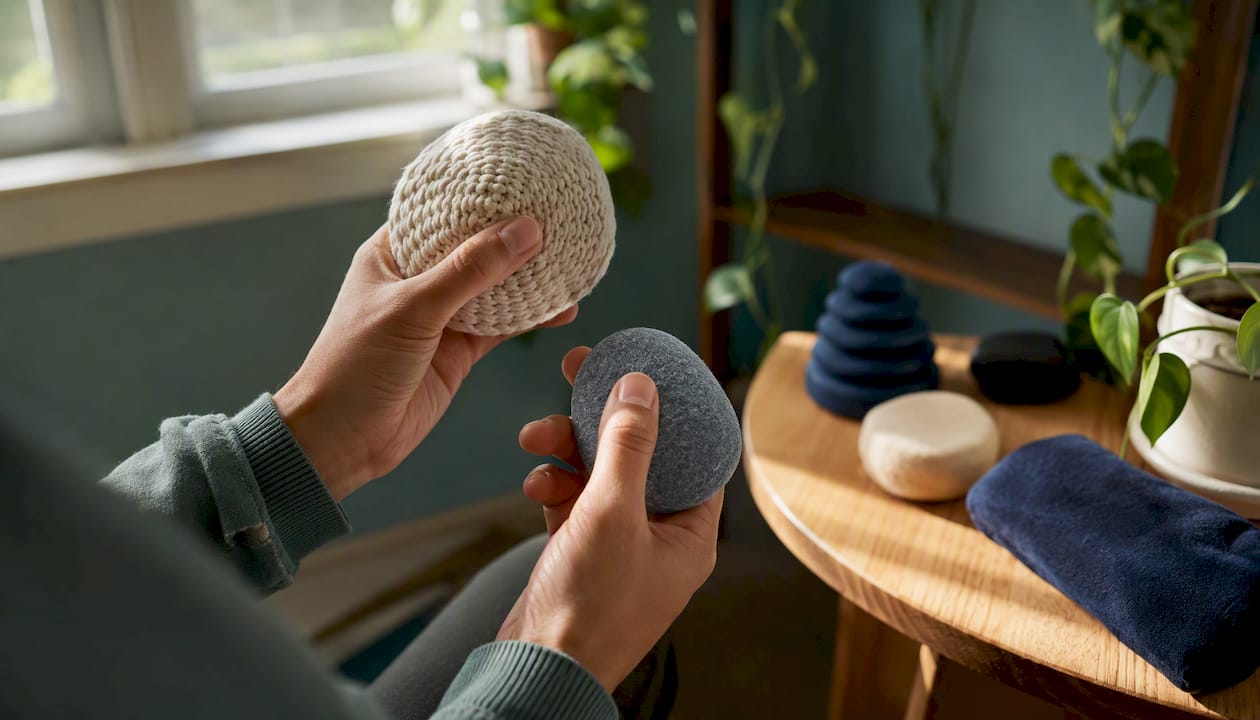
Healthline notes that stress balls act as a sensory grounding tool for situational anxiety, redirecting attention from distress to the object in your hand. That lines up with haptics research showing that tactile and thermal stimulation produced measurably greater relaxation than no stimulation at all in a 49-participant trial, even though some physiological changes didn’t reach statistical significance. Squeezing also triggers proprioception and mimics progressive muscle relaxation, a well-established technique for easing perceived stress.
That said:
- Stress balls work best for mild, situational anxiety, not chronic or clinical anxiety disorders.
- They’re a complement to other coping tools, not a standalone treatment.
Three Quick Stress Ball Exercises You Can Do Anywhere
These take one to three minutes and fit into a bathroom break, a parked car, or a pause before you walk into a room.
- Squeeze, hold, release. Grip the ball at about 70% of your max strength for 5 seconds, then release completely for 5 seconds. Repeat several times, for about a minute or so in total. This is your go-to for sudden tension spikes.
- Breath-synchronized squeeze. Inhale for 4 counts while squeezing gradually, hold for 2 counts at full grip, then exhale for 6 counts while releasing slowly. Do several cycles over about a minute. This pairs the calming effect of paced breathing with relaxation techniques to enhance your wellness, combining tactile focus with breath work for greater stress relief, which tends to outperform squeezing alone.
- Palm roll and finger massage. Roll the ball slowly across one palm, then switch hands and use your thumb to press small circles into the ball as if massaging it. Good for a quiet, discreet version at your desk.
Quick pulses (steady squeeze) work better for sudden spikes of tension. Slower holds (breath-synchronized) suit lingering low-grade anxiety, like before a presentation.
Pro Tip: The biggest mistake people make is mindless squeezing while their mind stays elsewhere. Actually notice the ball’s texture, whether it’s warming in your palm, and how your forearm muscles release on the exhale. That attention is what separates a fidget from a grounding exercise.
If you want variety, aromatherapy-infused stress balls add a scent cue that reinforces the calming association, and cooling gel-filled versions give a stronger temperature contrast. Single-hand versions work well for a subtle office move; two-hand palm rolls are better saved for private moments.
Longer Stress-Ball Routines for a Deeper Reset
When you have five to ten minutes, a longer routine gives the nervous system more time to downshift than a quick squeeze alone.
- The 5-minute reset. Sit down, set a timer, and begin with the breath-synchronized squeeze at a slow pace: 4-count inhale, 2-count hold, 6-count exhale. Aim for about 6 cycles per minute. Around the 3-minute mark, shift to the palm roll, keeping your breathing steady. Use this before a high-stakes call or after a tense conversation.
- The 10-minute wind-down. Start with 2 minutes of steady squeezing while you scan your body for tension, then move into 5 minutes of the breath-synchronized squeeze at a slower tempo, around 4 cycles per minute. Close with 3 minutes of light palm rolling while you let your thoughts settle without judging them. This one works best before bed.
Pro Tip: Try pairing either routine with slow, steady music. A randomized trial found that gradually decreasing vibration tempo combined with music significantly lowered subjective stress and salivary cortisol compared to a control condition. You don’t need special equipment, just a calm playlist and consistent breath counting.
How to Choose the Right Stress Ball for These Exercises
Not every stress ball supports every exercise equally well, and the wrong pick can turn a calming routine into an annoying one. A ball that’s too firm makes long holds tiring; one that’s too soft loses its grounding resistance fast.
- Firmness: softer foam fills suit longer routines and sensitive hands, firmer gel or bead fills give sharper resistance for quick squeeze-hold-release sets.
- Size: a ball that fits comfortably in one palm without your fingers overlapping keeps the grip natural.
- Outer texture: fabric-covered balls add a warming, tactile layer; smooth silicone or rubber surfaces give a cooler, cleaner feel.
- Fill type and durability: foam is forgiving and quiet, gel offers a satisfying push-back, and beads add subtle texture as you roll them.
Mindpanda’s aromatherapy and themed stress ball sets let you test different resistances and scents without committing to just one, and a piece like the empowering pink stress ball shows how a themed design can make the habit feel more personal.
Pro Tip: If you’re unsure which firmness suits you, start with a medium resistance ball. It works for both quick pulses and slow breath-synced holds, so you’re not buying two.
Safety, Limits, and When to Seek Professional Help
Stress ball exercises are safe for almost everyone, but a few precautions matter.
- Stop squeezing if you feel sharp pain, numbness, or tingling in your hand or wrist.
- Avoid gripping to the point of strain, especially during longer routines, since repetitive overuse can aggravate tendons.
- Take breaks between sessions rather than squeezing continuously for extended periods.
These exercises are best suited to mild, situational anxiety, the kind tied to a specific moment like a deadline or a difficult conversation. Healthline is clear that stress balls aren’t a substitute for treating chronic or clinical anxiety. If you’re dealing with persistent worry, panic attacks, or anxiety that interferes with daily functioning, talk to a licensed mental health professional. If you’re in crisis, contact a local crisis line or emergency services right away.
A Simple Daily Plan for Stress Ball Practice
Consistency beats intensity here. Short, frequent microbreaks build the habit faster than occasional long sessions.
- Morning: a 30-second steady squeeze right after you check your first emails, before reacting to anything in your inbox.
- Mid-afternoon: a 60-second breath-synchronized squeeze before your next meeting or right after your commute home.
- Evening: the 5-minute reset or 10-minute wind-down routine about 30 minutes before bed.
Attach each microbreak to something you already do, like brewing coffee, closing your laptop, or brushing your teeth. That cue-based approach makes the habit automatic instead of something you have to remember. Start with just the two microbreaks in week one, then add the evening routine once the shorter ones feel natural. Tracking it on a simple calendar checkmark for a week is usually enough to lock in the pattern.
What the Research Actually Says About Stress Balls
Tactile grounding tools reduce situational stress by giving the mind something concrete to focus on instead of an anxious thought loop, and pairing that touch with breath or sound tends to deepen the effect.
The evidence here is modest but consistent. Healthline frames stress balls as a sensory grounding tool for short-term anxiety. A 49-participant haptics trial found that mid-air and thermal tactile stimulation produced more reported relaxation than no stimulation, though not every physiological measure moved significantly. Separately, a vibration-and-music trial showed that combining touch with sound significantly lowered both subjective stress and cortisol.
The practical takeaway: stress balls work most reliably for short-term relief, and adding breath work or slow music tends to help more than squeezing alone.
- These particular exercises were chosen because they’re low-risk, backed by consistent findings, and require no equipment beyond the ball itself.
A note from the author
I’ve spent years writing mindfulness content for Mindpanda, testing these exact squeeze-and-breathe routines during my own stressful workdays. They’re not magic, but they’re reliable. Read more from me, Ravi, on the Mindpanda blog.
Try a Ready-Made Stress Ball Kit From Mindpanda
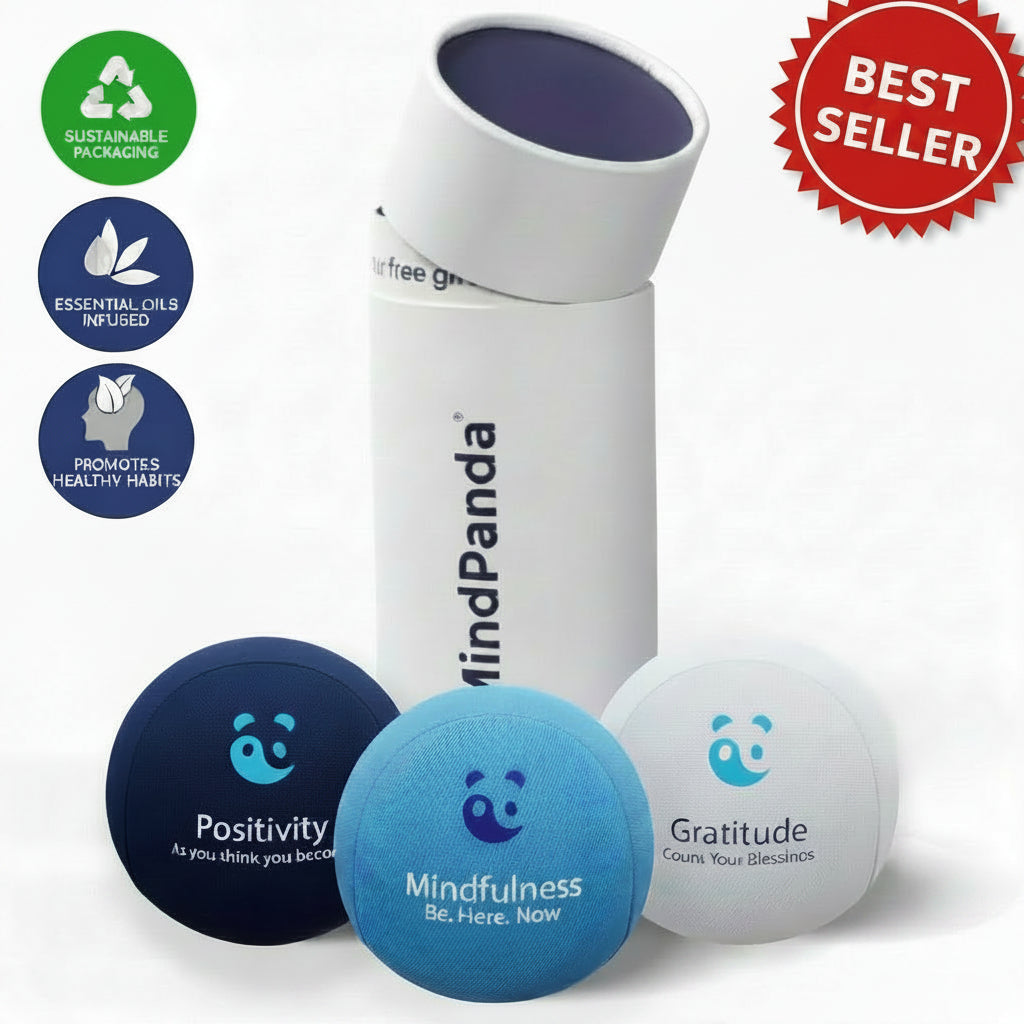
If you’d rather skip the trial-and-error of finding the right firmness or scent, Mindpanda builds that curation in from the start. The Mindpanda stress ball line comes in multiple resistances and aromatherapy options, so you can match the ball to the routine instead of adjusting your routine to the ball.
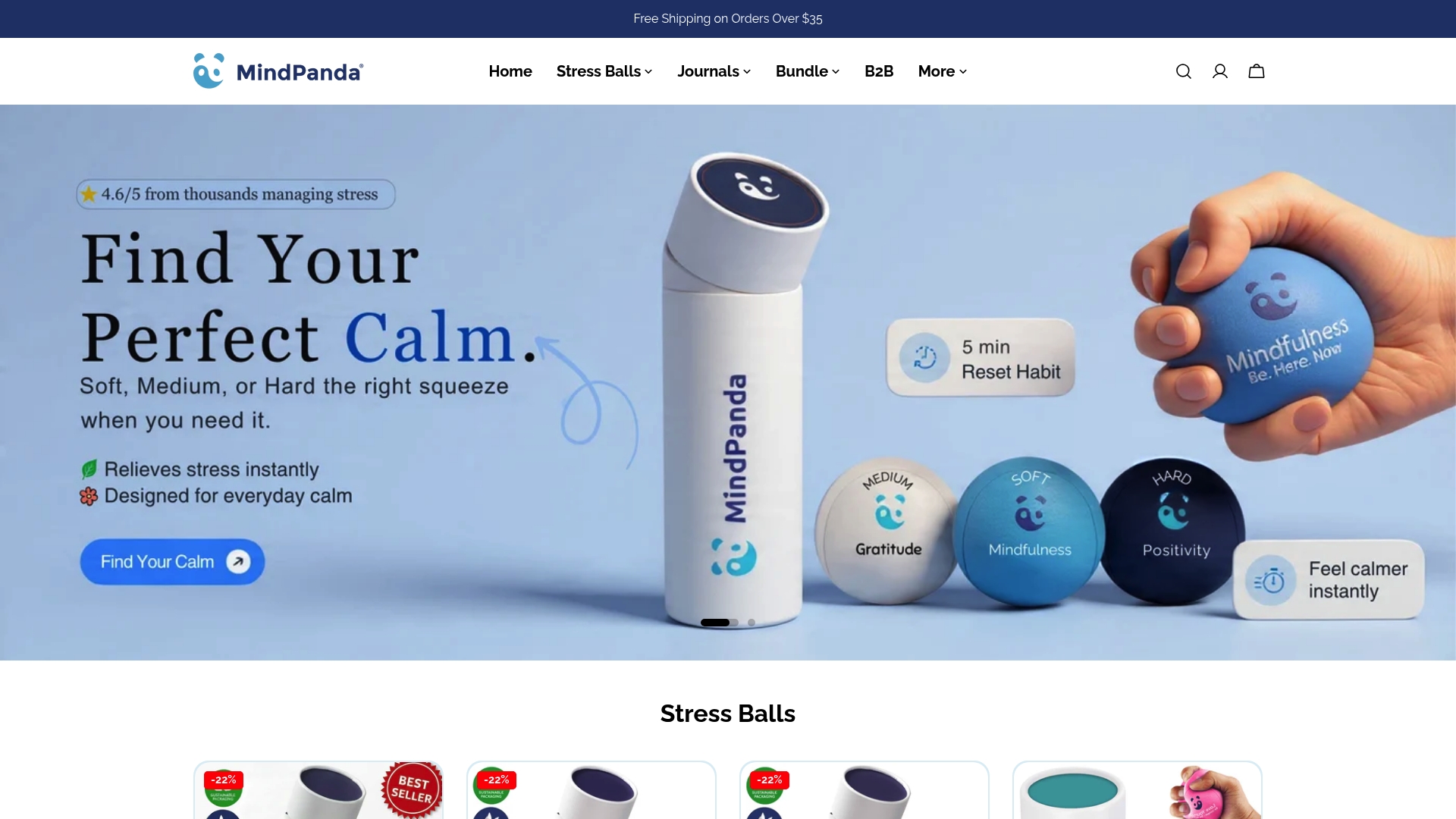
For a more complete setup, the Mindfulness Wellbeing Bundle pairs a stress ball with other grounding tools designed to work together, useful if you’re building out the full daily plan above rather than just the quick microbreaks. It’s portable enough for a desk drawer or a travel bag, and the scent options give you a sensory cue you can attach to specific routines, like lavender for the bedtime wind-down. If you’d rather mix and match your own pieces, you can also build a custom bundle around whatever resistance and scent combination suits you. Orders ship with straightforward return options, so trying a new firmness or scent isn’t a big commitment. Browse the current sets and pick one that matches the routine you’re most likely to actually stick with.
Frequently Asked Questions
How long should a stress ball exercise session last? Microbreaks of 30 to 90 seconds work for sudden tension, while longer 5 to 10 minute routines suit deeper resets before stressful events or bedtime.
Can stress ball exercises replace therapy or medication for anxiety? No. They help with mild, situational anxiety but aren’t a substitute for professional treatment if you have chronic or clinical anxiety.
What’s the best stress ball firmness for beginners? A medium resistance ball works for both quick pulses and slower breath-synchronized holds, so it’s the easiest starting point.
Can I combine stress ball exercises with music or breathing apps? Yes. Research on combining tactile stimulation with slow music shows it can lower subjective stress more than touch alone, so pairing the two is worth trying.
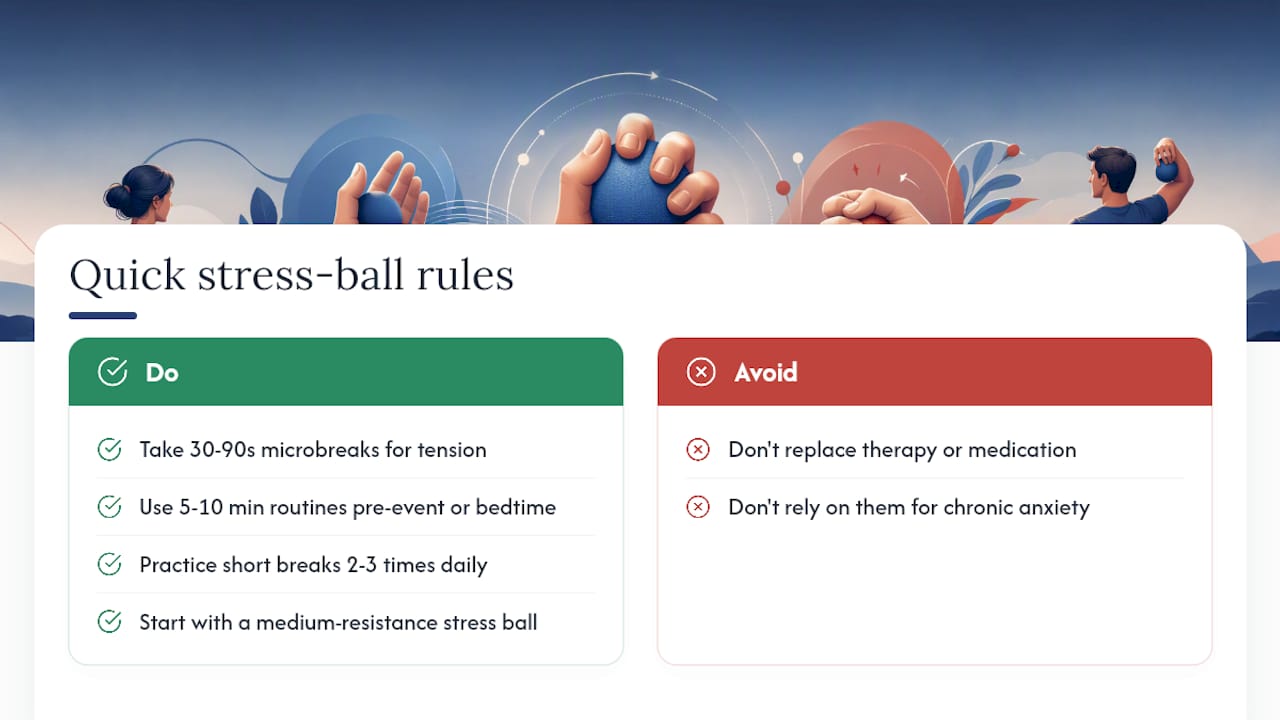
How often should I practice stress ball exercises? Short, frequent microbreaks, two or three times a day, build the habit faster than occasional long sessions. Start small and build up over a week.
Sources
- Stress Balls: Effectiveness, Benefits, and Limits
- Designing mid-air and thermal tactile stimuli for stress regulation (Appl. Sci. 2024)
- Tactile stimulation with music lowers subjective stress and cortisol (2025 study)
This article draws on peer-reviewed haptics research and evidence-based wellness guidance from the sources above.