
Journaling for stress relief works, but only when you write a certain way: putting real feelings into words, not just logging your day. The evidence backing expressive writing is solid enough that therapists recommend it as a companion to other stress tools. Right now, set a timer for seven minutes and write about whatever is weighing on you, without stopping to fix grammar or make it sound good. Try this starter prompt: “Right now I feel ___ because ___, and what I actually need is ___.” Finish the sentence three times, then keep going if you want.
Key Takeaways
Journaling reduces stress through expressive processing and cognitive offload, but the effect is modest and depends on consistent, judgment-free practice over weeks.
| Point | Details |
|---|---|
| Start small today | Write for 10 to 15 minutes using a feeling-first prompt, with no editing. |
| Match technique to stress type | Use planning writing for ongoing stress and expressive writing for past events. |
| Expect gradual results | Benefits often build over one to three months, not overnight. |
| Watch for warning signs | Persistent low mood, sleep problems, or hopelessness call for professional support. |
| Use a guided tool if helpful | Mindpanda’s Thrive & Reflect Bundle offers structured prompts that support the starter plan. |
Table of Contents
- Why Journaling Reduces Stress, According to the Research
- How to Start a Stress-Relief Journaling Habit This Week
- What Journaling Style Fits Your Stress?
- Does Journaling Really Work, and When It Isn’t Enough
- Keeping the Habit Useful Instead of a Chore
- Why Simple Beats Perfect Every Time
- A Simple Way to Start: MindPanda’s Journaling Bundle
- Frequently Asked Questions
- Sources
Why Journaling Reduces Stress, According to the Research
Writing about a stressful event forces your brain to organize what otherwise feels like a chaotic mess of emotion. Psychologists call this expressive processing: turning a vague, looping worry into a structured narrative that your mind can file away instead of replaying on a loop.
A few other mechanisms do real work here. Getting a to-do list or a spiraling thought out of your head and onto paper is a cognitive offload; it frees up mental bandwidth the same way closing browser tabs frees up your laptop. Writing about what matters to you, called values affirmation, seems to reduce the emotional sting of stress by reminding you who you are beyond the current crisis. Self-distancing, or writing about yourself in the third person (“Sam felt overwhelmed” instead of “I feel overwhelmed”), creates just enough psychological space to think more clearly. And the physical act of slow, sustained writing tends to calm the body’s stress response the way slow breathing does.
- Expressive processing turns chaotic feelings into a coherent story
- Cognitive offload clears mental clutter tied to unfinished tasks or worries
- Values affirmation reconnects you to what matters beyond the stressor
- Self-distancing (third-person writing) reduces emotional intensity
- Physiological calming happens through slower, sustained writing
Evidence snapshot: Structured expressive-writing studies report modest but real effect sizes, often in the range of d = 0.15 to 0.16. That is not a dramatic before-and-after transformation. It is a small, consistent nudge toward better emotional regulation, and it tends to show up more reliably when sessions are spaced out rather than crammed into one long writing marathon.
Pro Tip: Judge a journaling session by how it felt to write, not by how the entry reads afterward. A messy, half-finished page that helped you calm down did its job. A tidy paragraph that felt hollow to write did not.

How to Start a Stress-Relief Journaling Habit This Week
You do not need a special notebook or a perfect routine to begin. You need ten minutes and permission to write badly.
- Pick a consistent time and place. Right after waking up, during a lunch break, or right before bed all work. Consistency matters more than the specific hour.
- Timebox it. Set a timer for 10 to 15 minutes. Research on expressive writing practical guides suggests this window is long enough to process something real without becoming a rumination spiral.
- Open with a feeling, not a summary. Skip “Today I had a meeting and then…” and start with “I feel tense because…”
- Explore without editing. Let the sentence structure fall apart. Cross out nothing. This is the single biggest factor in whether expressive writing actually helps.
- Close with a next action or reframe. End every session with one sentence like “The next thing I’ll do about this is…” or “One thing I can let go of is…”
- Decide privacy rules before you start. Most stress journaling works best kept private, since knowing someone might read it changes what you’re willing to admit on the page.
Here’s what a real closing line might look like: “I’m still anxious about the deadline, but tomorrow I’ll email my manager and ask for two more days.”
Sharing your journal only makes sense in a therapy context, where a clinician can help you process what surfaces. Otherwise, treat it as yours alone.
What Journaling Style Fits Your Stress?
Different stress calls for different writing. If a stressor is ongoing, like a job search or a strained relationship, action-oriented formats like planning lists or bullet journaling help more than deep emotional excavation. If the stressor has already passed, expressive, narrative writing that processes what happened tends to work better.
- Expressive/therapeutic writing: Free writing about a specific event and how it made you feel.
- Cognitive offload / planning: Bullet-style lists that get tasks and worries out of your head.
- Gratitude journaling: Three things that went right, even on a hard day.
- Self-distancing reflection: Writing about yourself in third person to gain perspective.
Ten prompts to try, mixed by difficulty:
- What is one small thing that went well today? (quick)
- What’s one task I keep avoiding, and why? (quick)
- If a friend described my week, what would they say? (moderate)
- What does my stress feel like in my body right now? (moderate)
- What am I afraid will happen if I don’t fix this? (moderate)
- What would “future me” tell “today me” about this problem? (moderate)
- Describe the hardest part of this week in full detail. (deep)
- What did this situation teach me about what I actually value? (deep)
- What’s a story I keep telling myself that might not be true? (deep)
- If I let this go completely, what would change? (deep)
Five-minute brain dump: Set a timer, write every thought crossing your mind with zero filtering, then circle the one sentence that feels most true.
Does Journaling Really Work, and When It Isn’t Enough
Journaling’s benefits are real but modest, and they build over time rather than appearing overnight. Many expressive writing studies find measurable improvement at one to three month follow-ups, not after a single session.
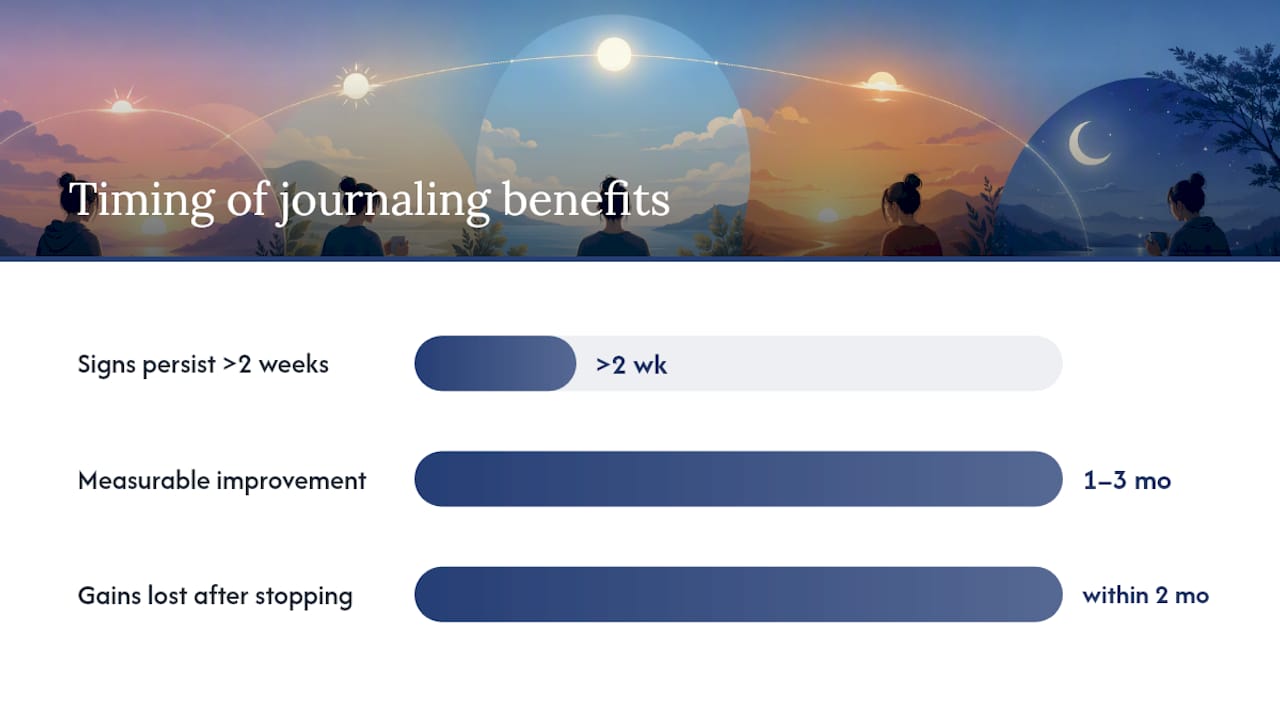
There’s a catch worth knowing: the benefits can fade. One study found that people who stopped journaling lost most of their gains within two months. Journaling also isn’t the right tool during an unresolved crisis, since expressive writing protocols work best when you have some distance from the event, not while you’re still in the middle of it.
Watch for these signs that journaling alone isn’t enough:
- Stress or sadness that persists most days for more than two weeks
- Trouble sleeping, eating, or functioning at work or school
- Thoughts of self-harm or feeling hopeless about the future
- Panic symptoms that interfere with daily life
If any of these apply, talk to a doctor or therapist. Journaling complements professional care; it does not replace it.
Keeping the Habit Useful Instead of a Chore
The biggest threat to a journaling habit isn’t lack of time. It’s turning it into another task you judge yourself for doing “wrong.” Attach it to something you already do, like your morning coffee or your nightly phone-charging routine, so it doesn’t need its own willpower.
- Pair journaling with an existing habit (coffee, commute, bedtime routine)
- End every entry with one next action to avoid spiraling into rumination
- Match your technique to your stress type: planning for ongoing stress, reflection for past events
- Keep a backup low-effort option, like a three-word mood log, for busy days
Pro Tip: If you skip three days in a row, don’t restart with a big session. Restart with one sentence. Momentum matters more than length.
Why Simple Beats Perfect Every Time
What surprises people most isn’t that journaling works. It’s how little it takes to see something shift: a few honest sentences, written without an audience in mind, do more for stress than a beautifully kept diary nobody’s willing to be truthful in. The advice to match technique to stress type gets skipped by nearly everyone, and I think that’s the real gap between people who stick with journaling and people who quit after a week. Don’t chase a perfect streak. A messy paragraph on a hard Tuesday counts more than a polished entry you forced.
A Simple Way to Start: MindPanda’s Journaling Bundle
If ten minutes and a blank page sounds good but you’d rather not start from scratch, the Thrive & Reflect Bundle from Mindpanda pairs a guided journal with prompts built around exactly the kind of process-over-product writing this article covers.
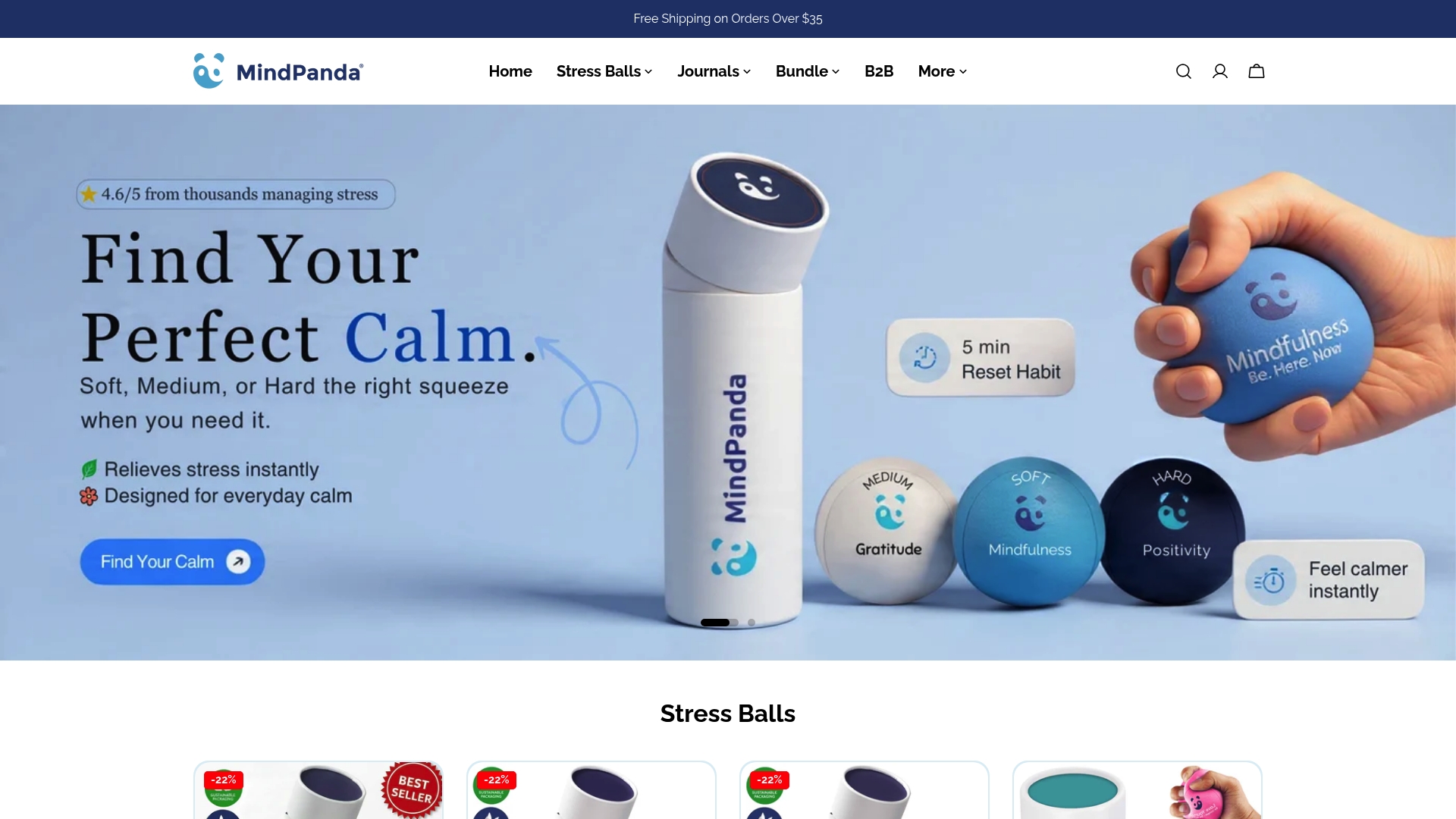
The bundle’s structured prompts remove the “what do I even write” hesitation that stops most people before they start, and its compact format makes it easy to keep on a nightstand or toss in a bag for the ten-minute session you promised yourself. It maps closely to the three-step starter plan above: pick a time, timebox it, close with a next action, with the guided pages doing some of that structuring for you. Mindpanda also carries the broader Mindfulness Wellbeing Bundle for readers who want journaling alongside other calming tools. Journaling supports emotional well-being, but it works best as one piece of a larger routine, alongside sleep, movement, and professional support when you need it. Visit the Thrive & Reflect Bundle page to see what’s inside and start your first entry tonight.
Frequently Asked Questions
How long does it take for journaling to reduce stress? Most people notice small shifts within a couple of weeks, but measurable benefits in research studies typically show up between one and three months of consistent practice.
What should I write about if I don’t know where to start? Start with how you feel right now and why, in one unedited sentence. If that feels too open, try a structured prompt like a gratitude list or a brain dump of everything on your mind.
Is it better to journal in the morning or at night? Neither time is objectively better. Pick whichever slot you can protect consistently, since regularity matters more than time of day.
Can journaling replace therapy? No. Journaling works well as a self-care habit that complements therapy, but it isn’t a substitute for professional care if you’re dealing with persistent anxiety, depression, or crisis-level stress.
What if journaling makes me feel worse? That can happen if you write about an unresolved crisis without any distance from it. Try switching to a planning or gratitude format instead, and consider talking to a therapist if the distress persists.
This article is general information, not a substitute for advice from a qualified doctor. Consult a qualified healthcare professional about your own circumstances before acting on anything here.
Sources
- Monthly wellness corner - February 2026
- Journaling to manage stress — Psychology Today
- PMC article on expressive writing (NCBI)