Here are ready-to-use self-reflection journal prompts organized by purpose, plus a short synthesis method to turn your answers into concrete insight. Pick a category below, set a timer for 5 to 20 minutes, and write without editing yourself. If a prompt touches something raw, that’s normal. Skip it, pause, or come back to it another day. This is presented as a working toolkit, not a syllabus.
TL;DR:
- Focusing on three or four favorite prompts helps reduce decision fatigue and encourages consistent journaling habits.
- Setting a timer for short daily entries and longer weekly sessions balances habit formation with meaningful reflection.
- Spotting recurring themes, avoided questions, or conflicting statements in your entries allows you to create small, actionable experiments for growth.
- Writing about emotions or patterns during hard days can support coping but should be paused if it feels overwhelming or triggers intense distress.
- Keeping prompts visible and preparing low-friction tools like a prompt card increases the likelihood of maintaining a regular reflection practice.
Table of Contents
- How to Use These Self-Discovery Journal Prompts (Without Overthinking It)
- Self-Reflection Journal Prompts Organized by Theme
- Turning Journal Entries Into One Actionable Insight
- What I’ve Learned About Sticking With This
- A Simple Companion for Your Reflection Practice
- Sources
- FAQ
How to Use These Self-Discovery Journal Prompts (Without Overthinking It)
You don’t need a ritual to start. You need a timer and permission to write badly.
- Set a time box. Give daily check-ins 5 to 15 minutes. Save 20 to 40 minutes for deep sessions on values, patterns, or big decisions.
- Write stream-of-consciousness. Skip grammar and structure. The inner editor is the thing blocking insight, not helping it.
- Keep a favorites list. Tape three or four go-to prompts inside your journal’s front cover so you’re never stuck choosing. Practitioners who journal regularly often reuse the same handful of prompts over months, and re-answering one periodically shows you how much you’ve actually changed.
- Have an exit plan for hard emotions. If a prompt stirs up more than you expected, name the feeling in one word, put the pen down, and take five slow breaths before deciding whether to keep writing or stop for the day.
- Try a template. A daily check-in might be three lines: what happened, what I felt, what I need. An end-of-week synthesis might review five entries and name one pattern. A career reflection might compare this month’s energy against last month’s.
Pro Tip: Keep a small notebook or three index cards with your five favorite prompts somewhere you’ll actually see them, like a nightstand or bag pocket. Decision fatigue kills more journaling habits than lack of motivation does.
Self-Reflection Journal Prompts Organized by Theme
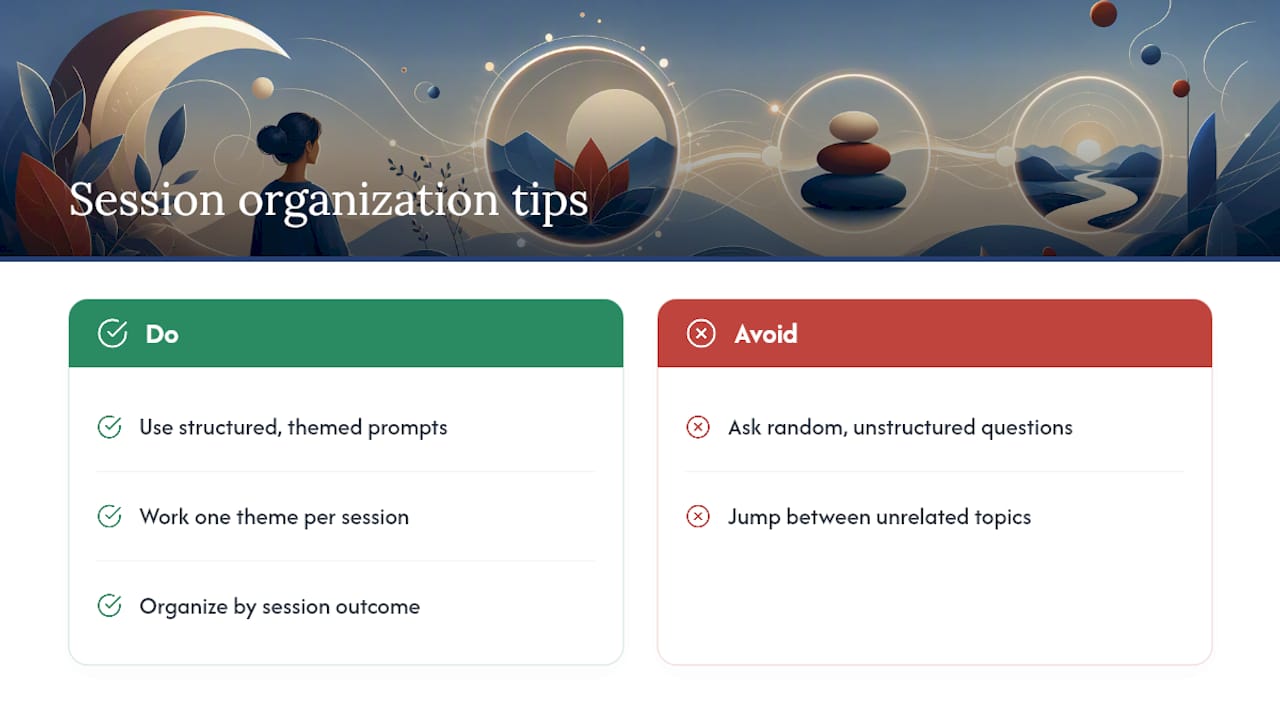
Structured, themed prompts produce deeper reflection than random questions, according to Positivepsychology, and working through one theme per session beats jumping between unrelated topics. Here’s a working set organized by what you’re trying to get out of the session.
Daily check-in and gratitude prompts
Quick hits for 5 to 10 minutes, best done first thing or right before bed:
- What’s one thing that went better than expected today?
- What drained my energy, and what gave it back?
- Who or what am I grateful for right now, specifically?
- What did I avoid doing today, and why?
- If today had a headline, what would it say?
For a deeper dive into gratitude specifically, Mindpanda’s gratitude journal prompts guide offers a full week’s worth.
Deep reflection: values, identity, and patterns
These need the full 20 to 40 minutes. Pick two or three per sitting, not all of them:
- What belief did I inherit from my family that I no longer agree with?
- When do I feel most like myself, and what’s present in that moment?
- What pattern keeps showing up in my relationships, jobs, or conflicts?
- What would I do differently if no one were watching or judging?
- What’s a compliment I struggle to accept, and why?
- What does “success” mean to me right now, versus five years ago?
- What am I pretending not to know about my own life?
- Which of my current habits would surprise the person I was ten years ago?
- What do I do when I’m avoiding something important?
- If I stopped explaining myself to others, what would change?
Naming emotions and triggers
Emotion-processing prompts work best when they ask for specifics, not summaries:
- What emotion visited me most this week, and what usually triggers it?
- Where in my body do I feel stress, and what does it usually mean?
- What am I angry about that I haven’t said out loud?
- What’s the story I’m telling myself about this situation, and is it true?
If anxiety is a recurring theme in your answers, Mindpanda’s journal prompts for anxiety collection goes further into grounding techniques.
Relationships and boundaries
- What relationship in my life needs a boundary I haven’t set?
- Who do I feel most myself around, and what do they do differently?
- What am I tolerating in a relationship that I wouldn’t recommend to a friend?
- When did I last say yes when I meant no?
Growth, goals, and future-self prompts
- What skill would change my life the most if I actually built it this year?
- What would my future self thank me for starting today?
- What’s one thing I’m proud of that I haven’t told anyone?
- If fear weren’t a factor, what would I attempt next?
Prompts for hard days
Grief, anxiety, and burnout call for gentler entry points. Journaling can help you cope during genuinely difficult stretches, according to Greater Good Magazine at UC Berkeley, and the goal on these days isn’t insight, it’s just getting the weight out of your head.
- What do I need to hear right now that no one is saying?
- What’s one small kindness I can offer myself today?
- What has gotten me through hard days before?
If any prompt on this list feels too heavy in the moment, that’s your signal to pivot. Switch to a daily check-in prompt instead, or simply write “I don’t want to answer this today and that’s fine” and close the notebook. Nothing here requires finishing what you start.
Turning Journal Entries Into One Actionable Insight
Writing without review just produces a pile of pages. The value shows up when you scan what you wrote and pull out a pattern, ideally within 48 hours of writing, before the emotional context fades and the insight becomes harder to reconstruct.
Run three quick scans across your last three to five entries:
- Recurring nouns. The same person, job, fear, or place showing up again and again is rarely a coincidence.
- Avoided questions. Notice where you changed the subject mid-entry or answered a different question than the one you were given.
- Conflicting statements. Where you said one thing about yourself in one entry and the opposite in another, that tension usually points to the real issue.
Once you spot a pattern, name it in one sentence and turn it into a single, small experiment for the coming week. Not “fix my whole relationship with work,” but “leave the office by 6 p.m. three days this week and note how it feels.” Keep a dedicated insights page at the back of your journal for these one-line patterns and experiments, separate from the raw daily entries.
This isn’t just a nice habit. Peer-reviewed research on expressive writing shows that writing about emotions and experiences supports emotional processing and can reduce distress, and the effect appears stronger when the writing leads somewhere, not when it just accumulates. Additional writing-intervention research points the same way: regular reflective writing tracks with measurable improvements in mood and coping over time.
What I’ve Learned About Sticking With This
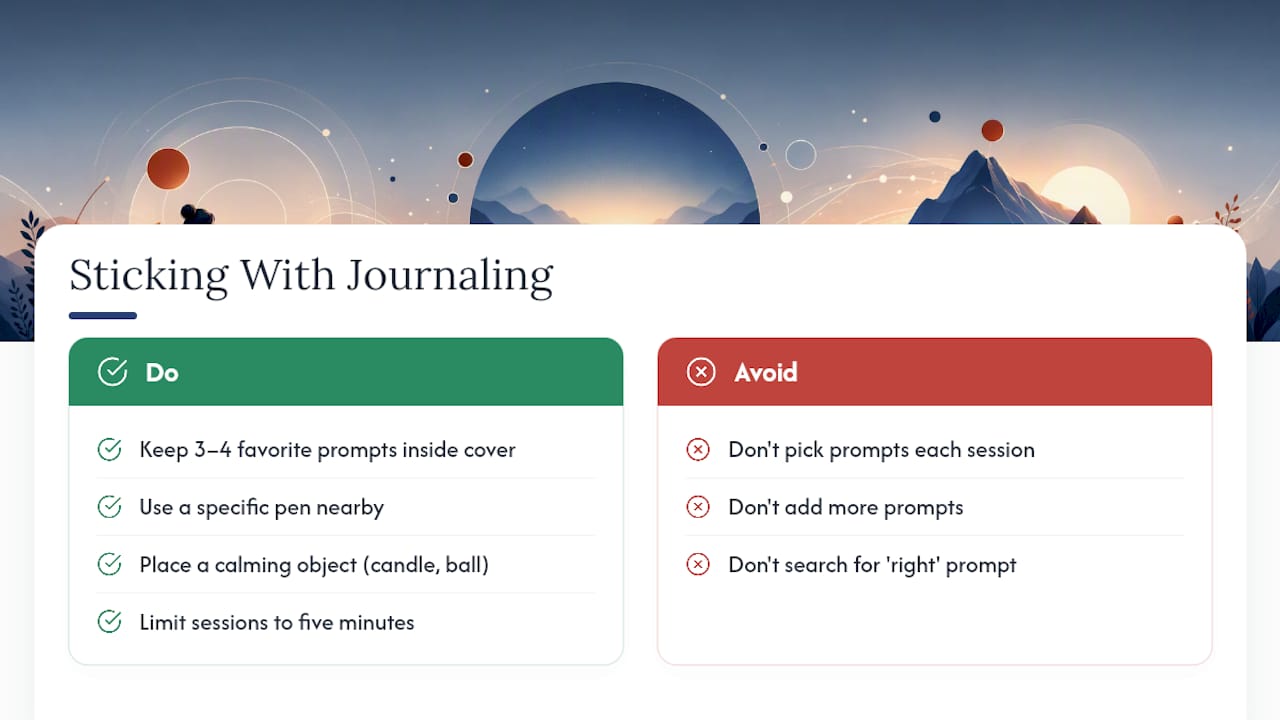
Writer’s block during journaling almost always comes from staring at a blank page trying to pick the “right” prompt. The fix isn’t more prompts. It’s fewer, chosen in advance.
Keep three or four favorites written on the inside cover of whatever you’re using, whether that’s a dedicated journal or a stack of index cards. The friction of choosing disappears, and you write instead of deliberating. A calming object nearby, a stress ball, a lit candle, a specific pen you like, does something small but real: it turns journaling into a five-minute ritual instead of a task on a list.
— Ravi
A Simple Companion for Your Reflection Practice
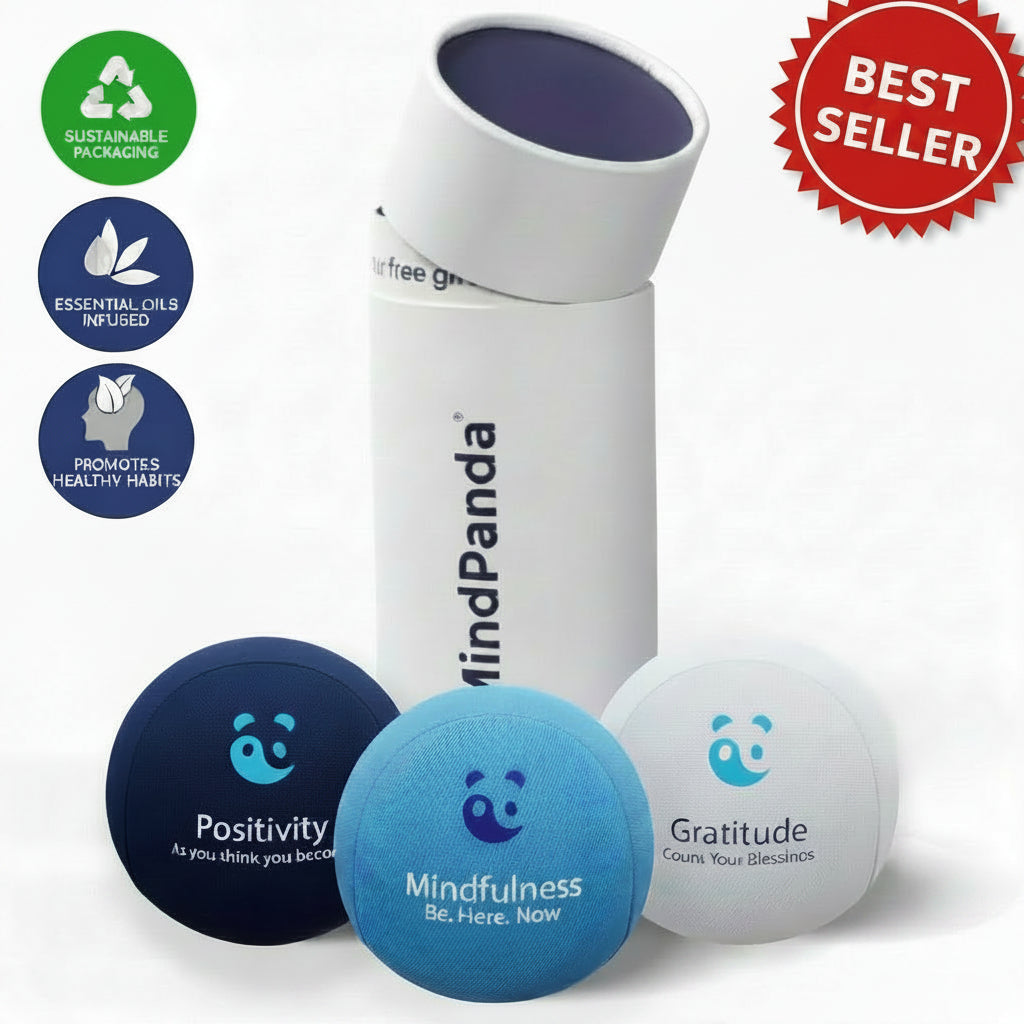
If you’d rather not build a journaling kit from scratch, Mindpanda’s Mindfulness Wellbeing Bundle gives you a running start instead of a blank page and a vague intention.

The bundle typically pairs a guided journal with calming, tactile items designed to lower the friction of actually sitting down to write, since the biggest obstacle to journaling usually isn’t motivation, it’s the ten seconds of hesitation before you open the notebook. Use the inside cover to tape your three favorite prompts from this list, keep a pocket-sized prompt card in your bag for slow moments, and build a short evening routine around it: a few minutes of quiet, then a single prompt, then done. Check the product page for current availability and shipping details in your region before ordering, since options vary by location. It’s a low-effort way to make self-reflection something you actually keep doing instead of something you meant to start.
Sources
For more on the research behind reflective writing and structured prompt collections, see PositivePsychology.com’s introspection guide and Rosebud’s synthesis-focused prompt collection.
- Expressive writing and health: evidence and Theoretical rationale (PMC6305886)
- Positivepsychology
- 40 journaling prompts for self-discovery (Rosebud)
- How journaling can help you in hard times (Greater Good Magazine, UC Berkeley)
FAQ
What are good questions for self-reflection?
Good questions ask for specifics rather than summaries, like “what pattern keeps showing up in my relationships” instead of “how am I doing.” The themed prompts above cover values, emotions, relationships, and growth so you can match the question to what you’re actually trying to understand.
How do I start a self-reflection journal?
Pick one theme, set a timer for 5 to 15 minutes, and write without editing yourself using a daily check-in or deep-reflection prompt from a themed list. Keep three or four favorite prompts visible so you never lose time deciding what to write about.
How often should I journal for self-reflection?
Short daily entries of 5 to 10 minutes paired with one longer weekly session of 15 to 40 minutes balances habit-building with real depth, based on guidance from applied psychology sources. Daily entries build consistency; the weekly session is where synthesis and pattern-spotting happen.
What if a journal prompt brings up something painful?
Pause, name the emotion in one word, and decide whether to keep writing or switch to a gentler prompt about self-compassion or gratitude. Journaling can support coping during hard times, but it isn’t a replacement for professional support when the distress feels bigger than the page.
How do I turn journal entries into real change?
Scan your last few entries for recurring nouns, avoided questions, and conflicting statements, then convert whatever pattern you find into one small, specific experiment for the coming week. Doing this within 48 hours of writing keeps the insight from fading before you can act on it.