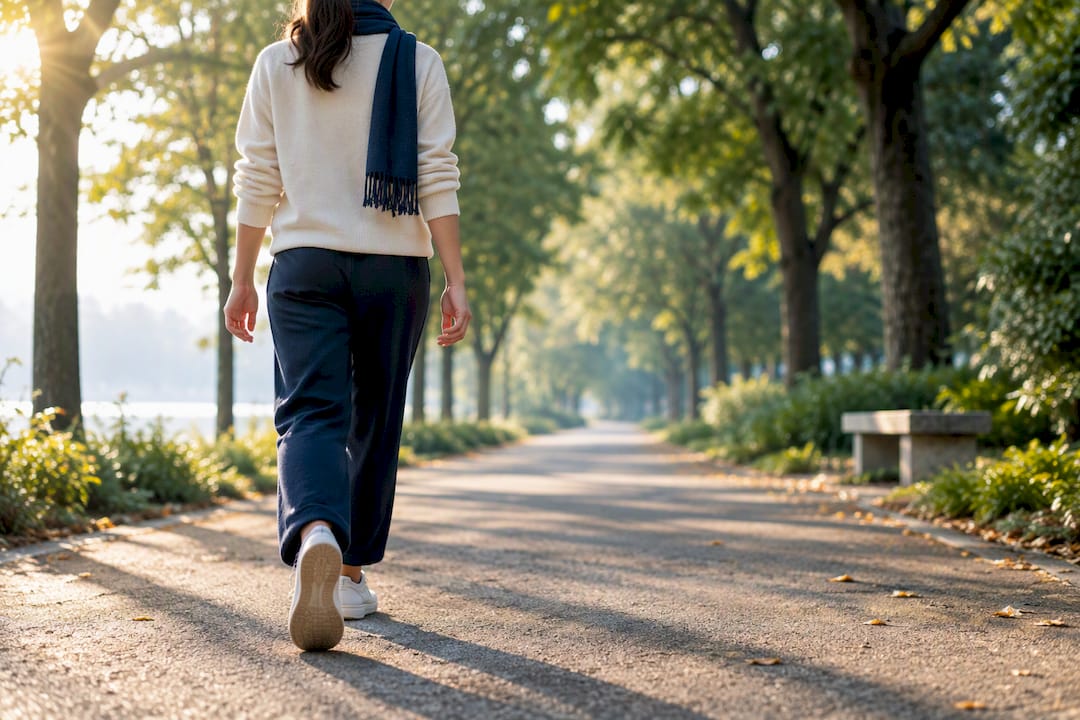
Mindful walking practice is a short, body-centered meditation you can start right now: pick a 10 to 20 step path or a quiet stretch of sidewalk, stand still for a breath, then walk slowly while paying attention to each footfall. It works as a stand-in for seated meditation when your mind is restless or your schedule is tight. Most people notice calmer nerves and sharper focus within a single 5 to 10 minute session.
TL;DR:
- Mindful walking can significantly reduce perceived stress within four weeks, with an average stress reduction of 8.8 points on the Cohen’s Perceived Stress Scale.
- The practice involves slow, deliberate footsteps broken into lifting, moving, and placing, with attention for five to ten minutes daily, adaptable indoors or outdoors.
- Maintaining proper posture, such as relaxed shoulders and soft knees, enhances body awareness and prevents discomfort during the walk.
- Progress is subtle but measurable through increased session duration and quicker return of attention after wandering, rather than dramatic results.
- Consistency is key, and the practice’s flexibility makes it suitable to fit into various routines, with minimal equipment needed beyond a path and timer.
Table of Contents
- Why mindful walking is worth five minutes of your day
- A 5 to 10 minute mindful walking routine you can start today
- Making mindful walking fit your body and your day
- What the research and the traditions actually say
- Posture and body alignment while you walk
- Noticing progress without forcing it
- What keeps this practice going
- Simple tools that make the practice easier to keep
- Sources
- FAQ
Why mindful walking is worth five minutes of your day
Mindful walking gives you a way to interrupt stress without needing a cushion, an app, or a quiet room. Because it pairs attention with movement, it tends to suit people who find seated meditation frustrating or who simply do not have a spare half hour.
- Lowers the felt sense of stress by giving your mind one simple job: the next step.
- Sharpens attention by training you to notice small sensations instead of drifting into autopilot.
- Grounds you physically, which can ease racing thoughts faster than trying to think your way calm.
- Lifts mood slightly through steady, repetitive motion combined with attention.
A randomized controlled trial found that a four week mindful walking program produced a significant drop in perceived stress, with an adjusted mean reduction of 8.8 points on the Cohen’s Perceived Stress Scale. That is a meaningful shift for a practice that asks for only a few minutes at a time. Unlike seated meditation, which some people find hard to stick with, mindful walking piggybacks on something you already do every day, which makes consistency easier to build.
A 5 to 10 minute mindful walking routine you can start today
You do not need special clothing, an app, or a park. A hallway, a quiet room, or a short garden path will do. Here is a sequence adapted from practical walking meditation guidance from Greater Good in Action, which recommends a runway of about 10 to 15 paces and roughly 10 minutes of daily practice.
Before you start: Choose a straight path of 10 to 20 steps, indoors or outdoors. Set a timer for 5 or 10 minutes so you are not checking a clock. Wear whatever shoes feel comfortable, or go barefoot if the surface allows it. Stand at one end of your path with your arms relaxed at your sides.
- Stand still for three slow breaths, letting your shoulders drop and your gaze settle a few feet ahead.
- Begin walking more slowly than usual, breaking each step into three parts: lifting the foot, moving it forward, and placing it down.
- Silently note each part as it happens, “lifting, moving, placing,” to keep your attention anchored to sensation rather than thought.
- When you reach the end of your path, pause fully before turning, treating the turn itself as part of the practice rather than a break from it.
- Turn slowly and deliberately, then walk back along the same path, repeating the lifting, moving, placing sequence.
- Continue for your chosen time, letting each lap be identical in pace and attention.
Your mind will wander. That is normal, not a failure. When you notice a thought has pulled you away, name it quietly (“planning,” “worrying,” “remembering”) and return your attention to the next part of the step sequence: lifting, moving, or placing. Some people find it easier to count steps (“one, two, three…up to ten, then restart”) instead of naming sensations, especially in the first few sessions.
Pro Tip: Use a short phrase like “lifting, moving, placing” or a simple step count for your first two weeks. It gives your attention something concrete to hold onto until slower walking starts to feel natural.

Making mindful walking fit your body and your day
The core practice, slow attention paired with movement, adapts easily once you understand the principle behind it. The goal is not a specific gait. It is sustained, gentle attention to physical sensation during motion.
- Formal practice uses a short runway and deliberately slow steps, often indoors, for focused sessions.
- Informal practice folds the same attention into a normal-paced walk to the store, the mailbox, or between meetings.
- Breath and steps do not need to be forced into a rigid count. Guidance from Plum Village suggests letting breath and pace vary naturally with terrain, which keeps the practice sustainable outdoors.
- Wheelchair users can adapt the practice by attending to handrim pressure, the release of the push, and the rolling rhythm of the chair instead of foot contact, a substitution Greater Good in Action notes is fully workable.
- Choose safe, familiar routes. Slow, inward attention does not mix well with traffic, uneven pavement, or unfamiliar terrain.
- Try folding it into an existing routine: a mindful lap before a walking meeting, or a short walk at lunch followed by a few lines in a journal about what you noticed.
What the research and the traditions actually say
The evidence base is modest but encouraging, and the practice itself has deep roots outside clinical research.
- The four week program mentioned above produced a significant reduction in perceived stress, an adjusted mean difference of 8.8 points on the Cohen’s Perceived Stress Scale.
- Smaller pilot trials point in the same direction, showing reduced perceived stress after short, low-dose mindful walking interventions, though sample sizes are small and results are promising rather than conclusive.
- The practice sits within the mindfulness-based stress reduction lineage associated with Jon Kabat-Zinn, and it appears in the teachings of figures like Thich Nhat Hanh and Jack Kornfield, who frame it as a contemplative practice rather than a medical treatment.
A short mindful walking program has been shown to meaningfully lower perceived stress in as little as four weeks. Treat these findings as a reason to try the practice consistently, not as a guarantee of a specific result for every person.
Posture and body alignment while you walk
Good posture keeps mindful walking from turning into a slouch fest, and it helps you actually feel the sensations you are trying to notice. Stand tall without stiffening: let your head balance naturally over your spine, shoulders relaxed and slightly back, chest open rather than collapsed.
Keep your gaze soft and lowered a few feet ahead rather than fixed on your feet or scanning the horizon. Let your arms hang loosely at your sides or clasp gently in front of you, whichever feels less distracting. Your knees should stay soft, never locked, so each step absorbs smoothly instead of jarring your joints.
Breathing follows posture more than the other way around. An open chest and relaxed shoulders let your breath move freely, which is part of why slouched walking often feels more agitating than calming. If you catch your shoulders creeping up toward your ears, that is a useful cue to pause, reset, and continue.

None of this needs to be perfect. The point of paying attention to alignment is to notice it, adjust gently, and keep walking, not to hold a rigid pose for the entire session.
Noticing progress without forcing it
Mindful walking does not produce dramatic before-and-after results, so the signs of progress are usually subtle. The clearest early sign is duration: sessions that once felt long at five minutes start to feel short, and you find yourself wanting to continue.
A second sign is how quickly your attention returns after wandering. In early sessions, a distracting thought might pull you away for an entire lap. With regular practice, most people notice they catch the drift sooner and return to lifting, moving, and placing with less effort.
A simple way to track this without turning the practice into homework is to jot one line after each session: how many times you noticed your mind wander, or a single word for how you felt afterward. Reviewing a week of these notes side by side often reveals a trend that a single session never would.
Resist comparing today’s walk to yesterday’s. Attention naturally varies with sleep, stress, and mood, and a session that felt scattered is not a setback. What matters is the pattern across weeks, not the quality of any one walk.
What keeps this practice going
Most people abandon meditation habits because the sessions are too long or too rigid for a real week. Mindful walking survives because five minutes fits almost anywhere: before a meeting, during a lunch break, on the way to get coffee. I would rather see someone walk mindfully for five minutes most days than aim for a perfect twenty minute session they only manage twice a month.
Mental wellness can be supported by small, practical tools that encourage habit formation rather than replacement, including journals designed to make reflection quick rather than another chore.
— Ravi
Simple tools that make the practice easier to keep
You do not need any product to do mindful walking. The steps above work with nothing but a path and a timer. That said, a few small tools can make the habit easier to sustain once you are past the first week or two.

A short journal entry after each walk, even one line, helps you notice patterns in your attention over time, which is part of why we built the Journals & Planners collection around quick, low-friction reflection rather than long-form writing. If you want a physical prompt to return to during a stressful moment between walks, our Stress Balls collection offers themed and aromatherapy options packaged eco-consciously, useful as a grounding object rather than a substitute for the walk itself. None of these tools are required to benefit from mindful walking. They simply give the habit something to anchor to on the days motivation is thin. If you want a specific product to pair with a daily walking practice, the Balance productivity planner is built for exactly that kind of short daily check-in.
Sources
- Effects of a mindful walking program on perceived stress (PubMed)
- Walking Meditation (Greater Good in Action)
- What Is Walking Meditation? How To Do It (Cleveland Clinic)
FAQ
How can I practice mindfulness while walking?
Slow your pace, pick a short path, and break each step into lifting, moving, and placing your foot, noting each part silently as it happens. When your attention drifts, name the distraction and return to the next step in the sequence.
What are the 5 basics of mindfulness practice?
Definitions vary across teachers and traditions, but common threads include present-moment attention, non-judgment, acceptance of what arises, an anchor such as breath or movement, and consistent, brief repetition. Mindful walking covers most of these by using footfall as the attention anchor.
What does Thich Nhat Hanh say about mindful walking?
Thich Nhat Hanh teaches that each step can be an arrival rather than a means of getting somewhere else, emphasizing solidity and freedom in each movement. He treats turning and pausing as full parts of the practice, not breaks from it.
What are the 5 R’s of mindfulness?
There is no single, widely recognized “5 R’s” framework tied to mindful walking specifically, and definitions of a general “5 R’s of mindfulness” vary by source. Rather than cite an unverified list, it is more useful to focus on the core actions this guide covers: noticing sensation, naming distraction, and returning attention to the next step.
How long should a mindful walking session last?
A 10 minute session is a manageable starting point for most beginners, though even 5 minutes can produce a noticeable calming effect. Consistency across days matters more than the length of any single walk.