A productivity planner reliably improves time management, sharpens focus, and lowers stress by giving your day a fixed structure instead of a mental to-do list you keep re-running. The core benefits are consistent across research and daily use: better prioritization, fewer unfinished tasks, stronger follow-through on goals, and a measurable drop in the rumination that comes from trying to hold everything in your head. What separates a good planner habit from a wasted notebook is covered below, along with the research behind it.
TL;DR:
- A planning system that combines goal setting, task outlining, and obstacle thinking yields the most consistent cognitive flexibility and productivity benefits.
- Implementing a daily 5-12 minute ritual with top priorities and evening reviews significantly reinforces habit formation and mental clarity.
- Weekly planning that involves brain dumps, goal prioritization, and schedule buffers leads to fewer unfinished tasks and better adaptation to unexpected issues.
- Paper planners with reflection prompts and visual habit trackers tend to improve focus and memory more effectively than digital tools alone.
- Consistency and simplicity are key; skipping days or overcomplicating the system can diminish benefits, especially for those with working memory challenges or ruminative tendencies.
Table of Contents
- How Do Productivity Planners Improve Time Management and Focus?
- What Does the Research Say About Planner Benefits?
- How Do You Build a Daily and Weekly Planner Routine?
- What Features Actually Matter When Choosing a Planner?
- How Do You Turn Planning Into a Lasting Habit?
- A Candid Take on Planners and Mental Wellness
- Where to Find a Planner Built for These Routines
- Sources
- FAQ
How Do Productivity Planners Improve Time Management and Focus?
A planner works because it turns an abstract goal (“get organized,” “be less stressed”) into something you can see and act on in the next 20 minutes. That shift from vague intention to concrete plan is where almost every benefit below actually originates.
Time management improves first, because a planner forces you to look at your day as a fixed container instead of an infinite list. When you write down that you have eight working hours and eleven hours of tasks, you catch the overcommitment before it wrecks your afternoon. This is the mechanism Zoho’s overview of productivity planners points to when it describes planners combating the “mere-urgency effect,” the tendency to work on whatever feels most urgent rather than what actually matters.
Focus comes next. A planner reduces what researchers call decision friction: the small, draining choice of “what should I work on right now?” that you make dozens of times a day. When your top three priorities are already written down, that decision is gone before you sit at your desk. Setting a clear intention for a work session, rather than opening your laptop and reacting to whatever appears, is one of the most consistent recommendations in Psychology Today’s review of daily planner habits, which also links planning to free up mental bandwidth for creative work.
Goal follow-through is where the numbers get striking. Writing goals down is associated with a 42% higher likelihood of actually achieving them, according to Dr. Gail Matthews’ study on goal-setting. That is not a small nudge. It suggests the physical act of writing a goal, rather than just thinking about it, changes how seriously your brain treats it.
Stress reduction follows a similar logic. About 62% of people report feeling stressed at least once a week, and a lot of that stress comes from a sense of losing control over competing demands. Planning restores a feeling of control simply by making the workload visible and finite instead of open-ended and looming.
Habit formation and reflection round out the picture. Habit trackers and a short weekly review train consistency the same way a workout log does: you can see the streak, and you don’t want to break it.
The mechanism behind most of this is externalized memory. Once a task lives on paper or in an app, your brain stops rehearsing it, which lowers cognitive load and quiets the background noise of “don’t forget to…”
- Time management: fewer overcommitted days, clearer sense of available hours
- Focus: less decision friction, fewer context switches
- Goal achievement: up to 42% higher likelihood when goals are written down
- Stress reduction: restored sense of control over a 62%-stressed population
- Habit consistency: visual tracking reinforces repetition
- Reflection: weekly reviews catch problems before they pile up
Pro Tip: Write your top three tasks the night before, not the morning of. Decisions made under evening calm are almost always better than decisions made under morning pressure.
What Does the Research Say About Planner Benefits?
The strongest evidence for planning benefits comes from a 2023 field experiment involving 208 participants who logged 947 weekly entries over several weeks. Researchers had one group complete a brief weekly planning exercise, then tracked outcomes against a control group.
The results were specific and measurable. Participants who did the weekly planning exercise showed fewer unfinished tasks, less rumination, and improved cognitive flexibility compared to those who didn’t, according to the field experiment on weekly planning behavior. Cognitive flexibility, the ability to shift between tasks and adapt to new information without getting stuck, is not something most people associate with a paper notebook. But it makes sense: when your brain isn’t holding a running list of unfinished obligations, it has more room to adapt.
That study also found the planning exercise worked best when it combined three elements: setting a goal, outlining concrete steps, and thinking through likely obstacles in advance. A plan that only lists tasks without addressing what might go wrong tends to underperform a plan that does both.
The 42% goal-achievement figure from the Matthews study adds a second layer to this picture. It is not just that planning organizes your day. Writing a goal down appears to make you treat it as a commitment rather than a wish, which explains why so many productivity systems insist on writing goals in full sentences rather than jotting a single word.
And the stress numbers matter here too. With roughly 62 percent of adults reporting weekly stress, a tool that restores a sense of control over one’s schedule addresses a real, common problem rather than a niche one.
A few caveats are worth naming honestly:
- The 208-person field experiment measured a brief planning intervention, not years of sustained use, so long-term effects are inferred rather than directly measured.
- Engagement is mixed evidence territory: some people plan diligently for a week, then quietly stop, and the research doesn’t fully explain why some habits stick and others don’t.
- Results likely depend on how planning is done. A plan that only lists tasks (no obstacle-thinking, no goal-setting) may not reproduce the same cognitive flexibility gains.
How Do You Build a Daily and Weekly Planner Routine?
You don’t need an hour a day to get these benefits. Most of the research and practitioner guidance points to short, repeatable rituals, not marathon planning sessions.
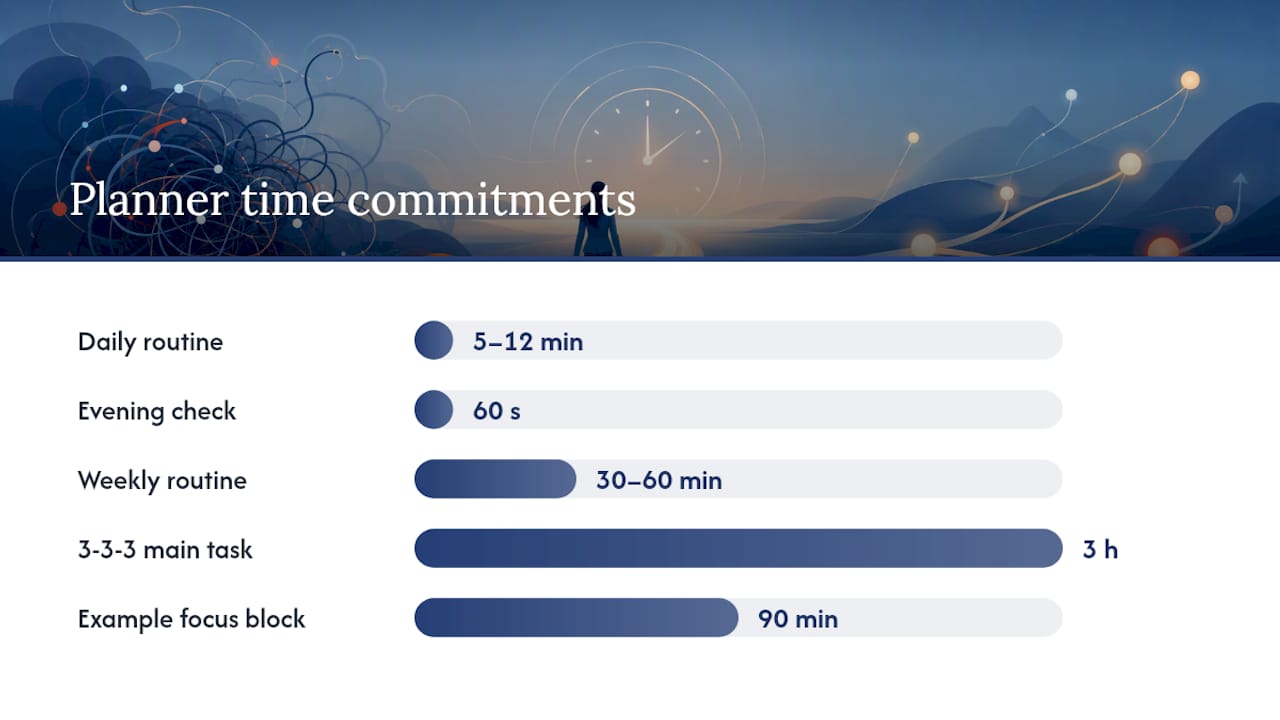
The daily routine (5 to 12 minutes):
- Set a one-line intention. Before you open email or messages, write down what “a good day” looks like in one sentence.
- Name your top one to three tasks. Not ten. Three, ranked by importance, not urgency.
- Time-box your first focus session. Give yourself a specific block, say 90 minutes, for the top task, and treat interruptions as things to log for later, not react to immediately.
- Do a 60-second evening check. Cross off what’s done, move what isn’t, and jot one line about what worked or didnot.
That evening check matters more than people expect. A practitioner guide on planner use notes that short, consistent rituals, closer to 10 or 12 minutes than an hour, tend to outperform longer, infrequent planning sessions, because consistency builds the habit loop that makes planning automatic.
The weekly routine (30 to 60 minutes):
- Brain-dump everything. Every task, worry, and half-formed idea rattling around your head goes on paper first, unsorted.
- Set one to three weekly goals. Pull these from your brain dump. If everything feels equally important, you have not prioritized yet.
- Break projects into next actions. A goal like “finish the report” is useless on a Monday. “Draft the intro section” is not.
- Schedule focus blocks and buffer time. Put your most demanding work in your highest-energy hours, and leave unscheduled buffer for the inevitable fire drill.
- Review what carried over from last week. Recurring carryovers are a signal, not a failure. They usually mean a task is too big or poorly defined.
A few micro-templates worth borrowing: the 3-3-3 rule (three hours on your most important task, three shorter tasks, three maintenance items like email or chores) gives structure without over-scheduling. Simple priority labels (A, B, C or a colored dot system) work faster than writing paragraphs about urgency.
If you use both paper and digital tools, that hybrid setup is common and works well. Paper for the intention and top priorities, a digital calendar for anything with a fixed time or that needs sharing with others. Keep your planner light: pen, sticky flags for the current week, and nothing you have to dig through a bag to find. If you miss a day, don’t try to reconstruct it. Start fresh the next morning; a missed day is not a broken streak, it’s just a skipped entry.
Pro Tip: Pair your morning planning with something you already do without thinking, like your first cup of coffee. Habit stacking works better than relying on willpower alone.
For readers who want a compressed version of this same logic applied to content and creative work specifically, a 30-day content planning framework shows how the same next-action breakdown scales to bigger projects in under an hour.
What Features Actually Matter When Choosing a Planner?
Not every planner delivers the same benefits, and the differences come down to a handful of features that determine whether you’ll actually use the thing in three months.
- Layout type. Daily layouts suit people juggling many small tasks; weekly layouts suit people who think in projects and need to see the whole week at a glance.
- Reflection prompts. A planner with built-in space for a short evening or weekly reflection nudges you toward the review habit that the field experiment tied to reduced rumination.
- Habit trackers. A visual tracker (a simple grid of checkboxes) reinforces consistency far better than trying to remember whether you did something yesterday.
- Portability and durability. A planner that stays home because it’s too bulky to carry provides zero benefit. Size and binding matter more than most people expect.
On the paper versus digital question, the evidence leans toward paper for focus and retention. Harvard Business Review’s research on note-taking found that handwriting engages deeper processing than typing, which is part of why paper planners tend to improve focus and memory compared to always-on devices. Digital tools win on search, sharing, and syncing across a team. Most people land on a hybrid: paper for daily focus, digital for anything collaborative.
For ADHD-friendly or minimalist use, prioritize fewer, bigger writing spaces over dense grids, and pick trackers with visual checkboxes instead of text fields. Before buying, ask yourself: Do I think in days or weeks? Will I actually carry this? Do I need reminders built in, or will I set those on my phone anyway?
How Do You Turn Planning Into a Lasting Habit?
Consistency, not perfection, is what makes a planner worth keeping.
- Start small. A five-minute version you’ll actually do beats an elaborate system you abandon by week two.
- Use a trigger. Pair planning with an existing habit, like your morning coffee or your commute, so it doesn’t rely on memory.
- Watch for perfectionism and over-planning. If you’re spending more time decorating your planner than using it, simplify. Skipping a weekly review “because it wasn’t perfect” defeats its purpose.
- Adapt the system to you. Simplified checklists, big visual trackers, or phone alarms all work if the standard format doesn’t fit how you think.
- Know when to switch. If you’ve stopped opening your planner for two weeks straight, that’s a signal to change the format, not to give up on planning altogether.
Pro Tip: If a habit tracker feels like one more chore, drop it. The planning and the daily review matter more than the tracker itself.
A Candid Take on Planners and Mental Wellness
Planners don’t fix stress. They reduce the specific kind of stress that comes from carrying too much in your head at once, which is real and common, but it’s not the whole picture. Mindpanda builds planners as one piece of a mental-wellness routine, alongside journals and stress-relief tools, because organization and calm tend to reinforce each other rather than substitute for one another.
Expect a good week, then a messy one. That’s normal. The benefit comes from returning to the habit, not from never missing a day.
— Ravi
Where to Find a Planner Built for These Routines
Some planners are built around the exact rituals covered above: daily layouts for your top three tasks, built-in reflection prompts for the evening check, and habit trackers that reinforce consistency instead of guilt-tripping you for missed days. The Thrive productivity planner pairs a daily structure with weekly review pages, so the morning intention and the Sunday reset live in the same system instead of two disconnected apps.
If your stress runs more emotional than schedule-related, the Reflect journal leans further into reflection prompts and pairs well with a planner rather than replacing one. And if you’re planning for a team or want branded planners as corporate gifts, Mindpanda handles bulk orders and bespoke branding too. Start with the journals and planners collection and pick the layout that matches how you already think, daily or weekly, before adding trackers or extras on top.
Sources
FAQ
What Is the 3-3-3 Rule for Productivity?
The 3-3-3 rule breaks your day into three hours on your most important task, three shorter tasks, and three maintenance items like email or errands. It works well as a daily planning template because it caps the number of things fighting for your attention at once.
Which Personality Type Benefits Most From a Planner?
There’s no single personality type that owns planning. People who feel overwhelmed by open-ended tasks, or who tend to ruminate on unfinished work, typically see the biggest benefit, because a planner externalizes that mental load onto paper. Highly structured thinkers benefit too, just for different reasons: a planner lets them optimize a system they already enjoy managing.
Do People With ADHD Benefit From Using a Planner?
Many people with ADHD find planners genuinely helpful, particularly ones with visual trackers, big writing spaces, and simple daily checklists rather than dense grids. The externalized-memory effect, having tasks live on paper instead of only in your head, tends to matter even more for people who struggle with working memory. Simplicity and low friction matter more than a feature-packed layout.
How Long Does It Take to Feel the Benefits of Planning?
Most people notice reduced overwhelm within one to two weeks of consistent daily and weekly planning. The cognitive benefits measured in research, like improved flexibility and fewer unfinished tasks, showed up within the several-week window of the weekly planning field experiment, suggesting the effect builds fairly quickly once the habit sticks.