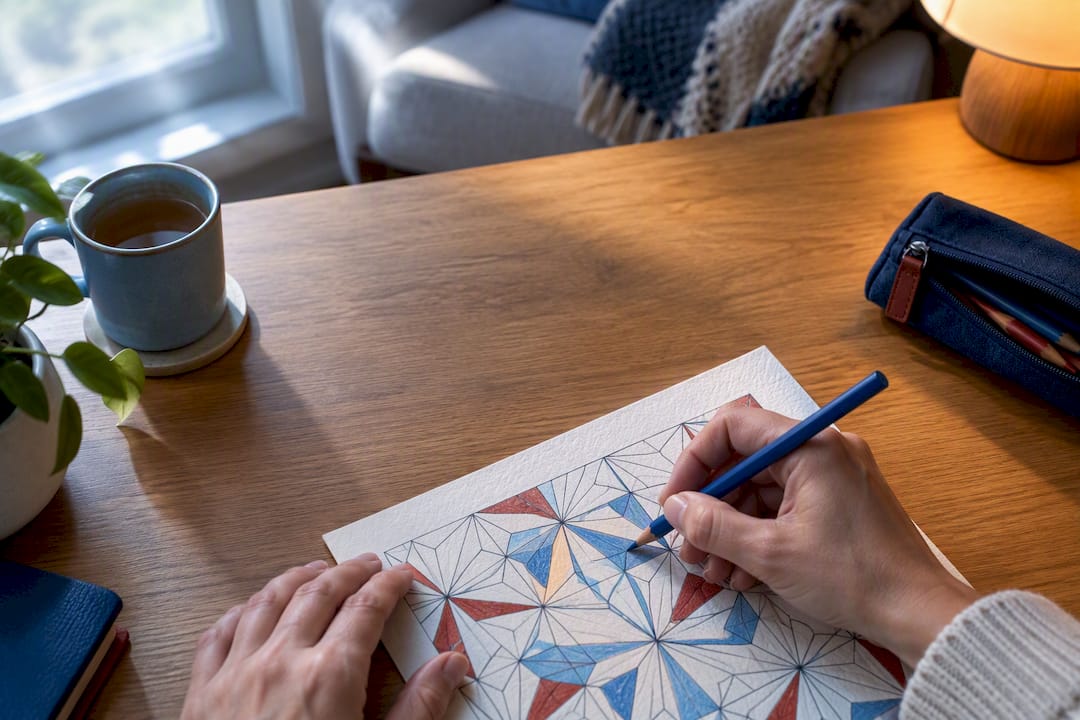
Mindful coloring works: it lowers stress and sharpens focus by giving your brain one simple, repetitive task to anchor around, and most adults feel a difference within a single 20-minute session. It suits beginners to mindfulness, busy professionals who need a break that doesn’t require silence or a meditation cushion, and anyone who wants a screen-free reset. The rest of this guide covers exactly how to run a session, what materials matter, and 25 prompts to keep the practice from going stale.
TL;DR:
- Mindful coloring provides short-term stress relief and improves focus by training attention on repetitive, sensory tasks that take less than 20 minutes to show benefits.
- Using centered, radial, or nature-inspired designs on heavier, one-sided paper enhances the activity’s calming effect and prevents bleed-through issues.
- Starting with a single page, a few minutes, and slow, deliberate coloring helps establish a sustainable habit, especially for those new to mindfulness or meditation.
- Combining coloring with brief breathing exercises, affirmations, or journaling can deepen the relaxation and awareness built during each session.
- Low-cost materials like colored pencils and simple printable pages are sufficient; quality paper and minimal distractions are key to maintaining focus and avoiding frustration.
Table of Contents
- What Is Mindfulness Coloring for Adults, and Why Does It Work?
- How to Run a Mindful Coloring Session Step by Step
- Materials, Paper, and Bleed-Through: What Actually Matters
- 25 Mindful Coloring Prompts and Session Templates
- Finding Trustworthy Books and Printable Coloring Pages
- Troubleshooting Common Problems and Deepening Your Practice
- Why You Can Trust This Guide
- What the Conventional Advice Gets Wrong
- Pair Your Coloring Practice With the Right Tools
- Sources
- FAQ
What Is Mindfulness Coloring for Adults, and Why Does It Work?
Mindful coloring means using coloring as a tool to stay anchored in the present moment, not as a way to zone out or multitask. That distinction matters more than it sounds. Casual coloring is what you do while a podcast plays in the background. Mindful coloring asks you to notice the pencil pressure on paper, the sound of the tip moving, the exact edge of a shape you’re filling in, and to keep returning your attention there every time it drifts.
It’s also not the same as formal art therapy, which is typically guided by a licensed therapist working toward specific clinical goals. Mindful coloring is a self-directed practice you can do alone, with no training required and no interpretation of what you draw. The point isn’t the finished page. The point is what happens in your head while you make it.
Here’s why it works on a practical level. Repetitive, low-stakes motor tasks (fill this shape, then the next one) give your prefrontal cortex something concrete to do, which crowds out the looping, anxious thoughts that drive rumination. Mayo Clinic frames art-based activities like this as legitimate mindfulness exercises, not just a hobby dressed up in wellness language. The clinic’s broader mindfulness guidance centers on the same mechanism coloring relies on: training attention to stay with one sensory experience at a time instead of jumping between worries.
A Mayo Clinic Connect post on the topic describes coloring as an accessible entry point into relaxation, especially for people who find seated meditation intimidating or boring. That accessibility is the real selling point. You don’t need an app, a class, or 45 minutes of silence. You need a page, something to color with, and a willingness to keep bringing your attention back when it wanders.
The design of the page matters too. Books like Mindful Coloring by Deepak Chopra lean on mandalas and nature-inspired patterns specifically because a centered, radial design gives your eyes and hands a natural path to follow. That structure isn’t decorative. It’s what makes the attention anchor work.
What the benefits actually look like, based on how this practice is typically used and studied:
- Short-term stress relief. A single session can shift you out of a stress spiral in less time than a coffee break takes.
- Improved sustained focus. Repeated practice trains your ability to notice when attention drifts and gently redirect it, a skill that transfers to other tasks.
- Lower barrier to entry than seated meditation. No stillness or silence required, which makes it realistic for people who find traditional mindfulness intimidating.
- A tactile, screen-free break. In a day dominated by phones and monitors, coloring gives your hands and eyes something analog to do.
- A built-in off-ramp from rumination. The repetitive motion competes for the same mental bandwidth that circular worry usually occupies.
Pro Tip: If seated meditation has never worked for you, mindful coloring is often the easier on-ramp. You get the same attention-training benefit without the pressure of “doing nothing” for 10 minutes straight.
How to Run a Mindful Coloring Session Step by Step
Most people either treat coloring as background noise or overthink it into another task to optimize. The sweet spot is a simple, repeatable structure that turns a coloring page into an actual mindfulness practice instead of a distraction.
Before you start: a 4-point setup checklist
- Pick one page, not a stack. Decisions drain the same mental energy you’re trying to calm. Choose a single design before you sit down.
- Print single-sided if you’re using a downloaded page. Double-sided printing on thin paper causes bleed-through with markers and gel pens, and a bleeding page pulls your attention straight back into frustration.
- Set up your space with minimal friction. A table, decent light, and your tools within reach. You shouldn’t have to get up mid-session to find a pencil sharpener.
- Silence notifications, but skip the ambient soundtrack if you can. Some people like quiet instrumental music; others find even that distracting. Test both and notice which one actually keeps you anchored.
The session itself
- Sit and take three slow breaths before picking up a tool. This is the transition signal that tells your nervous system you’re shifting modes. Don’t skip it, even if it feels unnecessary.
- Scan the page for 10 to 15 seconds without coloring. Notice the shapes, the density of the lines, where you’re drawn to start. This is your attention warm-up.
- Choose your starting point and commit to one small section at a time. Working center-out on a mandala, or one petal at a time on a floral design, gives you a natural rhythm to follow.
- Color slowly enough to notice texture and pressure. If you catch yourself speeding up or coloring on autopilot, that’s the cue to slow back down, not a sign you’re doing it wrong.
- When your mind wanders (and it will), notice where it went, then return to the shape in front of you. No self-criticism, no analysis of the thought. Just come back to the color.
- Close with 30 seconds of stillness before you get up. Notice how your body feels compared to when you sat down.
Timing options for different schedules
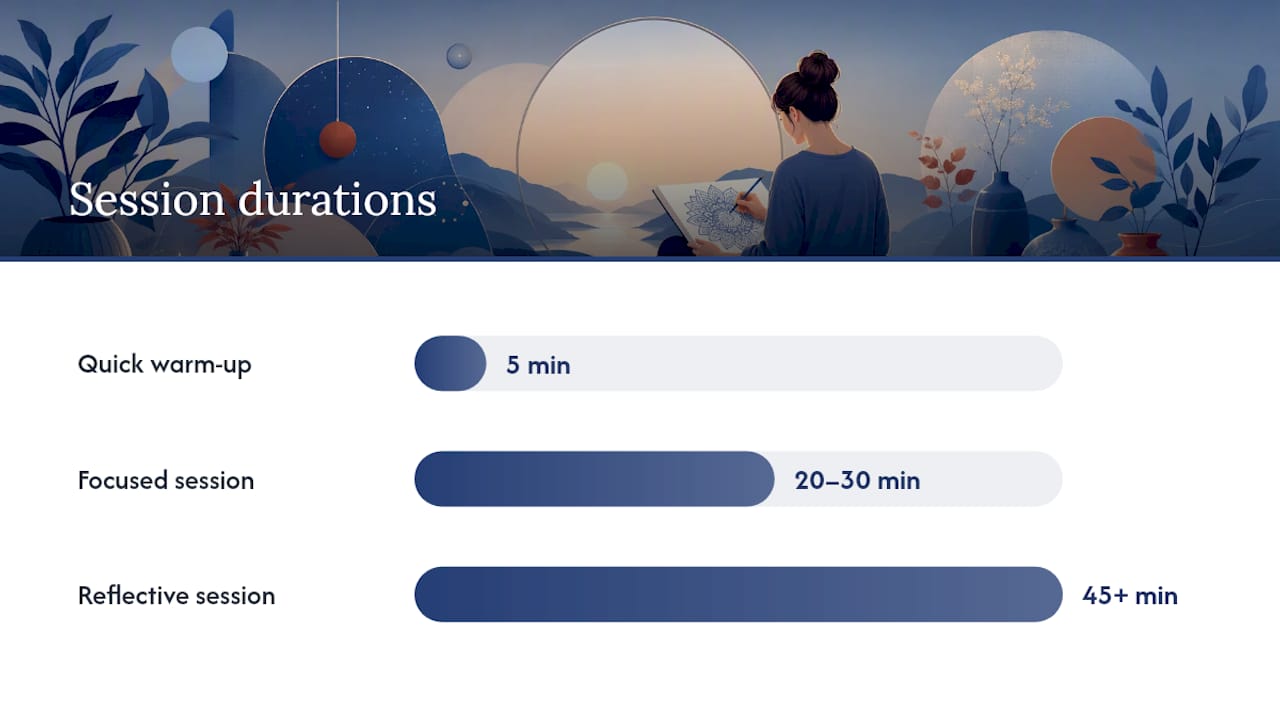
A 5 to 10 minute micro-session works well on a lunch break or between meetings. Pick a small, contained shape (a single mandala ring, one flower) and treat the whole thing as one continuous attention exercise. Shorter, repeatable templates like this tend to get used more consistently than longer sessions, simply because they fit into a packed day without requiring you to clear your calendar.
A 20 to 30-minute standard session is the sweet spot for most adults. It’s long enough to notice your mind settle but short enough that it doesn’t compete with the rest of your day.
A stretched session of 45 minutes or more works best on weekends or evenings when you have nowhere to be. Treat it less like a task and more like reading a book: no goal beyond staying present with it.
Pairing coloring with other practices
Coloring doesn’t have to stand alone. Try syncing your coloring strokes to your breath: fill one small section on the inhale, another on the exhalation. You can also repeat a short mantra silently as you work (“I am here,” “just this”), or keep a notebook nearby to jot one line about how you feel before and after the session. Pairing coloring with a few minutes of breathing exercises beforehand can help settle a racing mind before you even pick up a pencil.
Pro Tip: If you tend to rush through tasks, deliberately color slower than feels natural for the first five minutes. It sounds small, but it resets your pace for the rest of the session.
Materials, Paper, and Bleed-Through: What Actually Matters
The tools you use shape whether a session feels calming or aggravating, and paper choice is the detail most people get wrong. Cheap, thin paper with markers or gel pens is the single most common reason people abandon adult coloring books after a few tries: colors bleed through to the next page, ruining it before you’ve started.
Here’s the breakdown by tool:
- Colored pencils are the most forgiving option and work on almost any paper weight, including thin printer paper. Good for beginners and for travel.
- Fine liners and gel pens give crisp, saturated color but need slightly heavier paper (around 100gsm or more) to avoid ghosting through to the back of the page.
- Markers, especially alcohol-based ones, are the most likely to bleed through standard paper and need the heaviest stock.
- Watercolor requires the thickest paper of all and is the least beginner-friendly for a quick mindfulness session, since it demands more setup and drying time.
For markers or watercolor, aim for paper in the 120 to 160gsm range. Publishers of well-regarded adult coloring books, including Mindful Moments from Simon & Schuster’s Lake Press imprint, print on heavier stock and use one-sided page layouts specifically to prevent bleed-through and preserve the tactile feel of a finished page. That one-sided design isn’t a minor production choice. It means every page you finish stays intact, which matters when the whole point of the practice is an uninterrupted, satisfying finish.
If you’re buying a book rather than printing pages yourself, flip to a page near the back and press a marker or gel pen firmly on a test corner before committing to color through the whole thing. Paper behaves differently at 80gsm versus 160gsm, and that difference changes how much pressure you need and how satisfying the stroke feels. It’s a two-second check that saves you from ruining a book you paid for.
For anyone printing their own pages at home, set your printer to single-sided and choose a heavier paper setting if your printer supports it. Standard 20lb copy paper will bleed with anything wetter than a colored pencil.
Budget and travel-friendly setup: a basic set of 24 colored pencils, one printed or purchased coloring book, and a portable pencil case covers you for months. You don’t need 200 markers to make this work. A smaller, well-chosen kit actually reduces the decision fatigue that can undercut the calming effect before you’ve made a single mark.
25 Mindful Coloring Prompts and Session Templates
Repetition kills most wellness habits, and mindful coloring is no exception.
Repetition kills most wellness habits, and mindful coloring is no exception. Rotating through different prompts keeps the practice from feeling like a chore. Use these as a menu, not a checklist. You don’t need to do all 25. Pick whichever one matches your mood or time.
Breath-synced prompts:
Color one small section per inhale, pause on the exhalation, repeat down the whole page. 2. Fill a single petal or shape slowly enough that it takes exactly one full breath cycle. 3. Alternate colors every three breaths on a repeating pattern design. 4. Trace the outline of a shape with your eyes on the inhale, then color it on the exhale. 5. Use a four-count breath (inhale four, hold four, exhale four) while filling a mandala ring.
Mantra and affirmation pairings:
- Silently repeat “I am here” with each stroke on a simple geometric page.
- Write one gratitude word in the margin before you start, then color with that word in mind.
- Pick a single affirmation and mentally repeat it only while coloring the darkest color on the page.
- Color a page dedicated to a specific worry, letting each stroke represent “setting it down.”
- Use a page with lettering (many printable sets include one) and color it while repeating the phrase aloud once.
Theme-based exercises:
- Mandala meditation: work strictly center-out, one ring at a time, without skipping ahead.
- Nature observation: choose a botanical or leaf-pattern page and try to match colors to something you actually remember seeing outside.
- Color-limited palette: restrict yourself to three colors for the entire page to force slower, more deliberate choices.
- Monochrome practice: use a single color in different pressures and shading to build texture, which demands more attention than switching colors constantly.
- Symmetry tracking: on a symmetrical design, alternate sides so you’re constantly checking balance, which keeps your mind from drifting.
Quick warm-up template (5 minutes):
-
Pick a small, single mandala ring. Three breaths in, color the ring slowly, three breaths out.
-
Focused session template (20 to 30 minutes): full page, breath-synced coloring, one journal line before and after noting your stress level on a scale of one to ten.
-
Reflective session template (45+ minutes): full page, no music, silent mantra repetition, followed by five minutes of free journaling about what came up.
More one-line prompts to rotate through:
- Color with your non-dominant hand for two minutes to force slower, more present strokes.
- Choose the color you’re least drawn to and use it as the dominant color on the page.
- Color to a single repeated word instead of a full mantra (“steady,” “soft,” “here”).
- Set a timer for exactly seven minutes and notice how differently that constraint changes your pace compared to an open-ended session.
- Dedicate one full page to a specific emotion you’re carrying that day, without trying to “fix” it, just color while it’s present.
- Try a fully abstract, non-representational page and notice if it’s easier or harder to stay present without a recognizable image.
- End any session by coloring one small shape as fast as possible, then the next one as slowly as possible, and notice the difference in how each felt.
Reflection prompts and mantras paired directly with a coloring page are a common feature in printable mindfulness collections precisely because they nudge the activity from decorative to intentional. A blank page invites autopilot. A page with a built-in question or phrase invites presence.
Finding Trustworthy Books and Printable Coloring Pages
Not every coloring book or printable page supports a mindfulness practice equally well. Some are too busy, some are double-sided and prone to bleed, and some are cluttered with tiny sections that create frustration instead of focus.
When you’re choosing a page or a book, look for:
- A single focal point, usually centered, rather than a chaotic scattering of small images across the page.
- One-sided printing, especially if you plan to use markers, gel pens, or watercolor.
- Moderate complexity. Too simple and your mind wanders with nothing to hold it; too intricate and the fine detail becomes stressful rather than calming.
- Clear licensing terms if you’re downloading. Personal use is almost always fine for free printables, but classroom or commercial reuse (printing for a group, a business, or resale) often requires a separate license or explicit permission from the creator.
For books, Mindful Coloring by Deepak Chopra is a widely recognized option built around mandalas and nature-inspired patterns designed as focal points for attention. Mindful Moments from Lake Press is another solid pick specifically because of its one-sided page layout and heavier stock, which sidesteps the bleed-through problem that ruins a lot of budget coloring books.
For printables, sites like ColoringDojo offer single-page, centered designs, like lotus and mandala patterns, that work well as low-friction entry points if you don’t want to commit to a full book yet. Radial, center-to-edge designs like these create a natural sequence for your eyes and hand to follow, which makes them especially effective for anyone new to the practice.
| What to check | Why it matters | Good sign |
|---|---|---|
| Page layout | Prevents bleed-through with wet media | One-sided printing |
| Design complexity | Keeps attention anchored without overwhelm | Moderate detail, clear focal point |
| Paper weight (books) | Determines which tools you can use | 120 to 160gsm for markers |
| License terms (printables) | Avoids reuse restrictions | Clearly marked “personal use” |
Before you print or buy anything, ask yourself one question: does this page give my eyes an obvious place to start? If the answer is no, keep looking. That single detail predicts more about whether a page supports mindfulness than the subject matter does.
Troubleshooting Common Problems and Deepening Your Practice
Almost everyone hits the same handful of snags with mindful coloring. None of them mean you’re doing it wrong.
Your mind keeps wandering. This isn’t a failure, it’s the entire practice. Every time you notice the drift and bring your attention back to the shape in front of you, that’s a successful rep, not a setback.
You’re stressed about making it look good. Drop that goal entirely. The value of the session comes from the process of paying attention, not from the finished page looking gallery-worthy. Treating each session as practice rather than performance removes most of the pressure that causes people to quit.
You feel like you’re wasting time. Time-box it. Set a timer for 10 minutes and treat that boundary as fixed. Knowing there’s an end point makes it easier to stay present instead of watching the clock.
It’s not helping enough on its own. Mindful coloring is a useful, low-effort tool for everyday stress, but it’s not a substitute for therapy or medical care if you’re dealing with significant anxiety, depression, or trauma. Use it as a daily reset, not a replacement for support you actually need.
A few ways to deepen the practice once the basics feel comfortable:
- Add short breathwork before you start to settle your nervous system before you pick up a tool.
- Keep a one-line journal entry before and after each session to track how your stress shifts.
- Try guided audio meditation for the first two minutes, then switch to silent coloring.
- Rotate between the 25 prompts above instead of defaulting to the same approach every time.
- Notice which time of day the practice actually calms you most, and protect that slot.
Pro Tip: If a session leaves you more agitated than when you started, that’s a signal to change something, either the page complexity, the tool, or the time of day, not a sign the practice itself doesn’t work for you.
Why You Can Trust This Guide
This guide is created from the perspective of a retailer specializing in mindfulness and mental wellness tools, including journals, stress-relief items, and educational content meant to make mental health support practical and approachable. That vantage point shapes how this guide was put together: with an emphasis on what actually helps someone build a workable habit, not just what sounds appealing on a product page.
This piece draws on publicly available mindfulness guidance from clinical sources like Mayo Clinic, alongside established coloring book publishers and printable resource creators whose design choices (paper weight, one-sided layouts, focal-point patterns) reflect years of practical iteration on what makes coloring actually work as a mindfulness tool.
Mindful coloring pairs naturally with other simple tools. A journal nearby lets you jot a single line about your stress level before and after a session, turning a nice activity into a trackable habit. A stress ball within reach gives you something to squeeze during the pause between coloring and whatever comes next in your day, extending the grounding effect a few minutes longer.
The goal here isn’t to sell you on coloring as a cure-all. It’s to give you a session structure, material guidance, and prompts specific enough that you can start today with whatever you already have on hand, whether that’s a $3 coloring book from a drugstore or a carefully chosen printable from a design-focused site.
What the Conventional Advice Gets Wrong
Most articles on this topic treat mindful coloring like a lifestyle aesthetic: buy the pretty book, sit somewhere with good light, unwind. That framing undersells what actually makes the practice work, which is the attention mechanics, not the ambiance.
The biggest miss in typical advice is treating all coloring as interchangeable. It isn’t. Coloring while a show plays in the background is a distraction technique, and there’s nothing wrong with that, but it isn’t mindfulness. The version that actually reduces rumination requires you to notice when your mind drifts and deliberately bring it back, over and over, in the same session. That’s the whole mechanism. Skip it, and you’ve got a nice hobby instead of a stress-relief tool.
The second miss is materials advice buried as an afterthought. Bleed-through and flimsy paper quietly kill more coloring habits than lack of motivation ever does. If your first book bled through every page, you didn’t fail at mindfulness. You had bad paper.
Start with one page, one short session, and the honest goal of noticing your attention rather than perfecting a picture. Everything else in this guide is detail in service of that one habit.
— Ravi
Pair Your Coloring Practice With the Right Tools
A coloring book gets you started, but what happens in the minutes after you close it matters just as much. Mindpanda’s Thrive & Reflect journaling bundle gives you a place to land after a session, a few lines to note what came up, what settled, what you want to carry into the rest of your day. It’s the natural next step once coloring has done its job of quieting the noise.
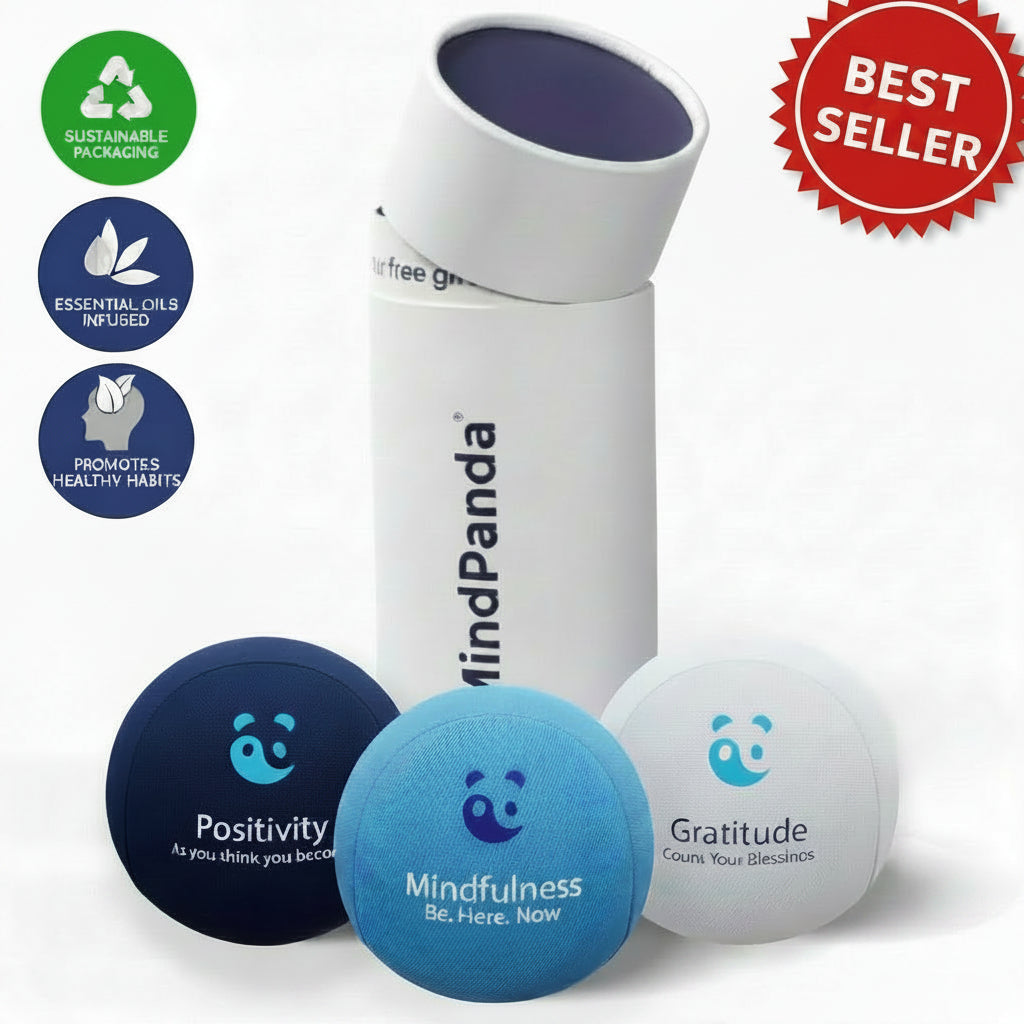
If you tend to color while still holding tension in your hands or shoulders, keeping a stress ball within reach gives you something to squeeze during the transition out of a session, extending the calming effect a little longer instead of snapping straight back into your day. And if you’re building a wellness routine for a team or an office rather than just yourself, Mindpanda’s corporate gifting and bulk order options let you bundle coloring-friendly tools with journals and stress-relief items for a group at once.
None of these products are required to make mindful coloring work. A page and a pencil are enough on their own. But if you want to extend the practice past the page, browse the journals and planners collection and pick one that fits the size of habit you’re actually trying to build.
Sources
- Mindfulness exercises — Mayo Clinic
- Mindful Coloring by Deepak Chopra — Penguin Random House
- Mindful Moments Coloring Book — Simon & Schuster / Lake Press
- Mindfulness through coloring — Mayo Clinic Connect
FAQ
What does mindfulness coloring do?
It gives your brain a repetitive, low-stakes task that competes for the same attention loop your worries usually run on, which helps lower stress and improve focus during the session. Mayo Clinic frames this type of art-based activity as a legitimate mindfulness exercise, not just a relaxing pastime.
Is adult coloring good for your brain?
Coloring trains sustained attention and gives your mind practice noticing when it wanders and gently redirecting itself, a skill that transfers beyond the coloring page. It won’t replace clinical treatment for anxiety or depression, but as a daily habit it supports the same attention-regulation skills that broader mindfulness training builds.
What is the best mindfulness coloring book?
There isn’t a single best option since it depends on your preferred design style and paper needs, but Mindful Coloring by Deepak Chopra is a well-known pick built around mandala and nature-inspired focal-point designs, and Mindful Moments from Lake Press stands out for its one-sided, heavier-stock pages that resist bleed-through.
What colors symbolize mindfulness?
There’s no fixed color code for mindfulness, since the practice is about attention rather than symbolism, but many people gravitate toward calming palettes like soft blues, greens, and neutral earth tones for coloring sessions. The specific colors you choose matter far less than how slowly and deliberately you apply them.
How do I use coloring for mindfulness if I’ve never meditated before?
Start with a short, five to ten-minute session on a single, centered design, and focus on noticing texture and pressure rather than finishing quickly. Pairing your strokes with slow breathing, one shape per breath, gives beginners a simple anchor without needing any prior meditation experience.