
The fastest fix for meeting anxiety is a three-part combo: a 30 to 60 second breathing reset, a three-point prep note, and one low-stakes comment offered in the first five minutes. Together they cut anticipatory panic, give your brain a script to follow, and break the silence that makes anxiety worse. The sections below give exact breathing scripts, in-meeting phrasing, and structural requests that make future meetings easier, drawing on therapist-backed guidance and practical suggestions from Mindpanda’s Ravi.
TL;DR:
- A physiological sigh performed for under a minute can effectively reduce acute meeting anxiety right before logging on.
- Pairing quick breathing exercises with a three-point prep improves focus and minimizes self-consciousness during meetings.
- Requesting clear agendas and defined speaking roles from organizers can significantly lower the structural sources of meeting-related stress.
- Regularly recording and reviewing short updates builds confidence and desensitizes the discomfort of hearing one’s voice in high-pressure scenarios.
- Using tactile tools such as stress balls and dedicated planners reinforces routines and supports long-term anxiety management strategies.
Table of Contents
- Meeting Anxiety Strategies for the Minutes Right Before You Log On
- Staying Present Once the Meeting Starts
- Asking for the Meeting Changes That Actually Lower Anxiety
- Building Longer-Term Confidence Between Meetings
- What I’d Tell Someone Who’s Tried Everything and Still Dreads Mondays
- Simple Tools That Make These Routines Stick
- Sources
- FAQ
Meeting Anxiety Strategies for the Minutes Right Before You Log On
What you do in the five minutes before a meeting matters more than what you do during it. Anticipatory anxiety peaks right before the call starts, which means a short, well-timed routine can defuse most of the spike before it happens.
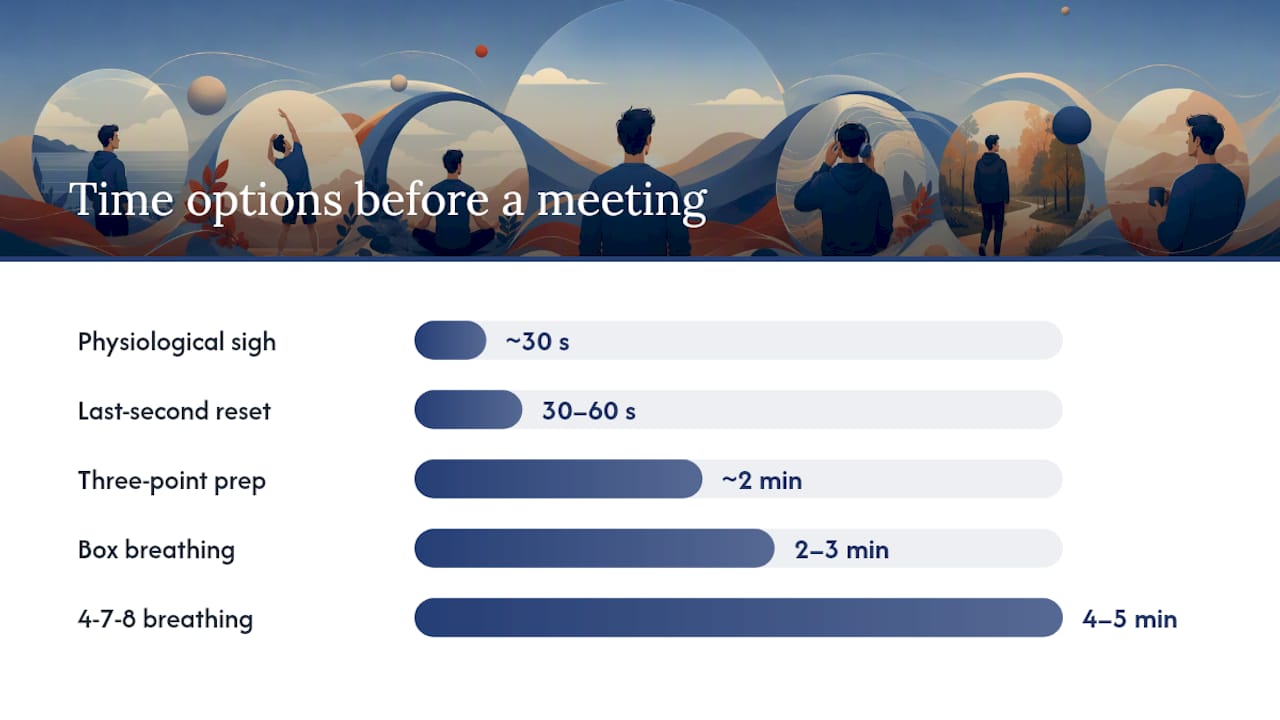
Pick your breathing technique based on how much time you actually have. Time-mapped breathing sequences work because they match the tool to the window, not the other way around:
- Under 60 seconds: Try a physiological sigh. Take two inhales through the nose (one deep, one short top-off), then a long, slow exhale through the mouth. Repeat this brief breathing pattern to help reduce stress quickly.
- 2 to 3 minutes: Use box breathing. Inhale for four counts, hold for four, exhale for four, hold for four. Cycle through it four or five times.
- 4 to 5 minutes: Try 4-7-8 breathing. This slower breathing pattern with longer exhales can calm the nervous system more thoroughly when you have several minutes to prepare.
- Last-second reset (30 to 60 seconds): Just extend your exhale longer than your inhale. Even without a formal count, a longer exhale signals your nervous system to stand down.
- If your mind is racing, not just your body: Use 5-4-3-2-1 grounding. Name five things you see, four you can touch, three you hear, two you smell, one you taste. It interrupts rumination fast.
Pair the breathing with a three-point prep, written or typed in under two minutes:
- State the meeting’s purpose in one sentence.
- List the three points you actually want to make.
- Choose one behavior goal, like “pause before responding” or “take one handwritten note,” instead of an outcome goal like “sound smart.”
Pro Tip: Join the call two minutes early, confirm your camera and mic work, and hide your self-view. Watching yourself talk is one of the most reliable ways to spike self-consciousness during a meeting.
One study-adjacent finding worth knowing: recording yourself and reviewing it before high-stakes calls reduces the novelty of hearing your own voice, which is part of why hiding self-view helps so much in the moment.
Staying Present Once the Meeting Starts
The urge to disappear is strongest in the first few minutes, which is exactly when speaking up matters most. Saying something small and low-stakes early, even just “I agree with that point” or “Can you repeat the last part?”, breaks the loop where silence feeds anxiety and anxiety feeds more silence.
Prepared phrases buy you time without making the pause feel awkward:
- “Let me think on that for a second.”
- “Can you say more about what you mean by X?”
- “I want to make sure I heard that right. Are you saying…”
- “I’ll follow up on that point after I check my notes.”
Handwritten note-taking does double duty. It gives your hands something to do besides fidget, and it shifts your attention outward, onto what’s being said, instead of inward, onto how you’re being perceived. Try writing a one-line summary after each major point instead of transcribing everything. It keeps you engaged without turning into a stenographer.
Pro Tip: If cameras are optional, keep yours on for the first few minutes to signal presence, then decide meeting by meeting. Nobody is grading your background.
Visuals help too. If someone shares a screen or slide, look at that instead of the gallery of faces. It gives your eyes somewhere to land that isn’t a row of people who, according to career coach Emily Durham, are almost certainly thinking about their own performance far more than they’re thinking about yours.
Asking for the Meeting Changes That Actually Lower Anxiety
Some of the most effective anxiety relief techniques for meetings aren’t things you do alone. They’re changes to how the meeting itself is run, and most reasonable organizers will make them if you ask.
- Request agendas 24 hours ahead. A short message like “Would it help the team if we shared a rough agenda the day before? I find I contribute better when I know what’s coming” reframes the ask as a group benefit, not a personal accommodation.
- Ask for defined speaking roles. “Could we assign who’s presenting what section ahead of time?” removes the guessing game of when you’re expected to jump in.
- Propose an async option for smaller updates. Suggesting that routine status updates move to a shared doc or chat thread, saving live time for real discussion, cuts the number of high-pressure verbal moments per week.
- Pick the right channel for the ask. Raise agenda and role requests privately with the organizer first. Save broader format changes, like moving to async updates, for a team retrospective where you can frame it as a process improvement.
These changes work because they attack the actual mechanism behind anxiety: uncertainty. Clear agendas, defined roles, and multiple ways to contribute reduce psychological load for everyone in the room, not just the person who asked.
Building Longer-Term Confidence Between Meetings
Micro-routines handle the moment. Reframing and repetition handle the pattern underneath it. Graduated exposure is the most researched piece of this puzzle: recording a 60 to 90 second update and listening back, repeated a few times a week, gradually desensitizes the discomfort of hearing your own voice under pressure.
Cognitive reframing does the rest. Career coaching guidance points to the “spotlight effect,” the mistaken belief that everyone in the meeting is scrutinizing you, as one of the biggest drivers of meeting dread. Most people in that meeting are tracking their own next comment, not yours. Swapping outcome goals (“impress everyone”) for behavior goals (“make one clear point, then pause”) also reduces pressure, since a behavior goal is something you fully control and an outcome goal never is.
A few habits worth scaffolding into your week:
- Tie a breathing reset to a calendar trigger, like every meeting invite that includes more than four people.
- Practice box breathing or the physiological sigh daily, even outside of meetings, so it’s automatic under pressure.
- Pair breathing with journaling. A quick note on what triggered anxiety and what helped builds a personal playbook over time.
Watch for over-preparing, too. Rehearsing a talking point until it’s memorized word-for-word tends to backfire, since it sets an expectation of perfection that a normal conversation can’t meet.
If anxiety is interfering with your job performance, sleep, or willingness to show up to work at all, that’s a signal to bring in professional support. CBT and, in some cases, medication are evidence-based treatments for anxiety that doesn’t respond to self-directed tactics, and a licensed therapist can tailor an exposure plan far more precisely than any article can.
What I’d Tell Someone Who’s Tried Everything and Still Dreads Mondays
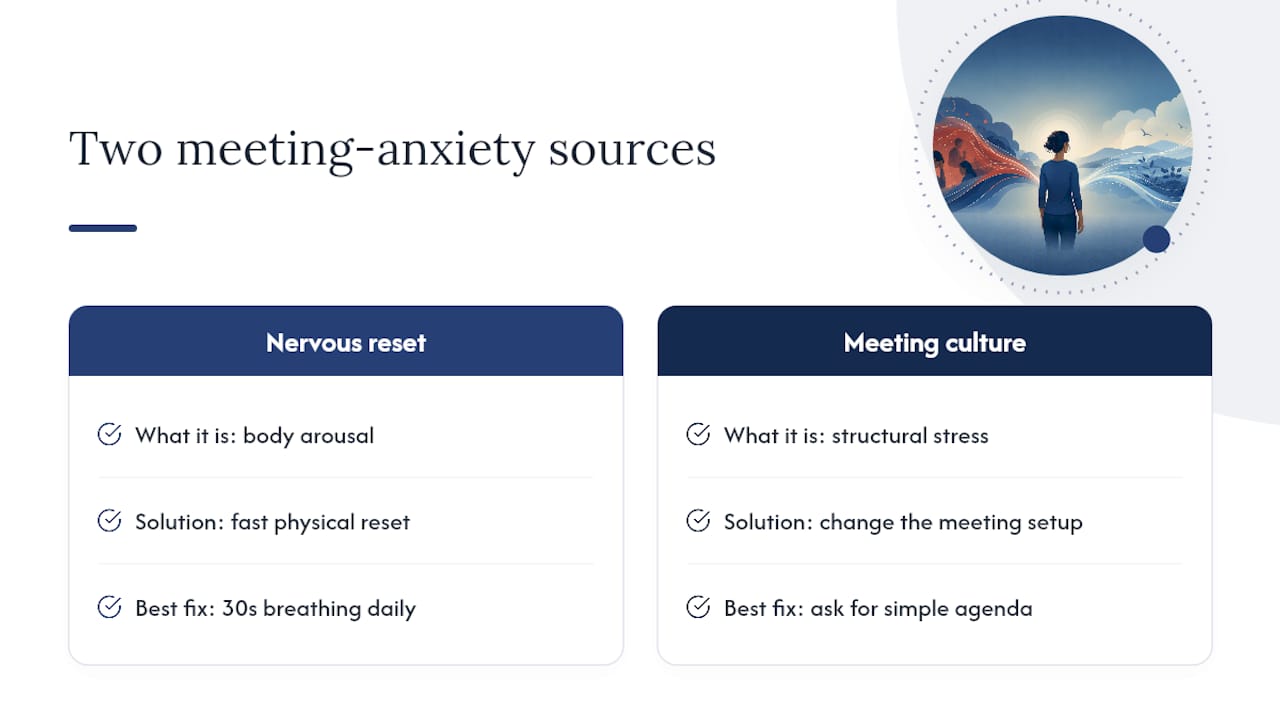
The mistake I see most often is treating meeting anxiety as one problem with one fix. It’s usually two problems stacked together: a nervous system that needs a fast physical reset, and a meeting culture that wasn’t built with anxious people in mind. Fixing the first without touching the second means you’re white-knuckling your way through structural problems that a simple agenda request could solve.
Small, repeatable moves beat overhauls. A 30 second breathing script practiced daily will outperform an elaborate anxiety-management plan you use once and abandon. If you want a place to start layering in daily practice, Mindpanda’s guides on breathing exercises and grounding techniques are built for exactly this kind of low-effort repetition.
— Ravi
Simple Tools That Make These Routines Stick
A breathing script is free, but having something in your hand while you use it makes the habit easier to repeat under pressure. A pocket-sized stress ball gives your hands a physical anchor during that pre-meeting reset or during a tense stretch of a call, and it travels well enough to sit in a laptop bag or desk drawer for whenever the next anxious moment shows up.
For the three-point prep and the habit-tracking side of this, a dedicated journal or planner gives you a consistent place to write your meeting purpose, your three talking points, and a quick reflection afterward on what worked. Some planners are built around that kind of daily scaffolding rather than a one-time fix, which matters more than any single trick once you’re trying to make this stick past next week. If you manage a team and want to extend this to the people you work with, Mindpanda’s corporate gifting and bulk order options can put stress relief tools in more hands at once. Browse the stress ball collection or pick up a planner today to build your own version of this routine.
This article is general information, not a substitute for advice from a qualified doctor. Consult a qualified healthcare professional about your own circumstances before acting on anything here.
Sources
- How to beat meeting anxiety, according to a recruiter — Business Insider
- Got anxiety in meetings? You’re not the only one — Psych Central
- Calm before a meeting: 5 breathing tricks — FeelClear
FAQ
What is the fastest way to calm nerves before a meeting?
A physiological sigh, two inhales through the nose followed by one long exhale through the mouth, works in under 60 seconds and is one of the quickest ways to lower acute stress before you join a call.
How do I stop overthinking during a meeting?
Handwritten notes and 5-4-3-2-1 grounding both shift your attention outward, onto the room or the conversation, which interrupts the inward spiral that fuels overthinking.
Should I ask my team to change how meetings are run?
Yes. Requesting agendas 24 hours ahead or clearer speaking roles is a reasonable, low-friction ask that tends to help the whole team, not just the person who requested it.
When does meeting anxiety require professional help?
If anxiety is disrupting your sleep, work performance, or willingness to attend meetings at all, it’s worth speaking with a therapist about CBT or other evidence-based treatment options.
Can a physical object like a stress ball actually help with meeting anxiety?
A tactile object like a stress ball can support a breathing reset by giving your hands something to do while your nervous system settles, and a stress ball collection can be built for exactly that kind of quick, discreet use.