
Journaling rarely replaces therapy, but it isn’t a lesser substitute either. It works best as an adjunct: a self-monitoring tool that sharpens what happens in the therapy room. For mild stress, transitional rough patches, or building emotional awareness, a structured journal alone can be enough. For clinical depression, trauma, active crisis, or anything involving safety risk, you need a licensed clinician.
TL;DR:
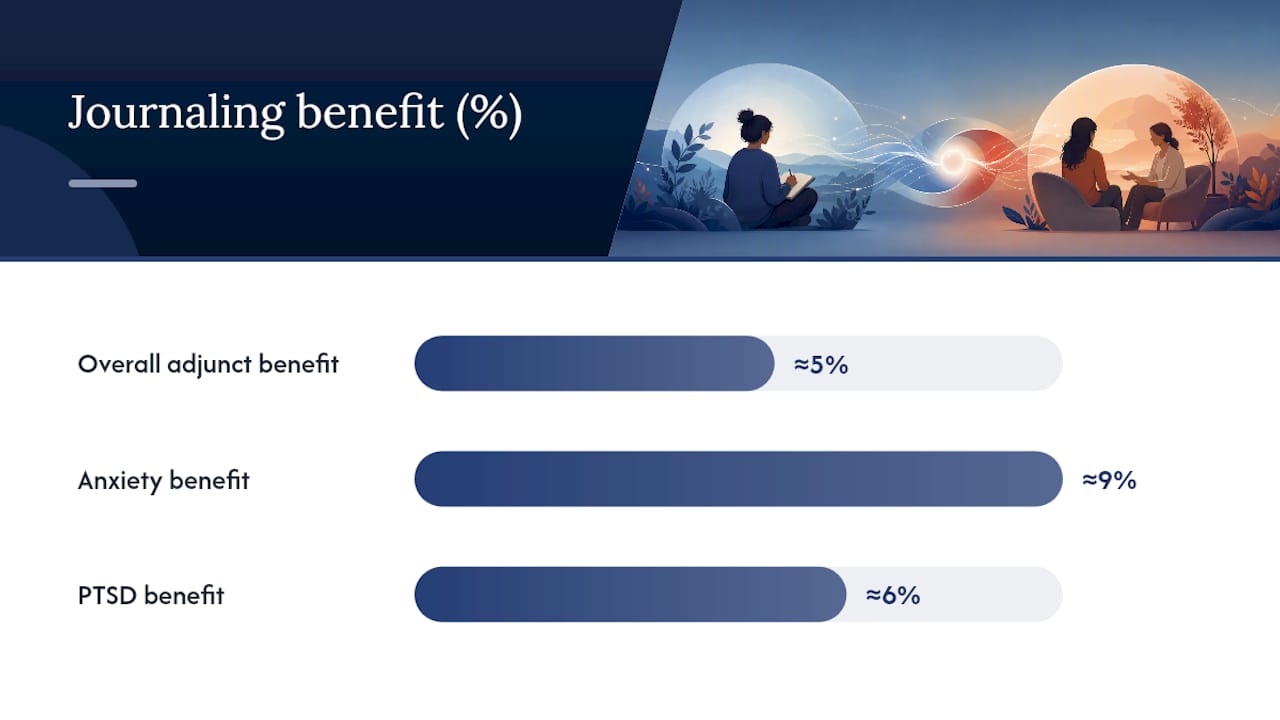
- Journaling provides a modest but measurable additional symptom reduction of about 5% when combined with standard care, especially effective for anxiety and PTSD.
- It works best for mild stress, transitional periods, or building emotional awareness but cannot diagnose or treat clinical disorders or crises.
- Structured journaling formats like mood logs and thought records generate more precise, time-stamped data that can enhance therapy outcomes.
- Combining journaling with therapy allows for more targeted insights, immediate flagging of concerns, and more effective session discussions.
- Heavy trauma, self-harm thoughts, or worsening symptoms require professional intervention beyond self-monitoring with a journal.
Table of Contents
- Journaling vs. Therapy: A Quick Comparison
- What the Research Actually Shows
- How Journaling and Therapy Actually Work Differently
- Types of Journaling and How Therapists Use Them
- How to Combine Journaling With Your Therapy Sessions
- A Simple Starter Routine for Journaling
- When Journaling Isn’t Enough
- What I’ve Learned From Pairing the Two
- Building a Journaling Habit That Actually Sticks
- Sources
- FAQ
Journaling vs. Therapy: A Quick Comparison
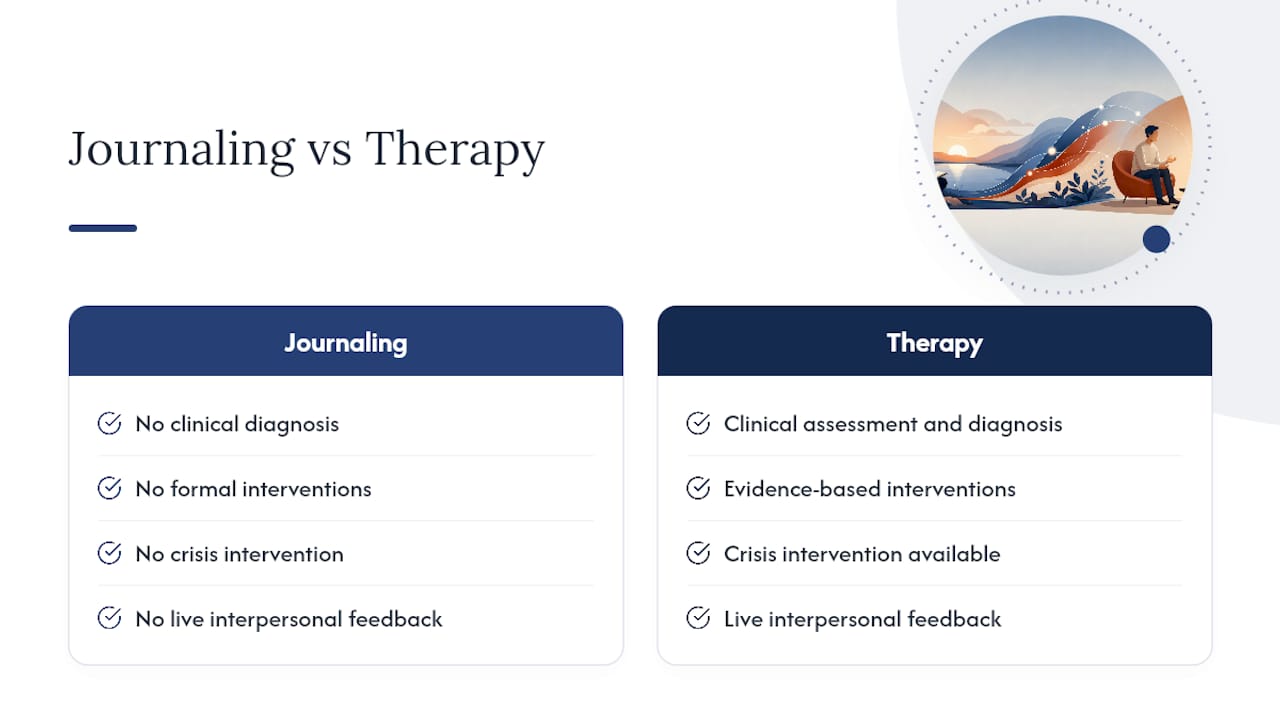
Journaling costs nothing but time, works on your schedule, and builds the kind of self-awareness that makes therapy sessions less about recounting the week and more about actually solving problems. Its ceiling is real: a journal can’t diagnose a personality disorder, interrupt a panic attack in the moment, or repair the kind of relational wounds that only show up when another person is in the room reacting to you in real time. Therapy provides assessment, structured intervention, and a live human relationship that can catch things you’d miss writing alone at your kitchen table. Its downside is access. Cost, waitlists, and geography still keep a lot of people from starting.
Here’s how to match your situation to an approach.
Journaling alone tends to work when:
- You’re dealing with everyday stress, a rough week, or a transition (new job, move, breakup) without signs of a clinical disorder.
- You want to build self-awareness or process a specific event and you have no history of trauma, suicidal ideation, or severe depression.
- You’re using it as a bridge while you wait for a therapy intake appointment.
Therapy is necessary when:
- Symptoms have lasted more than two weeks and are disrupting work, sleep, or relationships.
- You have any thoughts of self-harm, a history of trauma you haven’t processed with support, or a diagnosed condition like bipolar disorder or PTSD.
- Journaling about a topic makes you feel worse and stuck there, rather than clearer.
Combine both when:
- You’re already in therapy. Bring journal entries as raw material for sessions instead of trying to remember everything from memory.
- You want faster, more concrete progress on a specific behavior (anxiety spikes, anger outbursts, relationship patterns) that benefits from daily tracking.
If you’re in the first camp, start a two-week mood log tonight. If you’re in the second, call to schedule an intake this week. If you’re in the third, bring your last three journal entries to your next session and ask your therapist how they want you to use them going forward.
What the Research Actually Shows
The clearest evidence comes from a 2022 systematic review and meta-analysis of 20 randomized controlled trials, which found that journaling used as an adjunct to standard care produced about a 5% greater reduction in symptom scores compared to standard care alone.
By the numbers: Journaling as an add-on to standard treatment produced roughly a 5% greater symptom reduction overall, climbing to about 9% for anxiety and 6% for PTSD, according to the 2022 meta-analysis. The evidence was graded B, meaning it’s a reasonable recommendation, not a slam-dunk one.
That subgroup pattern matters. Anxiety and PTSD showed the strongest response, which tracks with what journaling does well: externalizing looping thoughts and giving traumatic memories a fixed narrative shape instead of letting them stay diffuse and intrusive. But the review also flagged high heterogeneity across the 20 trials, meaning study populations, journaling formats, and instruction quality varied enough that the pooled number hides a lot of noise. Some trials used trained facilitators; others handed participants a notebook and a vague prompt. That inconsistency is likely why the effect size looks modest rather than dramatic.
The foundational work behind almost all of this traces back to expressive writing research pioneered by James Pennebaker in the 1980s, which found that writing about emotionally significant experiences produced measurable psychological and physical health benefits, not just self-reported mood improvements, but changes in immune markers and doctor visits in some cohorts. That body of work is the reason expressive writing shows up in so many modern journaling protocols.
One overlooked variable: instruction quality. Studies that gave participants brief coaching on how to write, not just that they should, tended to show cleaner results. If you’re journaling on your own with no structure, you may be getting less benefit than the research subjects who had even minimal guidance.
How Journaling and Therapy Actually Work Differently
Both methods lean on the same basic psychological machinery. Cognitive processing, turning a jumbled emotional experience into language, forces your brain to organize it. Narrative creation gives chaotic events a beginning, middle, and end, which reduces their power to intrude randomly. Emotion labeling, simply naming what you feel, has been shown to calm the amygdala’s threat response. Journaling and therapy both use these mechanisms constantly.
Where they split is capability. A journal cannot diagnose you. It cannot tell the difference between situational sadness and clinical depression, and it has no mechanism for crisis intervention if you write something alarming at 2 a.m. Therapy brings clinical assessment, evidence-based interventions like cognitive behavioral therapy or exposure work, and something no notebook can offer: relational repair through an actual human relationship. A therapist reacts to you in real time. That live interpersonal feedback loop is often where the deepest change happens, particularly for attachment wounds and relationship patterns that only surface when another person is present.
Journaling’s advantage is different but genuinely valuable: it produces primary, time-stamped data. Ecological momentary assessment research shows that near-real-time self-reports are more accurate than what you remember and recount a week later in a session. A therapist relying only on your memory of “how the week went” is working with a compressed, filtered summary. A journal entry written the moment you felt your chest tighten before a meeting gives your therapist raw material they’d otherwise never see.
Types of Journaling and How Therapists Use Them
Different journaling formats serve different goals, and picking the wrong one for your situation is a common reason people give up on the practice entirely.
- Expressive writing means writing freely about an emotional experience for 15 to 20 minutes, usually over three to four sessions. This is the Pennebaker method and it’s best for processing a specific event, not daily maintenance.
- Gratitude journaling involves listing a few things you’re thankful for, often just two or three minutes a day. It’s low-risk and works well paired with behavioral activation for mood lift, though it won’t touch deeper symptoms.
- Mood logs track a numeric or word-based mood rating daily, often alongside sleep, exercise, or triggers. This is the format that generates the clearest data for a therapist to review.
- DBT diary cards are structured worksheets tracking urges, skills used, and target behaviors, typically filled out daily and reviewed weekly with a clinician.
- CBT thought records walk you through identifying an automatic thought, the emotion it triggered, evidence for and against it, and a more balanced reframe.
- Journal therapy is a distinct, therapist-guided modality using structured prompts within a clinical relationship, not the same as keeping a private diary. GoodTherapy’s overview draws that line clearly.
If your goal is symptom tracking, use a mood log or diary card. If it’s meaning-making after a hard event, expressive writing fits better. If you’re practicing a specific coping skill your therapist assigned, the diary card format is built for exactly that.
How to Combine Journaling With Your Therapy Sessions
Journaling gets far more useful once it’s structured around your actual therapy schedule instead of floating free.
- Before the session, spend five minutes writing a short agenda: the two or three things that felt hardest this week, ranked by urgency. Sessions are short. Walking in with a prioritized list keeps you from spending ten minutes on a minor annoyance while the real issue goes unmentioned.
- Between sessions, treat your journal like a lab notebook. If your therapist assigned an exposure exercise or a behavioral experiment, log what happened, what you predicted, and what actually occurred. This turns vague memory into evidence you can review together.
- Use diary cards for anything recurring, urges, panic episodes, angry outbursts. Weekly totals give your therapist pattern data that a single verbal recap can’t match.
- Flag anything alarming immediately, don’t wait for your next scheduled session to mention a written entry that concerned you. Text or call your provider’s office.
Research on combining structured writing with therapeutic support consistently shows larger effects than journaling alone, largely because the two methods create a feedback loop: the journal generates data, the therapist interprets it, and the next journal entry reflects what you learned.
Pro Tip: Highlight or star any journal entry that surprised you, a reaction stronger or weaker than expected. Those are usually the entries most worth bringing up in session, even if they feel too small to mention.
A Simple Starter Routine for Journaling
You don’t need an elaborate system to start. Pick one format, commit to a short window, and adjust after two weeks.
- Expressive writing: 15 to 20 minutes, three to four sessions, focused on one specific experience. Don’t reread it immediately afterward; give it a day.
- Daily mood log: One to three minutes, same time each day, rating mood on a simple 1 to 10 scale plus one triggering event.
- Gratitude entries: Two or three lines, ideally in the evening, naming specific moments rather than generic categories.
- CBT thought record: Used as needed when a strong negative thought hits, walking through the situation, the automatic thought, and a more balanced alternative.
- Quick check-in methods: The 3-3-3 method, three things you see, hear, and feel in your body, works well for grounding during anxious spikes. A 3/2/1 variation (three gratitudes, two wins, one challenge) works as a fast nightly wind-down.
On tools: paper journals reduce screen exposure before bed and feel more private, while digital mood-tracking apps make it easier to export data and spot patterns over months. Either works. If privacy is a concern and you plan to share entries with a therapist, keep a separate section or tab you can hand over selectively rather than exposing an entire private journal. For anxiety-specific prompts or gratitude prompts to get unstuck on day one, a short prompt list beats staring at a blank page.
When Journaling Isn’t Enough
Some signs mean it’s time to stop relying on a notebook and call a professional. Any thoughts of suicide or self-harm require immediate action, contact a crisis line or emergency services, not another journal entry. Severe functional decline, missing work repeatedly, being unable to get out of bed, withdrawing entirely from people you care about, points to something beyond what self-directed writing can address. If journaling about a traumatic memory consistently leaves you feeling worse for days rather than gradually lighter, that’s a retraumatization risk, not a normal part of processing.
The safest approach with heavy material is time-limited writing, setting a firm 15 to 20 minute cap, and doing it under the guidance of a clinician who can help you process what surfaces rather than writing alone into a memory that overwhelms you. If two weeks of consistent journaling produces no relief, or symptoms are getting worse instead of better, that’s your signal to seek a licensed clinician for a proper assessment. Journaling can wait; safety can’t.
What I’ve Learned From Pairing the Two
The biggest shift for me wasn’t journaling replacing anything. It was using pre-session notes to walk into therapy with a ranked list instead of a foggy “the week was hard” summary. Sessions got sharper almost immediately.
Post-session journaling surfaced feelings I hadn’t said out loud in the room, some uncomfortable ones. Writing them down first, then bringing them back to my therapist, made them easier to actually work through instead of just noticing them alone.
The takeaway: use the journal to capture what’s true in the moment, then let a trained person help you make sense of it.
— Ravi
Building a Journaling Habit That Actually Sticks
Most people who quit journaling don’t quit because the practice doesn’t work. They quit because an empty notebook and a vague intention aren’t enough to build a habit around. Some journals and planners come pre-structured, so you’re not staring at a blank page every night trying to invent a format from scratch.
Some wellness bundles pair guided journals with small tools, aromatherapy stress balls, and mood trackers to help maintain a journaling habit. None of this replaces a licensed clinician, and if you’re dealing with the red flags covered above, a bundle isn’t the next step, a phone call is. But for the mild-stress, self-awareness-building, adjunct-to-therapy use case this article has been describing, having a physical tool designed for the job removes a lot of the friction. If you’re ready to build a routine instead of relying on willpower alone, you can create your own wellbeing bundle and pick the journal format that matches what you actually need right now.
This article is general information, not a substitute for advice from a qualified doctor. Consult a qualified healthcare professional about your own circumstances before acting on anything here.
Sources
- Efficacy of journaling in the management of mental illness: a systematic review and meta-analysis
- Journal therapy: Evidence–based writing techniques for mental health and emotional wellness
FAQ
Can journaling replace therapy?
For mild stress or everyday emotional processing, journaling alone can be sufficient. For clinical disorders, trauma, or crisis situations, it cannot substitute for a licensed clinician, though it works well alongside therapy as an adjunct tool.
What is the 3-3-3 journaling method?
The 3-3-3 method is a quick grounding exercise where you write down three things you see, three things you hear, and three sensations you feel in your body, useful for calming anxiety spikes in the moment.
What do psychologists say about journaling?
Clinical research generally supports journaling as a useful adjunct, with a 2022 meta-analysis finding roughly a 5% greater symptom reduction when paired with standard care, though evidence quality is graded B due to variation across studies.
What are the different types of journaling?
Common formats include expressive writing, gratitude journaling, mood logs, positive-affect journaling, DBT diary cards, CBT thought records, and therapist-guided journal therapy, each suited to a different goal like meaning-making, tracking, or coping-skill practice.
What is the 3/2/1 method of journaling?
The 3/2/1 method is a brief nightly reflection format: three things you’re grateful for, two wins from the day, and one challenge you’re still working through, designed to take under five minutes.