Focused breathing, a 30 second body scan, the STOP practice, and a five minute walking break are the highest impact mindfulness exercises for the workday because they take almost no time and work inside the schedule you already have. Used consistently, they sharpen focus, lower stress in the moment, and make switching between tasks less jarring. The steps, timing, and evidence behind each one follow below.
TL;DR:
- Micro-practices like box breathing or a body scan are most effective when done multiple times a day, especially during transitions or breaks.
- Short daily mindfulness exercises show small to moderate benefits for stress and anxiety, with frequency often outweighing session length.
- Building habits around existing routines and using visual or tactile cues improves adherence without disrupting work schedules.
- Remote work requires deliberate buffers and cues, such as calendar blocks or guided audio, to maintain mindful pauses between calls.
- Short, structured routines like a one-minute STOP exercise or a five-minute walk can significantly reduce immediate tension and mental fatigue.
Table of Contents
- 1. Step-by-step mindfulness exercises for the workday
- 2. What research says about mindfulness and short practices at work
- 3. Making mindfulness stick without disrupting your schedule
- 4. Ready-made scripts for 1, 5, and 10 minute resets
- 5. Starting and ending tasks with intention
- 6. Bringing mindfulness into remote and virtual meetings
- 7. Working through common obstacles to a mindfulness practice
- 8. Making this realistic in a real workday
- Practical tools that support a workplace mindfulness habit
- FAQ
- Sources
1. Step-by-step mindfulness exercises for the workday
These practices are built for a desk, a meeting room, or a hallway, not a meditation cushion. Pick two or three to start rather than trying all of them at once.
- Box breathing (4-4-4-4): Inhale for a count of four, hold for four, exhale for four, hold for four. Repeat for four rounds before a stressful call. The even counts give your nervous system a predictable rhythm to settle into. Common mistake: rushing the hold phases, which defeats the calming effect.
- 4-4-4 and 7-11 breathing: For 7-11, inhale for a count of seven and exhale for eleven, which lengthens the exhale and tends to lower tension faster than even counts. Use it right before a presentation or a difficult conversation.
- Micro body scan (30 to 60 seconds): Starting at your jaw, notice and release tension moving down through shoulders, hands, and stomach. This catches the physical tension that builds silently during long stretches at a screen. Do it once an hour if you can set a reminder.
- STOP practice: Stop, Take a breath, Observe what you are feeling and thinking, Proceed with intention. It takes under a minute and works well right before you respond to a tense e-mail.
- 5-4-3-2-1 grounding: Name five things you see, four you can touch, three you hear, two you smell, one you taste. This pulls attention out of a spiraling thought and back into the room, and it is especially useful during a grounding exercise for acute anxiety rather than general stress.
- Mindful walking: Walk at a normal pace and pay attention to the sensation of each foot making contact with the ground. A five minute version between meetings resets attention better than scrolling a phone.
- Mindful eating: Eat one meal or snack a day without a screen, noticing texture, temperature, and flavor. This single habit often does more for midday energy than the food choice itself.
- Gratitude pause: Name one specific thing that went well in the last few hours, not a vague “good day” but a concrete moment. Thirty seconds, once a day, often at the end of a shift.
- Mindful listening: In your next meeting, put the device down and listen to one colleague without drafting your response while they talk. This is mindfulness applied directly to work rather than a separate break from it.
- Desk stretches: Roll shoulders, stretch your neck side to side, and extend your wrists for 30 seconds every hour. Combine this with the micro body scan so you notice where to stretch.
- Single-tasking with a timer: Set 25 minutes for one task with notifications off, then take a five minute break. The constraint itself is the practice: your attention stays where you put it instead of splitting across tabs.
Pro Tip: Attach a new practice to something you already do, like brewing coffee or closing your laptop, so you don’t have to remember it cold.
- Thirty second versions: one slow breath cycle, a jaw-to-shoulder tension check, naming three things you can see.
- One minute versions: box breathing for four rounds, the full STOP sequence, a gratitude pause with two reasons instead of one.
- Three minute versions: a seated body scan head to toe, a short lap around the building, 7-11 breathing for six rounds.
2. What research says about mindfulness and short practices at work
The evidence is encouraging but specific. A randomized controlled trial of managers who completed structured Mindfulness-Based Stress Reduction found significant reductions in perceived work-related stress and negative affect compared with controls. That is a real, measured effect, not just a reported feeling.
Results get more mixed when mindfulness is compared against other active ways of managing stress. The SWELL feasibility trial, which randomized 241 employees to an online mindfulness program or a light exercise program, found both groups improved on stress, anxiety, and depression, with negligible difference between them on work performance measures. A broader evidence map of mindfulness interventions backs this pattern: mindfulness-based programs show small-to-moderate improvements in stress, anxiety, and depression against passive controls, but effects on cognitive or performance outcomes are smaller and less consistent against active controls like exercise.
- Structured MBSR programs reduce perceived stress and negative affect in high-stress occupational groups, confirmed in randomized trials.
- Mindfulness and light exercise can produce similar mental-health gains, so neither should be oversold as uniquely superior.
- Practitioner-focused research finds that frequent, brief micro-practices spread through the day reduce the cognitive residue that carries over between tasks, often rivaling longer single sessions for workplace use.
The pattern favors frequency over duration: short, repeated practices integrated into the workday tend to produce more sustainable benefit than one long session saved for the weekend.
3. Making mindfulness stick without disrupting your schedule
Individual habits fail when they depend on willpower alone. Build structure around them instead.
- Anchor practices to transitions you already make: before opening e-mail, after a meeting ends, or when you sit back down from lunch.
- Use calendar nudges or phone settings: a recurring two minute block labeled “reset” works better than a vague intention to “be more mindful.”
- Pick one or two practices and track outcomes briefly: a single word in your notes app, like “calmer” or “same,” tells you within two weeks whether something is worth keeping.
- For managers, model it first: opening a meeting with sixty seconds of quiet breathing signals that the practice is welcome, not a sign of slacking. Team-level habits like this can shift norms around psychological safety, according to reporting from Wharton on leadership modeling and workplace mindfulness adoption.
- Pilot with a small team before rolling out company-wide: a two week trial with five volunteers surfaces friction points before you scale.
Time scarcity, skepticism, and hybrid coordination are the three barriers that kill most programs. Counter time scarcity by keeping the ask under three minutes. Counter skepticism by framing the practice as a trainable skill, similar to attention training rather than a personality trait, which makes it easier for data-minded colleagues to accept. Counter hybrid friction by making practices individually doable, not dependent on everyone being in the same room.
Pro Tip: Let people opt out visibly without explanation. Mandatory mindfulness reliably backfires.
For more on fitting these habits into a packed calendar, see our piece on staying mindful during a busy day.
4. Ready-made scripts for 1, 5, and 10 minute resets
Keep these three in your back pocket so you never have to improvise under pressure.
- One minute, before a meeting or call: Run the STOP sequence. Stop typing, inhale for four counts, exhale for six, name one word for how you want to show up in the next conversation.
- Five minutes, midday reset: Walk a short loop, indoors or outside, paying attention only to your feet and breath for the first two minutes, then let your mind wander freely for the rest. A guided version of this is laid out in the walking meditation script from the Greater Good Science Center.
- Ten minutes, end of day: Sit, breathe in a 4-4-4 pattern for two minutes, then spend the remaining time writing three lines about what drained you and one line about what helped. A stress ball or a plain notebook works well here if you want a tactile or written anchor rather than sitting with nothing in your hands.
Use the one minute script whenever your calendar is back-to-back, the five minute walk when you notice your focus sliding after lunch, and the ten minute routine as a closing ritual rather than squeezed in mid-task.
5. Starting and ending tasks with intention
The moments between tasks are where most mental fatigue quietly accumulates, because attention from the last task leaks into the next one without a break to signal the switch. A brief transition ritual gives your brain a clear boundary.
Before starting a new task, take three slow breaths and state the single outcome you want from the next block of time. This takes fifteen seconds and prevents you from opening five tabs out of habit rather than purpose. Before closing a task, especially an unfinished one, write one sentence noting where you left off. This “closing note” habit does double duty: it reduces the nagging feeling of unfinished business, and it means you are not reconstructing context from scratch tomorrow.
At the end of the workday, a short physical cue, closing the laptop fully, straightening your desk, or stepping outside for sixty seconds, helps separate work thinking from the rest of your evening. Without some version of this, many people report the day never quite feels finished, which shows up as low-grade background stress well past working hours. None of this requires new software or a long routine. It requires picking one consistent cue for “starting” and one for “ending,” and repeating it enough times that it becomes automatic rather than another thing to remember.

6. Bringing mindfulness into remote and virtual meetings
Remote work removes the natural pauses that used to exist between in-person meetings, like walking down a hallway or waiting for an elevator. Without those built-in buffers, video calls run back-to-back and transitions disappear entirely.
Build the buffer back in deliberately. Set calendar defaults to 25 or 50 minute meetings instead of 30 or 60, which forces a short gap before the next call. Use that gap for one minute of box breathing or a quick stretch rather than checking e-mail.
On camera, mindful listening takes on a slightly different shape: turn off self-view if it distracts you, and resist the pull to multitask just because no one can see your screen. A single minute of quiet breathing before unmuting at the start of a call, especially a high-stakes one, calms the voice and slows down rushed speech.
For solo practice during remote days, a short guided audio can substitute for the in-person cues you are missing. Resources like the guided mindfulness practices from UC Davis Health offer short sessions that work well between calls without needing a facilitator. Hybrid teams can also agree on a shared signal, such as the first minute of a weekly meeting reserved for silence, so remote and in-office colleagues build the habit together rather than remote workers practicing alone while the office carries on as usual.
7. Working through common obstacles to a mindfulness practice
The three obstacles that come up most are a racing mind that will not settle, a workday too fragmented to find a spare moment, and the feeling that short practices are not “real” mindfulness.
A racing mind is not a sign you are doing it wrong. Expect thoughts to intrude, especially in the first few sessions, and treat noticing the distraction as the practice itself rather than a failure of it. Naming the distraction silently, “planning,” “worry,” “to-do list,” then returning to the breath works better than trying to force the mind blank.

Fragmented time responds better to shorter, more frequent practices than to carving out a rare 20 minute block. If you only have 90 seconds between calls, use them rather than waiting for a slot that never arrives. The evidence on micro-practice frequency supports this: brief, repeated sessions distributed across the day tend to hold up as well as longer, infrequent ones for workplace use.
Skepticism about whether short practices count is worth addressing directly. A seven week online program for emergency dispatchers, a genuinely high-stress and interruption-heavy job, produced measurable stress reductions that held at a three month follow-up according to a CDC-supported study. If brief, structured practice worked there, it is a reasonable bet for a standard office day.
8. Making this realistic in a real workday
I don’t think the goal should ever be a perfect daily meditation streak. Most workdays are too unpredictable for that, and chasing it just adds another source of guilt. What actually holds up is picking one or two small practices, like a breathing cycle before a hard meeting or a tactile check-in with a stress ball at your desk, and tracking in a sentence or two whether they changed anything. Small, noticed improvements are what keep a habit alive longer than any ambitious plan does.
— Ravi
Practical tools that support a workplace mindfulness habit
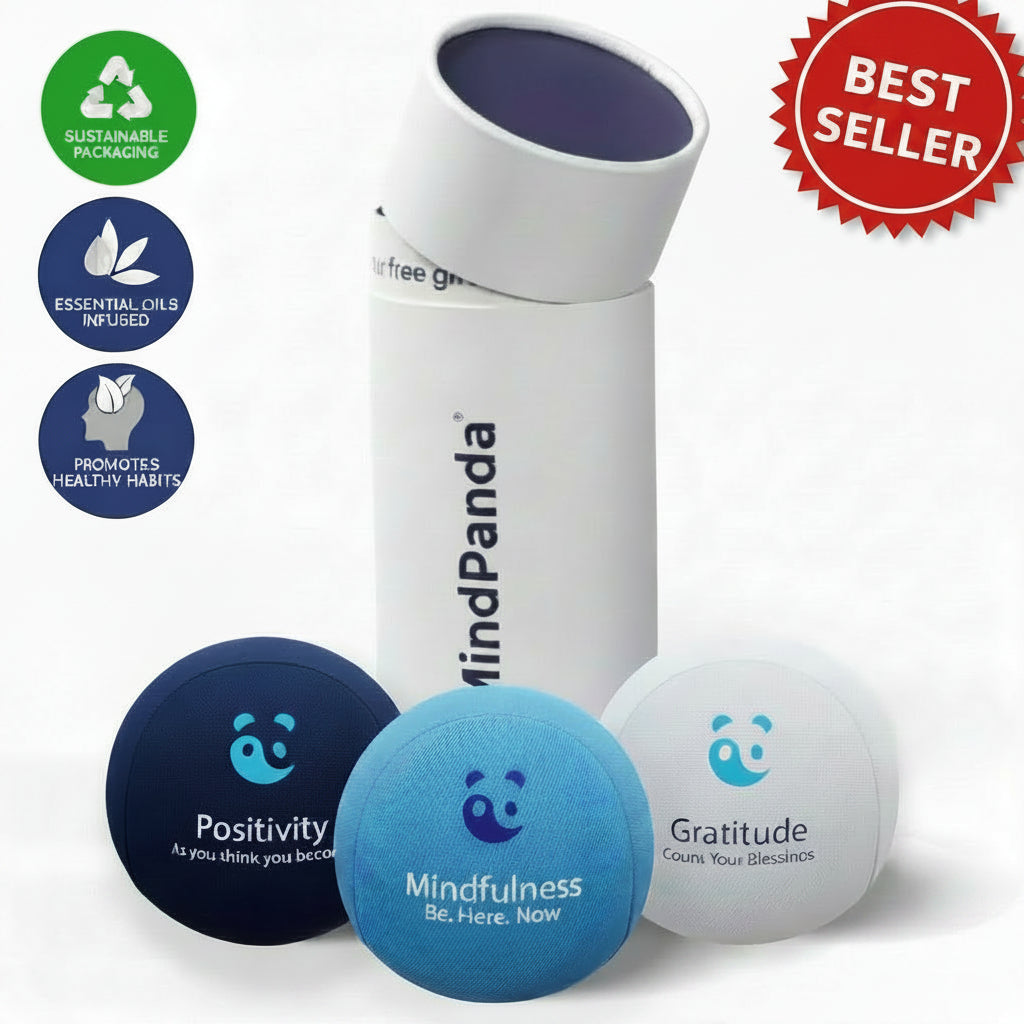
Some of these practices are easier to keep up with a physical anchor in hand. A themed or aromatherapy stress ball gives your hands something to do during a breathing cycle or a tense call, which for many people makes the pause easier to actually take. A journal or planner supports the reflective side, the one line closing notes, the gratitude pauses, the end of day debrief, by giving them a consistent place to live instead of scattered sticky notes.
- Stress balls work as a discreet, tactile cue for breathing or grounding exercises at a desk.
- Journals and planners support the writing-based practices, from transition notes to gratitude pauses.
- For managers rolling out a team habit, our corporate gifting and wholesale options make it simple to source a small batch of tools for a team pilot rather than sourcing items one at a time.
If you manage a team and want to put a few of these tools in people’s hands for a pilot, our business and wholesale page is the place to start.
FAQ
What are the 5 R’s of mindfulness?
Definitions vary across programs, but a common version includes Recognize, Reframe, Respond, Reflect, and Reinforce, a structured way of noticing a reaction, choosing a thoughtful response instead of an automatic one, and building the habit over time. It is one framework among several rather than a single fixed standard.
What is the 5-4-3-2-1 mindfulness activity?
It is a grounding exercise where you name five things you can see, four you can touch, three you can hear, two you can smell, and one you can taste. It works by pulling your attention out of anxious or looping thoughts and back into your immediate surroundings, and it takes under two minutes.
What are some calming exercises I can do at work?
Box breathing, a 30 second body scan, the STOP practice, and a short mindful walk are all calming options that fit inside a workday without needing privacy or special equipment. Choosing one you can do at your desk, like breathing or a body scan, makes it easier to actually use when stress shows up.
What type of exercise is most beneficial for anxiety?
Breathing techniques that lengthen the exhale, such as the 7-11 pattern, tend to calm the body’s stress response faster than even-count breathing. Grounding exercises like 5-4-3-2-1 are also well suited to acute anxiety because they redirect attention immediately rather than asking you to sit with the feeling.
Sources
The research summary above draws on a randomized controlled trial of structured MBSR in managers, a feasibility trial comparing online mindfulness with light exercise, and a broad evidence map of mindfulness outcomes across stress, anxiety, and depression. For readers who want to try a guided format rather than a self-led one, the walking meditation script and the guided practice sessions linked earlier offer a low-effort starting point. The CDC-supported study on a brief online program for emergency dispatchers is worth a look if you are skeptical that short, remote-friendly practices can hold up in a genuinely stressful job.
- Mindfulness-based stress reduction for managers: a randomized controlled study
- Work Engagement and Well-being Study (SWELL): a randomized controlled feasibility trial
- Mindfulness at Work: Evidence-Based Practices for Stress and Performance