
A weekly reset routine is a short, repeatable ritual where you clear loose ends, close out the past week, and set up the next one before it starts. The minimum viable version takes 10 to 20 minutes: a quick brain dump of what’s on your mind, a two-minute glance at next week’s calendar, and picking one anchor task to build the week around. Done consistently, it cuts decision fatigue and stops small tasks from piling into a Sunday-night scramble.
TL;DR:
- A weekly reset can save five to ten hours a week by reducing decision fatigue through a structured review of habits, finances, and tasks.
- The ideal duration varies from 10 minutes during tough weeks to 90 minutes for comprehensive monthly reviews, with flexibility to adapt.
- Key steps include a quick brain dump, calendar scan, to-do sweep, and a brief self-care reflection, tailored to available time and week complexity.
- Incorporating mindfulness practices like breathing or walking into the reset enhances focus and reduces stress, especially when integrated regularly.
- Habit stacking with existing routines and using sensory cues can reinforce the reset habit and help it persist through fluctuating schedules.
Table of Contents
- What Is a Weekly Reset and Why Does It Help?
- How Long Should a Weekly Reset Take?
- The Step-by-Step Weekly Reset Checklist
- Which Mindfulness Practices Actually Fit Into a Reset?
- How Do You Make a Weekly Reset Stick?
- A Realistic 30-Minute Sunday Reset
- Tools That Take the Friction Out of Your Reset
- Why Most People Get the Weekly Reset Wrong
- Sources
What Is a Weekly Reset and Why Does It Help?
A weekly reset is different from a daily habit or a deep monthly planning session. Daily habits are small and automatic, like brushing your teeth. Deep planning is the once-a-quarter session where you rethink goals. A weekly reset sits in between: it’s a maintenance ritual that clears the backlog from the past seven days and stages the next seven.
The evidence backs the practice up. A structured weekly reset built around four 15-minute pillars, habits, money, to-dos, and calendar, can save between five and ten weekday hours by cutting the number of small decisions you have to make on the fly. Other frameworks describe it more simply as a transition ritual: clear, close, and make the next week easier to start.
Pick a slot that survives contact with real life. Consider:
- Sunday evening, before the week’s momentum starts
- Friday afternoon, while work context is still fresh
- Monday morning, if weekends are unpredictable
- Whatever slot you can actually protect for 10 to 60 minutes, every single week
How Long Should a Weekly Reset Take?
The right length depends on how bad the week was, not on some fixed ideal. A reset that flexes between 10 and 90 minutes is more sustainable than one that demands the same commitment every week, because short, repeatable windows beat occasional marathon sessions for keeping the habit alive.
Use the 10-minute version during a bad week: sick kid, work crunch, travel. It’s an emergency reset, just enough to avoid losing the thread entirely. The 30-minute version is the standard weekly reset most people should aim for, covering the four core pillars at a workable pace. The 60-minute version is a full reset, useful when the week ahead has more moving parts than usual, and the 90-minute version works better as a monthly deep reset, where you also review goals and finances in more detail.
| Reset Size | Best Use Case | What It Covers |
|---|---|---|
| 10 minutes | Bad weeks, travel, illness | Brain dump, calendar glance, one anchor task |
| 30 minutes | Standard weekly reset | Habits, to-dos, calendar, quick home scan |
| 60 minutes | Busier or transitional weeks | Full pillar breakdown plus meal and money check |
| 90 minutes | Monthly deep reset | Everything above, plus goals and budget review |
Sunday evening tends to work best for people with a Monday to Friday schedule, since it separates rest from work mentally. Friday afternoon suits people who want their weekend fully off. Shift workers and parents of young kids often do better anchoring the reset to a recurring quiet window, like nap time or a commute, rather than a specific day.
The Step-by-Step Weekly Reset Checklist
This is the version to actually run, broken into pillars you can time-box. Pick your total budget, then trim pillars from the bottom up if you’re short on time.
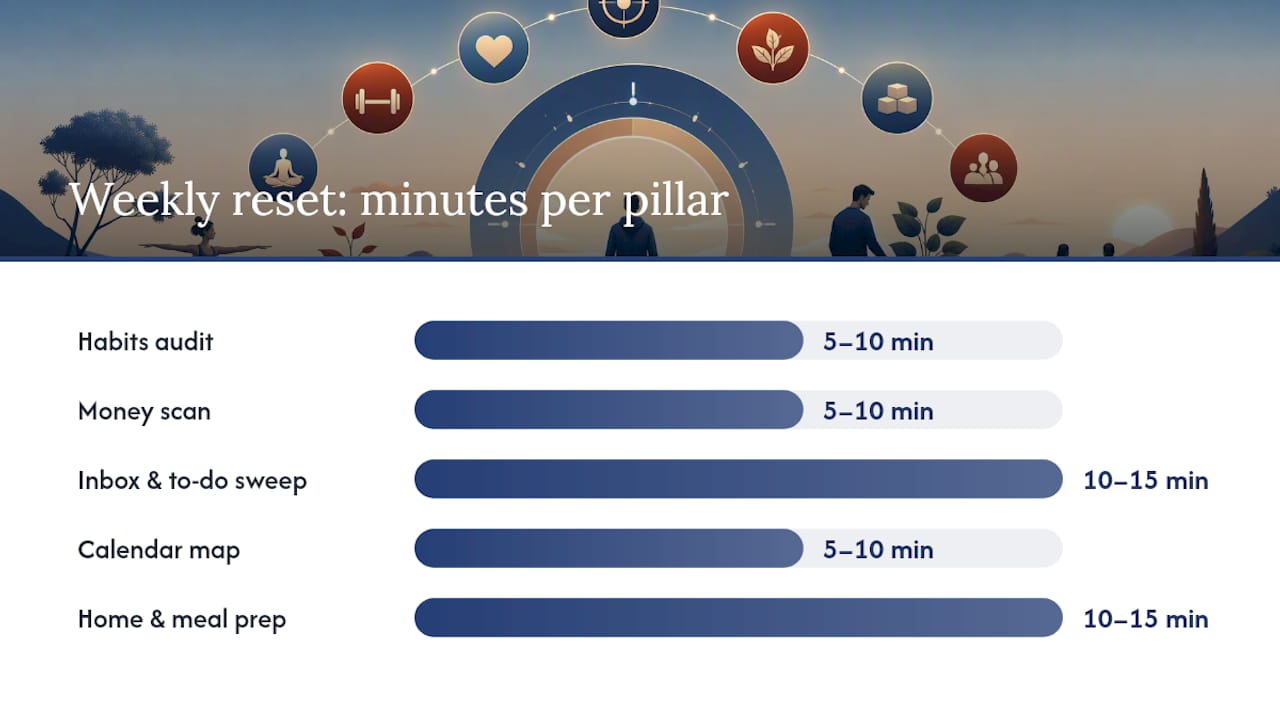
- Habits audit (5 to 10 minutes). Look back at the week. Mark finished items finished, note which habits slipped, and decide if any habit needs to shrink rather than disappear. A habit tracker makes this step almost automatic once you’ve used it for a few weeks.
- Money scan (5 to 10 minutes). Check your account balance, scan for any surprise charges, and glance at upcoming bills. This is often the pillar people skip, and it’s usually the one that prevents the slowest, most invisible kind of financial drift.
- Inbox and to-do sweep (10 to 15 minutes). Archive emails older than a week that don’t need action. For lingering to-dos, use three moves only: carry forward with a one-line note, resize into something smaller, or let it go entirely. Don’t rewrite your whole to-do list from scratch.
- Calendar map (5 to 10 minutes). Look at next week’s calendar block by block. Flag the two or three days that look overloaded now, while you still have time to move things around.
- Home and meal prep (10 to 15 minutes). A five-minute walk through the kitchen and living room to reset visible clutter, plus a rough meal plan for three or four dinners. You don’t need a full menu, just enough that Tuesday night doesn’t turn into a decision crisis.
- Quick self-care check (5 minutes). One line in a journal about how the week actually felt, plus one intention for the week ahead. This is the pillar most people cut first when rushed, and it’s the one that makes the reset feel less like admin and more like actually taking care of yourself.
If you only have 20 minutes: run the habits audit, the to-do sweep, and the calendar map. Skip money, home prep, and the self-care check, but don’t skip them two weeks running.
Pro Tip: Keep a standing note titled “This Week” open all week long. Every stray task, worry, or idea gets dumped into it the moment it appears, so your reset starts with a list instead of a blank page and a foggy memory.
Which Mindfulness Practices Actually Fit Into a Reset?
Short mindfulness exercises pair naturally with a weekly reset because both work on the same principle: small, consistent effort beats occasional intensity, as explained in mindfulness exercises for anxiety that actually work. Research from Harvard Health shows that brief practices like mindful breathing, walking, and eating can lower stress and sharpen focus in just a few minutes a day, with benefits building the more consistently you practice.
A few practices that slot directly into a reset:
- Mindful breathing. Take two or three slow breaths to settle, then continue for one to three minutes. Mayo Clinic recommends starting small and adding time gradually rather than forcing a long session from day one. Mindpanda’s breathing exercise guide and box breathing walkthrough both work well as two-minute openers before you start the checklist.
- Mindful walking. Five to ten minutes outside, paying attention to your feet hitting the ground and what you can hear around you, works as a reset transition between “week that just ended” and “week about to start.”
- Mindful eating cues. During your one weekend meal, put the phone away and actually notice flavor and texture for the first few bites. It’s a small practice, but it resets your relationship with rushing.
Pick one micro-practice, not all three, and use it as the hinge that opens your reset. Carry the same practice into weekday pockets, like the two minutes before a stressful meeting, and it stops being a Sunday-only ritual.
How Do You Make a Weekly Reset Stick?
Most resets fail from lack of structure, not lack of willpower. Habit stacking fixes this by tying the reset to something you already do without thinking. James Clear’s habit-stacking framework works especially well here: brew your coffee, then open your planner. Finish the laundry cycle, then do the calendar map. The existing habit becomes the trigger, so you stop relying on memory or motivation.
Buffer time matters just as much. Leave at least one hour unscheduled somewhere in your day when blocking next week’s priorities. That buffer absorbs the inevitable overrun and keeps one late meeting from wrecking your whole plan.
Common ways resets fall apart, and the fix:
- Doing the work instead of closing it. Don’t answer emails during your inbox sweep. Just decide what to do with each one.
- Tidying forever. Set a timer for the home prep pillar. When it rings, stop, even mid-shelf.
- Turning the reset into full planning. A reset stages the week; it doesn’t design your quarter. Save deeper planning for a separate, longer session.
Pro Tip: Attach your reset to a sensory cue, like a specific playlist or a favorite mug, so the ritual has a clear start signal even on weeks when your schedule is a mess.
A Realistic 30-Minute Sunday Reset
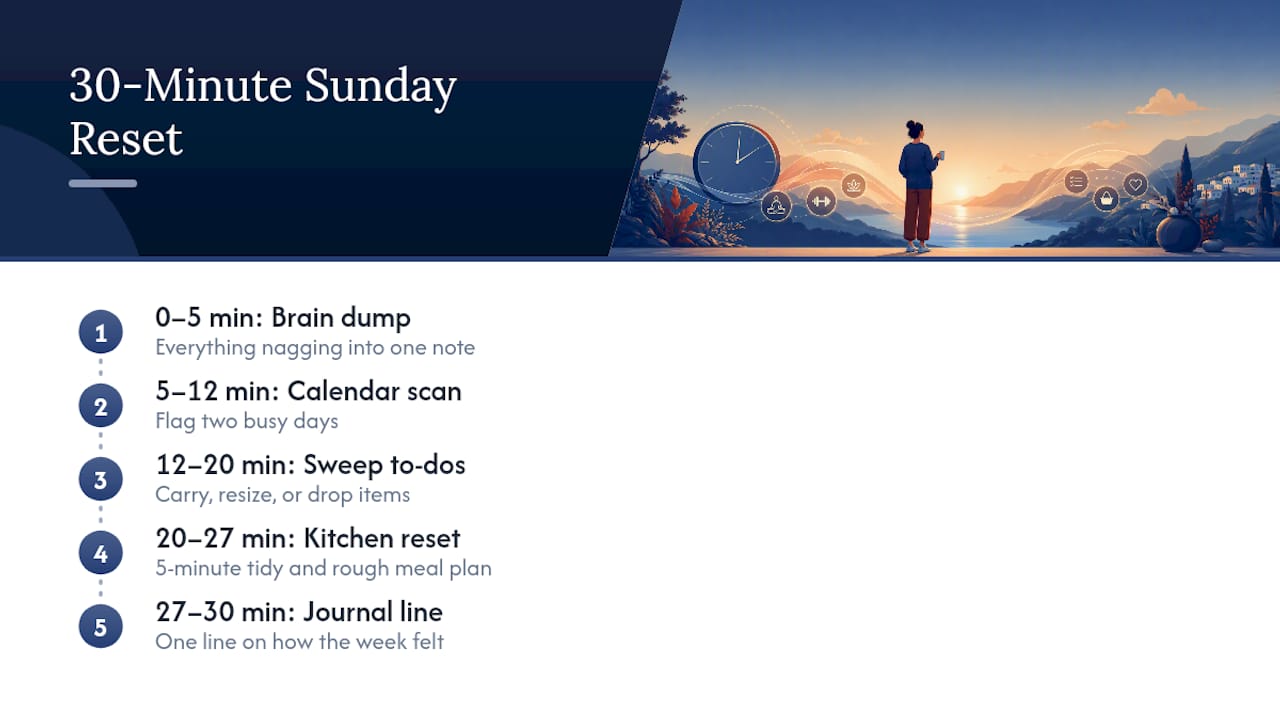
Here’s what a workable Sunday reset actually looks like: minutes 0 to 5, brain dump everything nagging at me into one note. Minutes 5 to 12, scan the calendar and flag two busy days. Minutes 12 to 20, sweep to-dos using carry, resize, or drop, nothing more elaborate. Minutes 20 to 27, a five-minute kitchen reset and rough meal plan. Minutes 27 to 30, one journal line on how the week felt.
With kids or shift work, I run the 10-minute version more often and save the full 30 minutes for whichever day actually stays quiet. Traveling weeks get the brain dump and calendar check only, nothing else, and that’s fine.
Tools That Take the Friction Out of Your Reset
A weekly reset works with nothing but a notebook and a timer, so don’t let a lack of gear stop you from starting tonight. That said, having a small, dedicated kit removes a real source of drop-off: the five seconds spent hunting for a pen or opening twelve apps before you even start your brain dump.

Mindpanda’s Mindfulness Wellbeing Bundle pairs a journal with grounding tools built for exactly this kind of short, repeatable ritual, so the reset becomes a physical habit with its own dedicated space rather than another browser tab. For readers who want the reflection and habit-tracking side covered specifically, the Thrive & Reflect journaling bundle handles the habits audit and self-care check in one object. If neither fits your exact routine, you can build your own bundle around whichever pillars you actually struggle to keep. Start with whichever piece addresses your weakest pillar first, not the whole kit at once.
Why Most People Get the Weekly Reset Wrong
The biggest mistake I see in how people talk about weekly resets is treating them as a productivity hack when they’re really a stress management tool wearing a productivity costume. The five to ten hours a structured reset can save you across the week matters, but it’s not the main reason to do one. The real payoff is smaller and less measurable: you stop carrying forty half-formed worries into Monday morning, because you already decided what to do with thirty-eight of them on Sunday.
The second mistake is treating consistency as an all-or-nothing switch. A reset you run for 10 minutes during a brutal week is not a failed reset. It’s the version that keeps the habit alive until you have a normal week again. People quit weekly resets not because the 60-minute version is too hard, but because they never gave themselves permission to run the 10-minute version when life demanded it. Build the flexibility in from day one, and the ritual survives long past whatever motivated you to start it.
— Ravi
Sources
- Mindfulness practices to reduce stress and improve focus — Harvard Health
- Mindfulness exercises — Mayo Clinic
- The weekly reset routine for habits, money, and to-dos — Evan Kristine
- Weekly reset: A simple 30-minute routine for the week — Asambl
- Habit stacking — James Clear