
Mindfulness for parents comes down to this: short daily practices, most under five minutes, reliably lower parental stress and change how you respond to your kids in hard moments. You don’t need a meditation cushion or a spare hour. You need a handful of essential self-care tips for parents seeking balance you can run while the toddler screams in the cereal aisle.
Five practices worth learning this week.
- 4-5-6 breathing — inhale for a few seconds, hold briefly, exhale slowly for a longer count. Approximately one minute.
- Five senses reset — name one thing you see, hear, feel, smell, taste. This quick exercise takes a minute or so.
- Brief body scan — unclench jaw, drop shoulders, soften hands in a quick, calming sequence.
- One-line self-compassion script — a brief phrase such as “This is hard, and I’m doing my best right now.”
- The STOP method — Stop, Take a breath, Observe, Proceed. Use it before you respond, not after.
Researchers at the University of Washington found that parents who practice mindfulness manage their own emotions better, and calmer parental responses help children settle faster during conflict.
Key Takeaways
Short, consistent mindfulness practices under five minutes long lower parental stress and directly improve how children behave and regulate in response.
| Point | Details |
|---|---|
| Start with one micro-practice | Pick 4-5-6 breathing or the five senses reset and use it daily before adding more. |
| Pair breath with brain science | A single deliberate breath shifts activity from the amygdala toward the prefrontal cortex. |
| Adapt activities by age | Use bubble breathing for toddlers, choice-based check-ins for school-age kids, and private modeling for teens. |
| Habit-stack, don’t schedule | Attach practices to routines you already do, like coffee brewing or bedtime lying-down. |
| Lead with self-compassion | Treat mistakes as repair opportunities, not proof of failure, to reduce reactive parenting. |
| Use a tactile anchor | Mindpanda’s stress balls and journaling bundles give quick practices a physical trigger that’s easier to keep up than an app alone. |
Table of Contents
- Why Mindfulness Helps Parents Manage Stress
- Quick Solo Practices for High-Stress Parenting Moments
- Mindfulness Activities to Do With Your Kids
- Building a Mindfulness Habit Without Finding Extra Time
- Self-Compassion Scripts That Change How You Respond
- Tools That Help These Practices Stick
- Setting Up a Home That Supports Mindfulness
- What Consistent Practice Does for Family Relationships Over Time
- Using Mindfulness in Everyday Decisions and Conversations
- The Gap Between Mindfulness Advice and What Parents Actually Need
- Where Mindpanda Fits Into Your Daily Practice
- Frequently Asked Questions
- Sources
Why Mindfulness Helps Parents Manage Stress
The mechanism is simpler than it sounds. When your kid melts down at 6:45 on a school morning, your amygdala fires before your thinking brain gets a vote. A single deliberate breath, paired with naming what’s happening out loud, pulls activity back toward the prefrontal cortex, the part of your brain that can actually choose a response instead of reacting on autopilot.
Clinical observation backs this up directly: taking one breath and naming the moment reduces amygdala reactivity and re-engages the prefrontal cortex, according to UW researchers, which is the neurological basis for why a five-second pause can change an entire interaction.
The child-outcome data is just as compelling. The Child Mind Institute reports that parents who learn mindful parenting techniques see improvements in their children’s behavior, not just their own mood. Parental stress transfers to kids directly; a calmer parent is a regulatory model a child’s nervous system borrows from.
That’s also why brief practices beat long ones for this specific population. A parent with two kids under six doesn’t have 20 minutes for seated meditation. What works instead:
- Micro-practices fit into existing transitions (car rides, diaper changes, the walk from car to front door).
- They don’t require privacy, special equipment, or advance planning.
- Consistency matters more than duration. A daily 60-second practice outperforms a weekly 30-minute one for stress reduction.
Quick Solo Practices for High-Stress Parenting Moments
These take under five minutes each, and most take under one. Learn the scripts now, before you need them.
-
4-5-6 breathing (60 seconds). Inhale through your nose for a count of 4. Hold for 5. Exhale slowly through your mouth for 6. Repeat four times. The extended exhale is what signals your nervous system to downshift.
-
Five senses grounding, the 5-4-3-2-1 version (90 seconds). Silently name 5 things you can see, 4 you can hear, 3 you can physically feel (the chair, your feet, your shirt collar), 2 you can smell, and 1 you can taste. ZERO TO THREE recommends this exact sequence as a fast reset during high-stress parenting moments, and it works because it forces your attention out of the spiral and into the room.
-
Mini body scan (30 to 60 seconds). Start at your jaw (unclench it), move to your shoulders (drop them), then your hands (uncurl your fists). Most parents carry tension in exactly these three spots without noticing.
-
The STOP method. Stop what you’re doing. Take one breath. Observe what you’re feeling and what your child needs. Proceed with a response instead of a reaction. This sequence is widely taught by mindfulness practitioners specifically for parenting flashpoints, and it works because it inserts a deliberate pause between trigger and response.
When to reach for which one: 4-5-6 breathing works well for the in-car meltdown, when you’re both belted in and going nowhere. Five senses grounding is better for 3 a.m. wake-ups, when your brain is too foggy for counting breaths. The body scan works standing in the kitchen while dinner burns. STOP is your go-to right before you respond to a teenager’s eye-roll or a toddler’s defiance.
Pro Tip: Pick one practice and attach it to something that already happens every single day, like buckling a car seat or waiting for the microwave. Repetition in the same context is what turns a technique into a reflex.
If anxiety is a bigger piece of your stress than everyday parenting friction, Mindpanda’s moments of calm activities for anxiety walks through additional grounding options built for that specific load.
Mindfulness Activities to Do With Your Kids
Practicing alongside your children teaches them regulation skills while you get your own reset. Age adaptation matters more than the exercise itself.
- Bubble breathing. Have your child imagine blowing a giant bubble without popping it: slow, steady exhale. Works for toddlers and preschoolers who respond to visual imagery better than instructions.
- Starfish breathing. Trace one finger up and down each point of a hand shaped like a starfish, inhaling on the way up and exhaling on the way down. Five points, five breath cycles.
- Glitter bottle. Shake a jar of water and glitter, then watch it settle together. A concrete, wordless way to show a toddler or preschooler what a calming mind looks like.
- Mindful freeze dance. Play music, dance, then freeze and notice one thing your body feels. School-age kids enjoy the game element more than the mindfulness label.
For school-age children, offer a choice and keep it brief, something like “Want to try a breathing thing for 30 seconds, or would you rather just tell me what’s wrong?” For teens, model the practice privately rather than announcing it, and ask permission before suggesting anything, since research on mindful parenting points to age-adapted framing as a major factor in whether kids actually engage.
- Introduce the practice as a game, never a correction (“let’s try something” beats “you need to calm down”).
- Do it with your child the first several times so it doesn’t feel like a punishment.
- Let them name the practice something silly. Kids stick with things they’ve claimed ownership of.
Mindpanda’s guide on teaching kids mindfulness and its collection of 15 age-adapted activities both expand on scripts for specific age bands if you want more material to draw from.
Building a Mindfulness Habit Without Finding Extra Time
Habit-stacking is the single most reliable trick here: attach a new, tiny practice to something you already do every day, so you’re not relying on willpower or memory to trigger it.
- Morning: one 4-5-6 breath while the coffee brews or the kettle heats.
- Mealtime: one gratitude sentence out loud before anyone eats, even a two-year-old’s “yay, pasta” counts.
- Bedtime: a 30-second body scan while you’re already lying down waiting for your kid to fall asleep.
Stanford Medicine Children’s Health recommends exactly this kind of habit-stacking, pairing a new mindful pause with an established routine so the existing habit becomes the reminder.
Guilt and exhaustion will still show up. You’ll skip days. That’s not failure, it’s the normal shape of habit-building with small kids in the house. If a set schedule keeps falling apart, drop the schedule and use sensory cues instead: the sound of the front door, the click of a seatbelt, the hiss of the microwave. Any repeated sound or motion can become your trigger.
Pro Tip: Don’t aim for a daily streak. Aim for “most days.” A parent who practices four days a week for a year beats one who tries for perfect daily practice and quits in February out of guilt.
Self-Compassion Scripts That Change How You Respond
Self-compassion is the part of mindful parenting most guides skip, and it’s arguably the part that matters most. Treating your own mistakes as repair opportunities rather than evidence of failure is what actually reduces the shame spiral that makes parents more reactive, not less, according to Verywell Mind’s reporting on self-compassion in parenting.
The hand-on-heart technique: place a palm on your chest, feel your own heartbeat, and say silently, “This is hard, and I’m doing my best right now.” It takes ten seconds and it works because physical touch triggers the same soothing response you’d offer a crying child.
- After snapping at your kid, try: “I got that wrong. Let me try again,” said out loud, in front of them.
- Replace “I’m a bad parent” with “That was a hard moment,” which separates the event from your identity.
- Notice the urge to over-apologize or spiral, and redirect it toward one concrete repair action instead.
The Child Mind Institute notes that parental stress is one of the largest single sources of stress in a child’s environment, which is exactly why modeling repair, rather than perfection, teaches kids more than a flawless parent ever could.
Tools That Help These Practices Stick
Abstract meditation apps work for some parents. Plenty of others do better with something they can hold. Tactile tools increase adherence for people who prefer doing something physical over sitting still with their eyes closed, and that’s a real distinction worth building your routine around.
- A journal gives your bedtime gratitude line and your self-compassion scripts a physical home, so the habit has a visible record instead of living only in your head.
- A stress ball works as an anchor for the five senses reset. Squeezing something textured while you name what you feel adds a physical cue your body remembers.
- A wellbeing bundle that pairs a few tools together removes the decision fatigue of figuring out what to buy first.
Twice-weekly check-ins with a simple tracker produce better long-term habit retention than meditation-only programs for busy caregivers. A journal you actually open twice a week beats a meditation app you download and never launch.
| Practice | Pairs well with |
|---|---|
| Bedtime body scan | A guided journal for a two-line nightly note |
| Five senses reset | A textured stress ball as a physical anchor |
| Weekly reflection | A structured planner with built-in prompts |
Setting Up a Home That Supports Mindfulness
You don’t need a dedicated meditation room. You need two or three physical cues scattered through the house that remind you to pause, plus a household tone that doesn’t treat a parent’s calm-down moment as weird or indulgent.
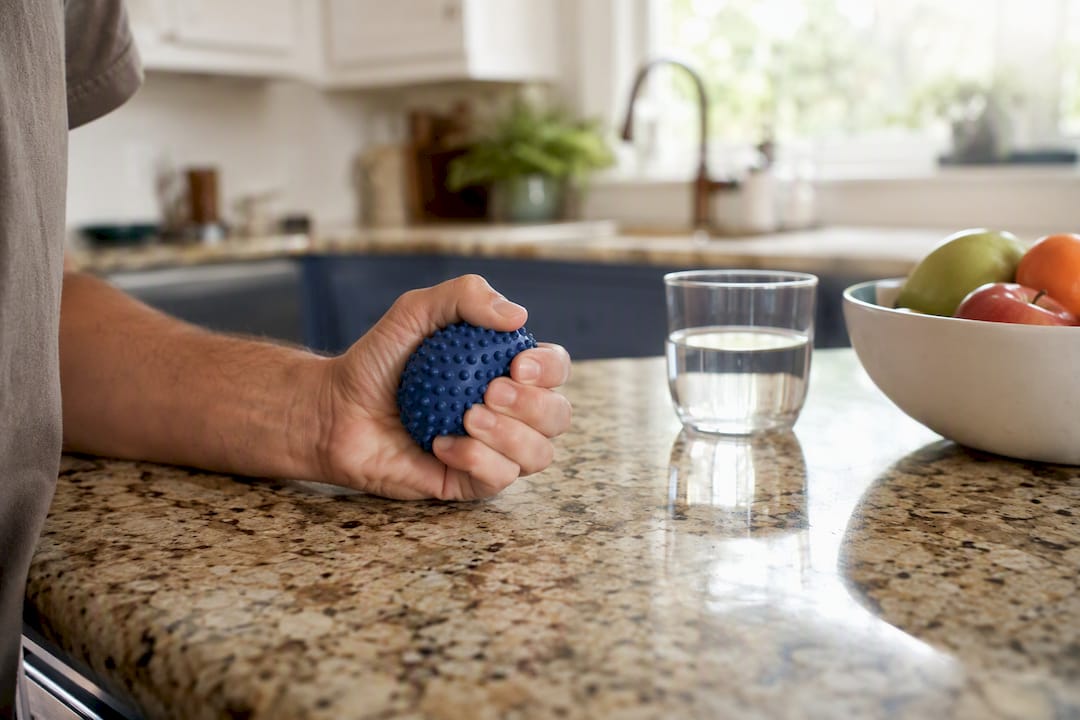
Pick one visible spot, maybe a specific chair or a corner of the kitchen counter, and keep a small object there: a journal, a stress ball, anything tactile. The object itself becomes a trigger; seeing it reminds you to use it, even on the days you’d otherwise forget.
Talk about pausing out loud, in front of your kids. Saying “I’m taking a breath before I answer that” normalizes the practice and models it at the same time. Kids who grow up watching a parent name and manage frustration learn to do the same thing themselves, often faster than they’d learn it from a lesson.
Reduce friction wherever you can. If a practice requires finding an app, remembering a password, and putting in earbuds, you’ll skip it on your worst days, which are exactly the days you need it most. A breathing technique that requires nothing but your own lungs, or a stress ball sitting on the counter, survives the days when everything else falls apart.
What Consistent Practice Does for Family Relationships Over Time
The daily payoff is calmer mornings. The long-term payoff is bigger: kids who watch a parent regulate consistently tend to develop stronger self-regulation themselves, and the parent-child relationship shifts from reactive to responsive over months, not days.
Mindful parenting interventions are associated with improvements in children’s self-regulation and reductions in behavioral problems, spanning social, academic, and behavioral domains, based on systematic review evidence on mindfulness interventions for children and parents. That’s not a one-off mood boost. It compounds.
Families that stick with these practices for months, not just weeks, report fewer escalating conflicts because both sides have a shared script (STOP, a breath, a pause) instead of two people reacting off each other’s stress in real time. The relationship stops being a series of unpredictable flashpoints and starts having a rhythm both people recognize.
Worth naming honestly: if adversity like trauma or financial strain is part of your household’s reality, short mindfulness practices still help, but they may work best paired with professional trauma-informed support rather than as a standalone fix, per the same PMC review. Mindfulness is a genuine tool. It isn’t a substitute for care your family actually needs.
Using Mindfulness in Everyday Decisions and Conversations
The same pause that stops a shouting match also improves harder calls: how to respond to a lie, whether to enforce a consequence, how to answer a question you don’t have a good answer to.
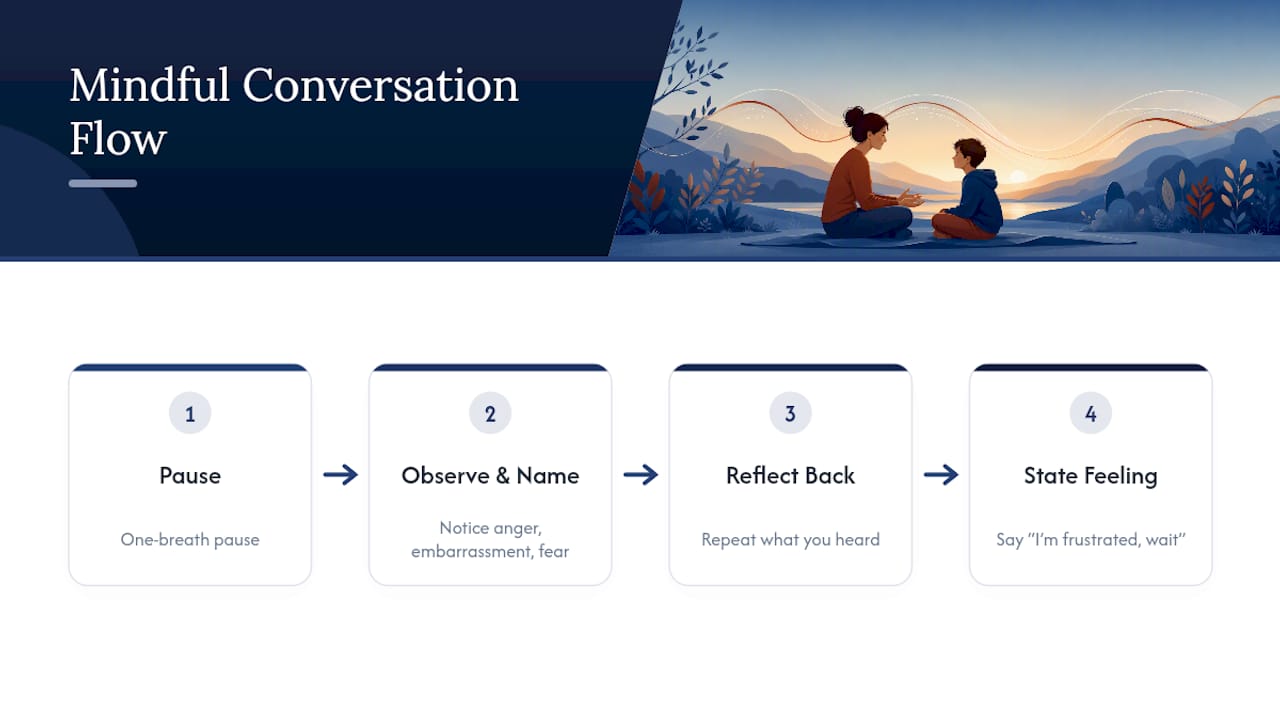
Before reacting to a big ask or a rule violation, run the STOP sequence silently: stop, breathe, observe what you actually feel (angry, embarrassed, scared), then decide. Decisions made from that second position tend to hold up better than the ones fired off in the first ten seconds of anger, and you’re less likely to hand out a consequence you’ll walk back later.
In conversation, mindfulness shows up as a communication habit more than a technique: pausing before responding to a teenager’s tone, reflecting back what you heard before defending your position, and naming your own emotional state out loud (“I’m frustrated, give me a second”) instead of letting it leak into your voice unannounced. None of that requires a special vocabulary. It requires the same one-breath pause you already practiced for the car-seat meltdown, applied to a harder conversation.
The Gap Between Mindfulness Advice and What Parents Actually Need
Most mindfulness content aimed at parents oversells the meditation-app model: 20-minute sessions, guided imagery, quiet rooms. That advice isn’t wrong, exactly. It’s just built for people without a toddler banging on the bathroom door.
What the research actually supports is smaller and less glamorous. A single breath. A ten-second hand on your chest. A five-senses check while you’re stuck in traffic with a screaming car seat behind you. These aren’t lesser versions of “real” mindfulness. They’re the versions that survive contact with an actual parenting schedule, and the evidence on brief practices backs that up directly.
The bigger blind spot in conventional advice is self-compassion. Most guides frontload breathing techniques and treat guilt over “failing” to meditate as a footnote. It should be the headline. A parent who skips three days and beats themselves up over it is doing more damage to their own regulation than the three skipped days ever did. Pick one practice, pair it with something you already do, and let go of the idea that consistency means perfection.
Where Mindpanda Fits Into Your Daily Practice
You’ve got the scripts. What most parents actually need next is something physical that keeps the habit from evaporating by Thursday. Mindpanda builds mindfulness products specifically for that gap between “I know the technique” and “I actually did it today.”

The Mindfulness Wellbeing Bundle pairs a tactile stress-relief tool with guided prompts, so your five senses reset and your bedtime body scan both have a physical anchor instead of relying on memory alone. If journaling fits your routine better than squeezing something, the Thrive & Reflect journaling bundle gives your one-line self-compassion script and gratitude sentence an actual page to land on, twice a week, which research on habit retention shows outperforms meditation-only approaches for busy caregivers. Prefer to mix and match your own combination of tools? The build-your-own wellbeing bundle lets you choose what pairs best with your household’s actual rhythm. Start with one tool, tied to one practice, and build from there.
Frequently Asked Questions
What is the fastest mindfulness practice for parents in a meltdown? The 4-5-6 breathing technique takes about 60 seconds: inhale for 4 counts, hold for 5, exhale for 6. It works in a car, a checkout line, or standing in a hallway.
Can mindfulness actually change my child’s behavior, not just my own mood? Yes. Mindful parenting interventions are linked to improved self-regulation and fewer behavioral problems in children, according to a systematic review of mindfulness interventions, because calmer parental responses give kids a regulatory model to copy.
How do I introduce mindfulness to my kids without it feeling forced? Frame it as a game, not a correction. Try bubble breathing or the glitter bottle for younger kids, and offer teens the choice to participate rather than announcing a family activity.
What if I keep forgetting to practice? Habit-stack instead of scheduling. Attach the practice to something automatic, like buckling a seatbelt or waiting for coffee to brew, so the existing routine becomes your reminder.
Is self-compassion really part of mindful parenting, or is that separate? It’s central. Treating a parenting mistake as a repair opportunity rather than a personal failing reduces the shame and reactivity that drive the next outburst, per Verywell Mind’s coverage of self-compassion.
Sources
- Mindfulness Practices for Children and Families | ZERO TO THREE
- Mindfulness and mindful parenting: Strategies for preschoolers with behavioral issues - PMC
- Learn Mindful Parenting Techniques - Child Mind Institute
- Practicing mindfulness benefits parents and children, UW study says