Use 3 to 5 specific items once or twice a week for the deepest impact, a short daily list of one or two lines when you need a quick mood lift, or an occasional letter to someone who mattered when you want the strongest emotional payoff. That’s the research in a nutshell, and it’s the backbone of every prompt below.
This article gives you themed, ready-to-use gratitude journal prompts organized by everyday moments, deeper reflection, relationships, health, and future goals, plus the exact methods (3-3-3, 3-2-1, weekly deep entries, gratitude letters) that research ties to real gains in life satisfaction and lower anxiety. Skip to whichever theme fits your mood today. There’s no wrong entry point.
Key Takeaways
Specific, people-focused gratitude entries, written 1 to 2 times a week for depth or daily in short-list form, produce measurable but modest gains in life satisfaction and lower anxiety.
| Point | Details |
|---|---|
| Start small | Pick one short daily prompt or one weekly reflective prompt rather than trying to do everything at once. |
| Match frequency to format | Use 3 to 5 detailed items once or twice a week, or a quick daily list for fast mood check-ins. |
| Letters carry extra weight | Save gratitude letters for once a month; they tend to produce the strongest single-session emotional gains. |
| Fight fatigue with specificity | Add sensory detail or try a subtraction prompt when entries start feeling repetitive or forced. |
| Expect modest, real gains | Research links gratitude journaling to small but reliable improvements in mental health and anxiety, not dramatic overnight change. |
| Consider a structured journal | The Mindpanda Gratitude Journal pairs daily short-list space with weekly deep-entry pages built around these exact methods. |
Table of Contents
- Quick Daily Gratitude Prompts for Fast Check-Ins
- Reflective Prompts for Deeper Journal Entries
- Prompts for Relationships and People You’re Grateful For
- Prompts for Health, Body, and Physical Wellbeing
- Prompts for Goals, Growth, and the Future
- How to Actually Use These Prompts
- Keeping Your Gratitude Practice From Going Stale
- The Research Behind Why Format and Frequency Matter
- What an Experienced Journaler Actually Does Day to Day
- A Ready-Made Way to Start: the Mindpanda Gratitude Journal
- Sources
Quick Daily Gratitude Prompts for Fast Check-Ins
Some days you have ninety seconds, not fifteen minutes. That’s fine. A short list still counts, and it still works. These are built to be copied straight into a notes app or the margin of a planner when you want a fast, low-friction check-in rather than a full session.
- Name one small thing that brightened your day.
- What made you smile without trying today?
- Which meal today tasted better than expected?
- What’s one text or call you were glad you got?
- Name a piece of good news you heard recently.
- What’s something in your home that made today easier?
- Which app, tool, or gadget saved you time today?
- What’s one thing your body did well today, even something small?
- Name a stranger’s small kindness you noticed.
- What weather or outdoor moment did you appreciate?
- Which coworker or classmate made your day less stressful?
- What song, show, or podcast lifted your mood?
- Name something you almost forgot you were grateful for.
- What’s one habit you’re glad you kept up this week?
- Which meal or snack felt like a small treat?
- What’s a memory from this week you’d want to relive?
- Name something that made you laugh out loud.
- What’s one problem that solved itself today?
- Which part of your morning routine went smoothly?
- What’s a comfort item (blanket, mug, chair) you used today?
- Name one thing about your neighborhood or city you like.
- What’s a skill you used today that you’re proud of?
- Which friend or family member crossed your mind fondly?
- What’s one thing you’re looking forward to tomorrow?
- Name a small win nobody else noticed but you.
- What’s a sound today that felt pleasant or calming?
- Which recent purchase turned out better than expected?
- What’s one thing about your body that worked without you thinking about it?
- Name a piece of advice you’re grateful you got.
- What’s something ordinary today that you’d miss if it were gone?
Pro Tip: Add one sensory detail to each line, the smell of coffee, the exact color of the sky, the sound of a specific laugh. Sensory language pulls your brain into the moment instead of just labeling it, which is why specificity keeps showing up as the single biggest lever in gratitude research from Greater Good in Action.
Reach for this format on rushed mornings, high-stress weeks, or whenever the idea of writing feels like one more chore. Save the longer prompts below for days when you actually have fifteen quiet minutes.
Reflective Prompts for Deeper Journal Entries
Short lists are useful, but they’re not where the biggest gains live. A randomized study comparing gratitude formats found that long-form writing, letters and short essays, produced stronger post-test improvements in elevation, positive affect, and life satisfaction than simple list-making. If you want gratitude journaling to actually move the needle on how you feel, these prompts are where to spend your time.
- Write a thank-you letter to someone who shaped who you are, even if you never send it.
- Describe a moment this year when you felt genuinely proud of yourself, in detail.
- Write about a hardship that, in hindsight, taught you something valuable.
- Describe your morning in full sensory detail: sounds, smells, temperature, light.
- Write a letter to your past self at a harder point in life.
- Reflect on a relationship that’s quietly gotten better over time. What changed?
- Describe a place that feels like home and why it holds that meaning.
- Write about a skill or ability you’ve built that you once lacked.
- Reflect on a mistake that ended up redirecting your life for the better.
- Describe someone who believed in you before you believed in yourself.
- Write about a piece of art, music, or writing that changed how you see something.
- Reflect on your health, not the ideal version, but what your body handles daily without complaint.
- Describe a routine or ritual that grounds you, and trace back how it started.
- Write about a risk you took that paid off, even in a small way.
- Reflect on the version of your life you have now versus the one you imagined years ago.
Give these prompts five to fifteen minutes, not thirty seconds. Once a week is a realistic, sustainable cadence for this depth of writing, since forcing it daily tends to flatten the reflection into rote phrasing.
Pro Tip: If a prompt makes you tear up or pause mid-sentence, stay there. That resistance is usually where the real insight lives, not a sign to move to an easier line.
Prompts for Relationships and People You’re Grateful For
Gratitude aimed at people tends to hit differently than gratitude aimed at things or circumstances. It’s more specific, more personal, and often more motivating to actually act on.
- Who showed up for you recently in a way you didn’t expect?
- Name someone whose humor makes hard days easier.
- Who taught you something you still use regularly?
- Describe a friend who has stayed consistent through changes in your life.
- Who gave you honest feedback that helped you grow, even if it stung?
- Name someone who believes in your goals more than you sometimes do.
- Who makes you feel like you can be fully yourself?
- Describe a family member whose quirks you’ve come to appreciate.
- Who has quietly supported you without asking for credit?
- Name a mentor, teacher, or boss who shaped your work ethic.
- Who introduced you to something that became important to you?
- Describe a person whose patience with you you’ve come to value.
- Who checks in on you even when life gets busy?
- Name someone from your past you’d thank if given the chance.
- Who makes ordinary days feel less ordinary just by being there?
If a prompt surfaces someone specific and present in your life, consider turning it into an actual message. You don’t need a full letter, a two-line text naming exactly what they did works. Social gratitude letters do increase warmth and connection, though the same research on gratitude formats notes they can also stir up feelings of indebtedness in the recipient. Following up with a small, genuine “no need to do anything back” note tends to soften that.
Pro Tip: Name the specific action, not just the person. “Thanks for being great” fades fast. “Thanks for driving across town at 11pm when my car wouldn’t start” sticks, for both of you.
Prompts for Health, Body, and Physical Wellbeing
Gratitude around health works best when it’s grounded in what your body actually does, not an idealized version of wellness you’re chasing.
- What’s one thing your body accomplished today without you noticing?
- Name a physical sensation today that felt good, warmth, rest, movement.
- What’s a meal that nourished you well today?
- Describe a moment of physical comfort you experienced recently.
- What’s one way your senses (sight, smell, taste, touch, hearing) served you well today?
- Name something about your energy level today that you’re grateful for.
- What’s a small physical capability you sometimes take for granted?
- Describe a moment of rest or sleep that helped you recover.
- What’s a form of movement, even a short walk, that felt good today?
- Name a health habit you’ve kept up, even imperfectly.
- What’s something your body has healed from that you’re grateful for?
- Describe a tool, device, or aid that makes daily physical life easier.
If you’re managing chronic illness, a flare, or a genuinely low-energy stretch, don’t force gratitude toward an idealized standard of health. Adapt the prompt down to something reachable: a moment of comfort, a reliable medication or device, five minutes without pain, a chair that supports your back. Small and true beats big and forced every time.
Pro Tip: Keep a running list of “small wins” separate from your main entries, a bad-flare day, a manageable pain day, a good-sleep night. Reviewing that list over weeks builds concrete evidence that things do shift, which supports both mood and motivation on the hard days.

Prompts for Goals, Growth, and the Future
Gratitude isn’t only backward-looking. Pointed at your goals, it becomes fuel instead of nostalgia.
- What progress have you made this month that you haven’t given yourself credit for?
- Name a skill you’re building that you’re grateful to be developing.
- What opportunity in front of you are you thankful to have?
- Describe a goal that excites you more than it stresses you.
- What resource (time, money, knowledge, support) are you grateful to have access to right now?
- Name a past version of yourself whose effort you’re benefiting from today.
- What’s one thing you’re closer to achieving than you were a year ago?
- Describe a future you’re genuinely looking forward to building.
- What risk are you glad you’re in a position to take?
- Name a person or program supporting your growth right now.
- What’s a lesson from failure that’s now paying off?
- Describe one thing about your current path that feels aligned with who you want to become.
The move that makes this section actually useful: turn one gratitude line into a single next action. If you wrote “I’m grateful for the progress I’ve made learning to cook,” the linked action might be “try one new recipe this weekend.” Gratitude names the momentum you already have; the action step is what keeps it moving. Pairing journaling with other personal growth habits, like the daily techniques covered in Mindpanda’s guide to personal growth practices, tends to reinforce both.
Pro Tip: End future-focused entries with one sentence starting “Next, I will…” Gratitude without a linked action can stay passive. One small step converts it into forward motion.
How to Actually Use These Prompts
Picking prompts is the easy part. Sticking with a method long enough to feel a difference is where most people drop off. Here are four approaches worth trying, each backed by different research on format and frequency.
- Weekly deep entry. Pick one reflective or relationship prompt. Write for 5 to 15 minutes, once a week. This matches the format that Greater Good in Action’s gratitude journal guidance frames around writing up to five items with real depth and specificity, and it protects against the fatigue that daily deep writing can cause.
- Daily short list (3-3-3 method). Write three things you’re grateful for, name three reasons you’re in a good mood, or note three good things that happened, in three sentences or fewer. Keep it under two minutes.
- The 3-2-1 method. Three things you’re grateful for, two things you accomplished, one thing you’re looking forward to. It blends gratitude with a small forward-looking nudge, useful on days when gratitude alone feels flat.
- A gratitude letter, monthly. Once a month, pick one relationship prompt and expand it into a full letter. You don’t have to send it. Research comparing formats found letters produced some of the strongest post-test gains in positive affect of any format tested.
| Method | Format | Frequency | Best for |
|---|---|---|---|
| Weekly deep entry | 3 to 5 detailed items | 1 to 2x per week | Sustainable long-term reflection |
| Daily short list (3-3-3) | Quick 3-line entry | Daily | Fast mood check-ins, busy weeks |
| 3-2-1 method | Gratitude + wins + anticipation | Daily or every other day | Combining reflection with motivation |
| Gratitude letter | Full letter or essay | Monthly | Strongest single-session emotional impact |
The evidence backing all of this isn’t marginal, but it isn’t magic either. A meta-analysis of 64 randomized controlled trials found gratitude interventions produced a 6.86% increase in life satisfaction, a 5.8% improvement in general mental health, a 7.76% reduction in anxiety symptoms, and a 6.89% reduction in depression symptoms. Small, reliable gains, not a cure, but consistent enough across dozens of trials to take seriously. A separate study during the COVID-19 pandemic found that participants assigned to gratitude writing maintained or increased their gratitude levels and showed reduced negative affect at one-month follow-up compared with expressive writing or no intervention at all, suggesting it holds up even during genuinely stressful stretches.
For a starting schedule, plan on 2 to 10 weeks of consistent practice using whichever method you picked above, then reassess. Most of the studies behind these numbers ran interventions in that window. If you notice you’re phoning it in by week three, that’s your cue to switch formats, not to quit.
Keeping Your Gratitude Practice From Going Stale
Gratitude fatigue is the most common reason people quit. You start strong, then by week two you’re writing “grateful for my family” for the fourth time and it feels hollow. Here’s how to head that off.
- Problem: entries feel repetitive. Fix: switch from daily short lists to a weekly deep entry. Less frequency, more specificity, per research and practical guidance from Robert Emmons, tends to outperform daily shallow entries on lasting benefit.
- Problem: journaling feels like an obligation. Fix: skip a day without guilt. Gratitude approached with curiosity beats gratitude forced out of duty, and a missed day doesn’t undo previous entries.
- Problem: you’re stuck writing the same three things. Fix: try a subtraction prompt, “what would today have been like without X?”, instead of a straightforward gratitude prompt. It forces a different angle.
- Problem: entries feel vague and unmemorable. Fix: add one sensory detail per entry. Specificity is the single biggest lever across nearly every study on this topic.
- Problem: you forget to journal entirely. Fix: pair it with an existing habit, right after morning coffee or a short meditation, so it rides on a routine you already have.
- Problem: hard days make gratitude feel fake. Fix: lower the bar. “I’m grateful the pain was manageable enough to get through the afternoon” is a legitimate entry. Idealized gratitude isn’t the goal; honest gratitude is.
A simple micro-habit checklist helps more than willpower does: keep the journal somewhere visible, pick one fixed trigger (after breakfast, before bed), and give yourself permission to write one line instead of none on rough days.
Pro Tip: When a prompt feels stale, flip it into a subtraction question. Instead of “what am I grateful for today,” ask “what would be missing if this good thing disappeared.” It’s the same gratitude, viewed from an angle your brain hasn’t gotten bored of yet.
The Research Behind Why Format and Frequency Matter
The differences between short lists, deep weekly entries, and letters aren’t stylistic preferences, they show up in outcome data.
| Format | Typical session length | Best-supported outcome |
|---|---|---|
| Short daily list | Under 2 minutes | Quick mood lift, low barrier to consistency |
| Weekly deep entry (3 to 5 items) | 5 to 15 minutes | Sustained gains without fatigue |
| Gratitude letter (monthly) | 15 minutes | Strongest single-session boost in positive affect |
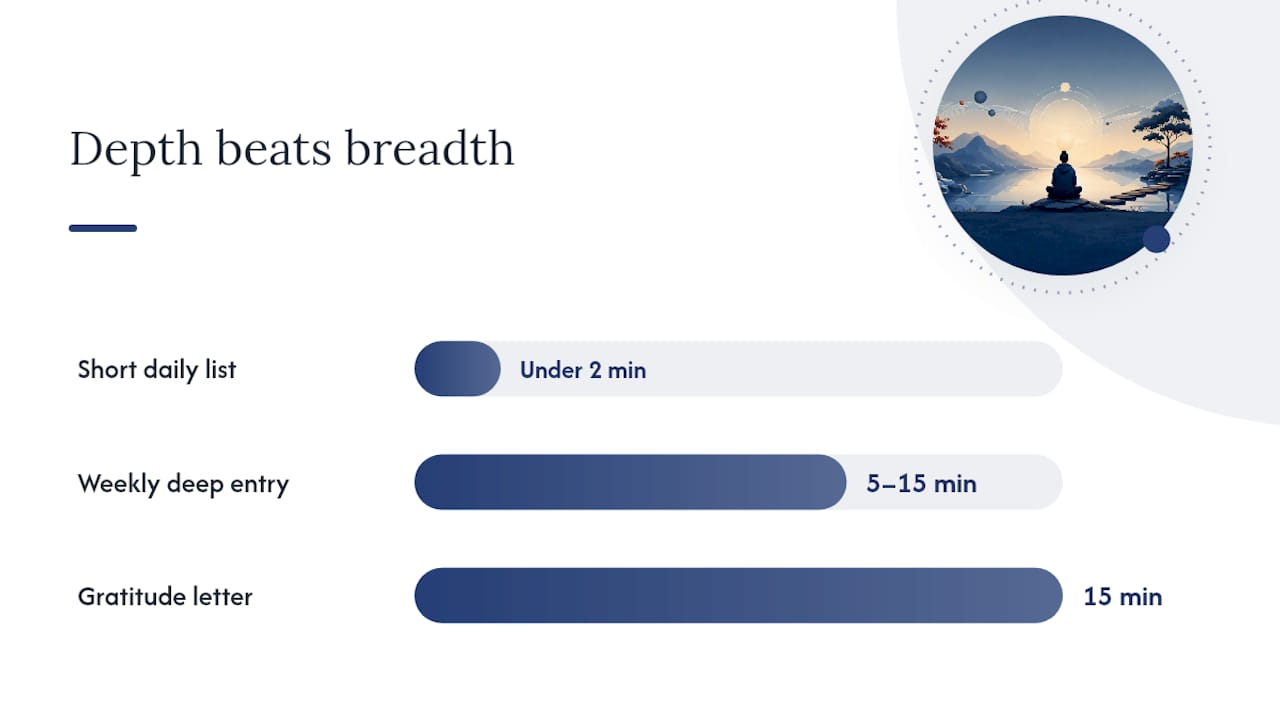
The pattern across the meta-analysis of gratitude interventions and the format-comparison study on letters versus lists points to the same conclusion from two different angles: depth generally beats breadth. Writing about one or two things with real detail seems to move the needle more than skimming through five shallow lines. That’s counterintuitive if you assume more gratitude equals more benefit, but the research suggests quality of attention matters more than quantity of items.
Social gratitude, prompts about people, carries its own wrinkle. It tends to boost feelings of connectedness and elevation more than gratitude aimed at circumstances or objects. But because it involves another person, it can also stir up indebtedness, especially if you share the entry directly. That’s not a reason to avoid relationship prompts. It’s a reason to pair them with a low-pressure follow-up (“no need to respond, just wanted you to know”) when you do choose to share.
If you want to go deeper into the primary research, the meta-analysis, the format-comparison study, and Greater Good in Action’s practice guide are the three most useful starting points, all linked throughout this article and again in the sources list below.
What an Experienced Journaler Actually Does Day to Day
The honest version of a sustainable gratitude practice doesn’t look like a perfectly filled-in journal every single morning. It looks more like a rotation: short lists on busy weekday mornings, one longer reflective entry on a Sunday, and a letter maybe once a month when someone specific comes to mind.
On hard days, the prompts change shape rather than disappear. A rough week doesn’t call for “what are you grateful for,” it calls for something smaller and more honest, “what got you through today.” That’s still gratitude. It’s just gratitude sized to match the day instead of an idealized version of it.
A workable weekly shape looks like this: a 3-3-3 entry most mornings, one deep reflective prompt on a quiet evening, and permission to skip entirely on the days that call for it. The connection between short daily practices and broader wellbeing habits tends to reinforce itself. Journaling gets easier once it’s sitting next to other small, consistent self-care habits instead of standing alone as one more task on the list.
Imperfect practice still counts. Missing three days and coming back with one honest line beats forcing a perfect streak that eventually collapses under its own pressure.
A Ready-Made Way to Start: the Mindpanda Gratitude Journal
If building your own system from scratch feels like one more thing to figure out, the Mindpanda Gratitude Journal is built directly around the methods covered above, so you don’t have to design the structure yourself.
It’s laid out with space for both formats the research favors: a quick daily check-in section for your 3-3-3 or short list entries, and dedicated weekly pages with more room for the deeper, five-item reflective prompts that tend to produce the strongest lasting gains. The durable binding matters more than it sounds, a journal that survives daily handling is a journal you’ll actually keep reaching for instead of retiring after a month. Pair it with one of the Mindpanda stress ball sets for a quick physical reset before you sit down to write, or explore the full Mindfulness Wellbeing Bundle if you want the journal alongside other tools built for the same daily practice. Check out the journal on the Mindpanda site and see which format fits your week.
Sources
- Gratitude interventions: Systematic review and meta-analysis (PMC10393216)
- Are Some Ways of Expressing Gratitude More Beneficial Than Others? Results From a Randomized Controlled Experiment | Affective Science
- Gratitude Journal | Greater Good in Action
- Gratitude writing versus expressive writing during the COVID-19 pandemic (PMC8867461)
- Robert Emmons (faculty page) — research and resources on gratitude