Box breathing is a four-part breath cycle, typically performed on a 4-4-4-4 count, that you can use anywhere to calm your nervous system and sharpen your focus. According to the Cleveland Clinic, each step lasts four seconds: inhale, hold, exhale, hold. That’s one cycle. Here’s how to try it right now:
- Empty your lungs fully through your mouth.
- Inhale through your nose for a slow count of 4.
- Hold your breath for 4 counts.
- Exhale slowly through your mouth for 4 counts.
- Hold again for 4 counts before your next inhale.
That’s one complete cycle. Most people feel a noticeable shift in tension within two or three rounds.
Pro Tip: Place one hand flat on your belly before you start. If your hand rises on the inhale, you’re breathing diaphragmatically, which is exactly what you want. If only your chest moves, consciously push your belly out first.
Key Takeaways
Box breathing works by engaging the parasympathetic nervous system through four equal breath phases, and daily practice builds a stress-response that activates automatically when you need it most.
| Point | Details |
|---|---|
| The core cycle | Inhale, hold, exhale, hold, each for 4 counts; repeat 3–4 rounds per session. |
| Modify if needed | Beginners can use 2-2-2-2 or 3-3-3-3 counts; evenness matters more than duration. |
| Practice when calm | Train the rhythm daily during low-stress moments so it works automatically under pressure. |
| Medical caution | Those with heart conditions, COPD, or pregnancy should consult a clinician before adding breath holds. |
| Mindpanda support | The Mindfulness Wellbeing Bundle pairs tactile stress tools and a habit journal to reinforce daily practice. |
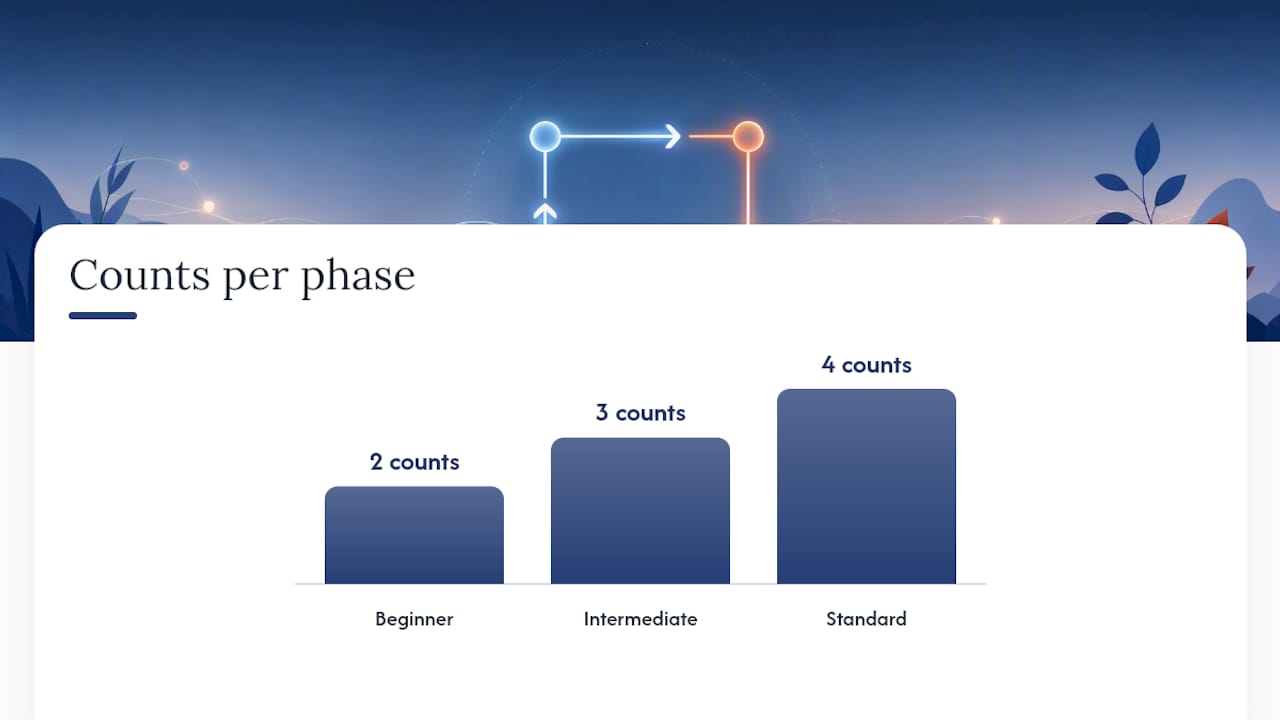
Table of Contents
- What is the box breathing technique, exactly?
- How to do box breathing: posture, mechanics, and a full guided cycle
- How long should you practice, and what do sample routines look like?
- What are the real benefits of box breathing?
- What if the counts feel too hard?
- Practical tips to make box breathing a daily habit
- Why box breathing works better than most people expect
- Mindpanda tools that support your breathing practice
- Sources
What is the box breathing technique, exactly?
Box breathing, also called square breathing or four-square breathing, is a regulated breathing method built on four equal phases: inhale, hold, exhale, hold. The “box” is a visual metaphor, one side per phase, which makes the rhythm easy to track mentally without a timer. Its Sanskrit name, sama vritti pranayama, translates roughly to “equal fluctuation breath,” which captures the core idea: every phase gets the same count.
The technique has roots in yogic pranayama practice and has been adopted well beyond yoga studios. Cleveland Clinic notes that it’s used by athletes, military personnel, and high-performance professionals to regulate attention and manage stress under pressure. The appeal is straightforward: no equipment, no special setting, and the mechanics are simple enough to learn in under five minutes.
How to do box breathing: posture, mechanics, and a full guided cycle
Getting the posture right matters more than most guides admit. Shallow chest breathing limits the technique’s calming effect, so the physical setup comes first.
Setting up your posture
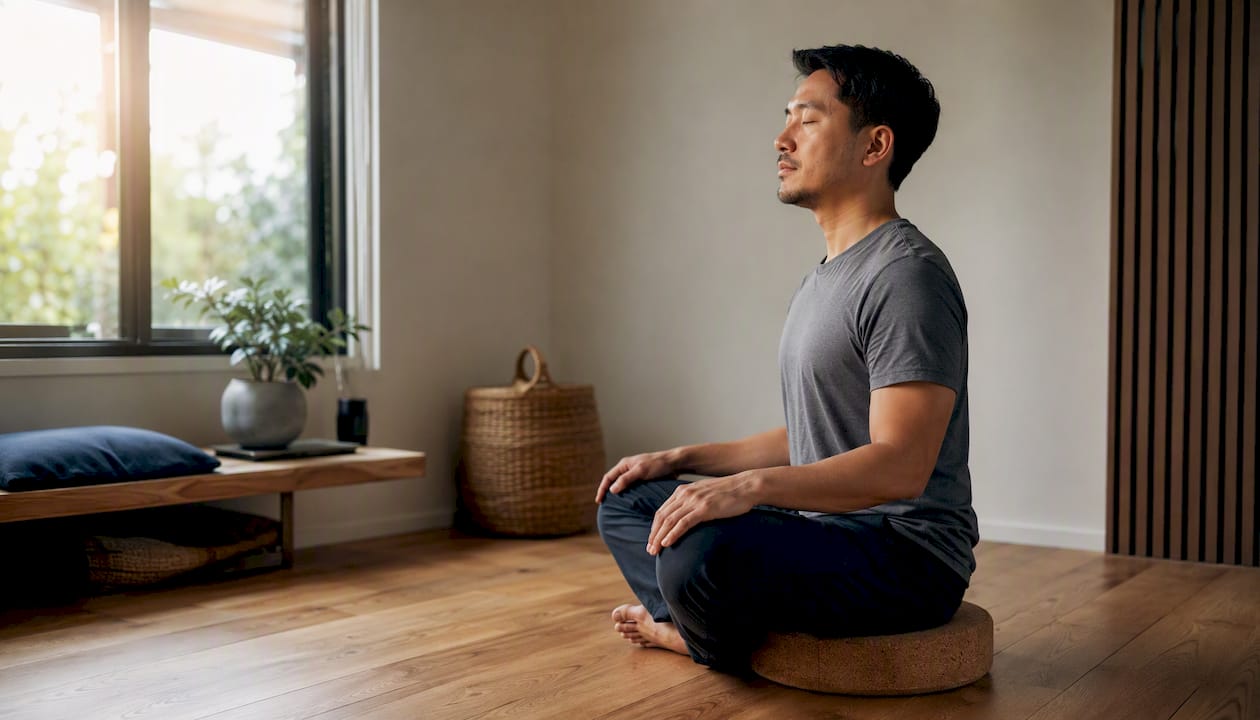
WebMD recommends sitting with your back supported, feet flat on the floor, and shoulders relaxed away from your ears. If you’re lying down, keep your knees slightly bent. Place one hand on your abdomen, just below your ribcage. This hand placement lets you feel whether your diaphragm is doing the work.
The full 4-4-4-4 cycle, step by step
- Empty your lungs completely. Exhale all the air out through your mouth before you begin. Starting from empty gives the inhale more room.
- Inhale through your nose for 4 counts. Breathe slowly and steadily, letting your belly expand first, then your chest. Count: 1, 2, 3, 4.
- Hold for 4 counts. Keep your throat and chest relaxed. Don’t clamp down; just pause the breath gently. Count: 1, 2, 3, 4.
- Exhale through your mouth for 4 counts. Let the air out evenly, belly falling first. Count: 1, 2, 3, 4.
- Hold for 4 counts. Lungs empty, body still. Count: 1, 2, 3, 4.
- Repeat. Begin the next inhale immediately after the final hold.
You can follow this script silently or whisper the counts. Three to four cycles is a solid starting point for a single session.
Safety note: If you feel lightheaded at any point, stop the holds and return to normal breathing. Lightheadedness usually means you’re either breathing too fast or holding too forcefully. Slow down, drop the holds, and resume when you feel steady.
Pro Tip: Try counting with a slow internal voice rather than rushing through the numbers. The pace of your count sets the pace of your breath, so a hurried count defeats the purpose.
How long should you practice, and what do sample routines look like?
The Cleveland Clinic suggests starting with 3–4 rounds per session as a minimum. From there, you build based on comfort and available time. The article suggests a few routines with varying rounds and durations tailored to different situations without specifying exact counts or times. These include quick resets for mid-task stress, short daily practices, and preparation before performances.
Frequency matters more than session length, especially early on. Mayo Clinic recommends integrating breathwork into daily routines so the body builds a reliable response. Practicing once or twice a day during calm moments trains the nervous system to access the technique automatically when stress hits. Think of it as rehearsal, not therapy.
Pro Tip: Don’t debut this technique in the middle of a panic attack. Practice it first when you’re calm, at your desk or before bed, so the rhythm becomes automatic. Then it’s available when you actually need it.
What are the real benefits of box breathing?
The core benefit is parasympathetic activation, which is the body’s “rest and digest” response. Controlled breathing at a slow, even pace signals safety to the nervous system, which lowers heart rate, reduces the physical sensation of anxiety, and brings attention back into focus. Mayo Clinic’s guidance on relaxation techniques confirms that breath control can help quell the stress response by engaging this system directly.
Key benefits tied to the physiology:
- Lower heart rate during and after practice, reducing the physical intensity of stress.
- Reduced cortisol response over time with consistent daily practice.
- Improved focus and attention by interrupting the mental chatter that accompanies anxiety.
- Portable stress relief with no equipment required, as Healthline notes, making it practical at a desk, in a car, or before a difficult conversation.
How does box breathing compare to similar techniques?
| Technique | Ratio | Primary Target | Ease for Beginners |
|---|---|---|---|
| Box breathing | 4-4-4-4 | Stress, focus, acute calm | High |
| 4-7-8 breathing | 4-7-8 | Deep relaxation, sleep | Moderate |
| Basic diaphragmatic breathing | No holds | Anxiety, general relaxation | Very high |
Box breathing uses equal counts across all four phases, which contrasts with the 4-7-8 method’s intentionally extended exhale. The 4-7-8 technique leans harder toward sleep and deep relaxation; box breathing is more versatile for daytime use and focus. Basic diaphragmatic breathing, with no holds at all, is the gentlest entry point for anyone who finds breath-holding uncomfortable.
What if the counts feel too hard?
The 4-second count is a guideline, not a medical requirement. NCBI clinical guidance recommends that beginners reduce counts to 2–2–2–2 or 3–3–3–3 and focus on keeping the phases even rather than hitting a specific duration. Evenness is the mechanism; the absolute count is secondary.
Common difficulties and their fixes:
- Breath holds feel uncomfortable: Drop the holds entirely and practice inhale-exhale only until the rhythm feels natural, then reintroduce holds one at a time.
- Chest-only breathing: Slow down and consciously push your belly out on the inhale. If it helps, lie flat on your back, which makes diaphragmatic movement easier to feel.
- Lightheadedness: Stop immediately, breathe normally, and check that you’re not breathing too fast or holding too tightly. Resume at a shorter count.
- Anxiety about holding the breath: This is common. Start with a 1-count hold and build gradually over days.
Who should check with a clinician first?
The NHS advises that people with severe heart conditions, COPD, or other serious respiratory conditions should consult a healthcare provider before starting new breathwork. The same applies during pregnancy. If you have any of these conditions, a clinician can confirm whether breath-holding phases are appropriate for you or suggest a modified version.
Pro Tip: If you’re managing a respiratory condition and want to try breathwork, start with simple diaphragmatic breathing (no holds) and bring it up with your doctor at your next visit. Most providers are supportive once they understand what you’re doing.
Practical tips to make box breathing a daily habit
The technique only works if you actually use it, which means building a cue before the habit sticks.
- Stack it onto an existing routine. Before your first meeting of the day, after you open your email, or right before bed are all reliable anchor points. You don’t need a dedicated session; three rounds before a Zoom call counts.
- Use it discreetly in public. No one can tell you’re doing box breathing. You can practice it at your desk, in a waiting room, or on public transit without any visible cues.
- Start with 1–2 sessions daily for the first week, then add an as-needed round whenever stress spikes. Consistency over the first seven days builds the muscle memory that makes it useful under pressure.
- Track it simply. A brief note in a journal (“did 4 rounds before the 9 AM call, felt calmer”) takes ten seconds and builds awareness of when and where it helps most.
- Lengthen counts gradually. Once 4-4-4-4 feels easy and natural, try 5-5-5-5. Never jump counts; add one second at a time and only when the current count feels effortless.
For more breathing exercises that pair well with this routine, Mindpanda’s guide covers a range of methods from simple breath focus to diaphragmatic techniques.
Why box breathing works better than most people expect
There’s a gap between how box breathing gets described and what actually makes it effective. Most articles frame it as a relaxation tool, which is accurate but undersells the mechanism. The holds are the part that matters most, and they’re also the part people most want to skip.
The pause after the inhale and the pause after the exhale are where the nervous system recalibrates. Holding after a full inhale creates a brief moment of pressure that signals the vagus nerve. Holding after a full exhale, lungs empty, is the more powerful of the two: it mimics the physiological state just before sleep, when the body is at its most parasympathetically dominant. Most relaxation breathing skips this second hold entirely.
The other underrated element is the count itself. Counting occupies the prefrontal cortex just enough to interrupt anxious rumination without demanding real cognitive effort. You can’t spiral into a worry loop while you’re tracking 1, 2, 3, 4. That’s not a side effect; it’s part of why the technique works so reliably for acute stress.
The mistake most beginners make is treating it as a one-time fix. A single session helps. A week of daily practice changes how your nervous system responds to stress by default. That’s the actual payoff, and it’s worth the five minutes.
Mindpanda tools that support your breathing practice
Box breathing needs nothing but your breath. But a few small physical anchors can make the habit stick faster, especially in the first week when the routine is still new.

A tactile stress ball gives your hands something to do during holds, which helps some people stay present instead of fidgeting. A short habit journal, used for just a line or two after each session, builds the awareness of when and where the technique helps most. Mindpanda’s Mindfulness Wellbeing Bundle pairs these kinds of supports in one place, including stress-relief tools and a journal designed for short daily use. If you’d rather pick exactly what fits your routine, you can build your own bundle from Mindpanda’s range. Browse the options and add the pieces that match how you actually practice.
Sources
The claims in this article draw from the following authoritative sources. Each is worth bookmarking if you want to read deeper.
Cleveland Clinic covers the standard 4-4-4-4 cycle, its origins in military and athletic use, and expert commentary on why simplicity is the technique’s strength. Box Breathing Benefits and Techniques
WebMD provides step-by-step posture cues and practical getting-started advice for diaphragmatic breathing. Box Breathing: How to Do It, Benefits and Tips
Healthline summarizes benefits and safety notes and highlights the technique’s portability for everyday stress management. Box Breathing: How to, Benefits, and Tips
Mayo Clinic explains how controlled breathing supports parasympathetic activation and recommends daily breathwork integration. Relaxation techniques: Breath control helps quell errant stress response
NHS offers practical breathing exercises and clear cautions for people with medical conditions who want to start breathwork safely. Breathing exercises for stress
NCBI Bookshelf provides clinical-style guidance on step modifications and recommends shorter counts for beginners to avoid hyperventilation. Box breathing guidance
This article is general information, not a substitute for advice from a qualified doctor. Consult a qualified healthcare professional about your own circumstances before acting on anything here.
- Box Breathing Benefits and Techniques
- Box Breathing: Getting Started with Box Breathing, How to Do It, Benefits and Tips
- Box Breathing: How to, Benefits, and Tips - Healthline
- Relaxation techniques: Breath control helps quell errant stress response - Mayo Clinic
- Box breathing guidance (NCBI Bookshelf)