Affirmations can help calm anxiety in the moment and build long-term resilience when they are believable and practiced regularly. For a sudden spike, use short, sensory phrases like “My feet are on the floor, I am breathing slowly.” For ongoing anxiety, daily compassionate statements build steadier footing over weeks. Neither replaces therapy or medication when anxiety is severe or persistent.
TL;DR:
- Affirmations are most effective when they are believable, specific, and paired with physical anchors like breathing or grounding techniques.
- Repetition of present-tense, personal statements helps reorient attention away from catastrophic thoughts, especially when integrated into daily routines.
- Affirmations work best as a complement to therapy and medication, and may backfire if they feel false or increase feelings of distress.
- Using short, physical routines for immediate anxiety and longer, self-compassionate phrases for daily resilience increases the likelihood of habit formation.
- A small, consistent ritual with tangible tools like journals and stress balls can improve long-term use and effectiveness of affirmations.
Table of Contents
- What Positive Affirmations Are and How They Work for Anxiety
- Do Affirmations Work for Anxiety? Evidence, Limits, and When They Backfire
- How to Craft Effective Affirmations for Anxiety
- Affirmations to Use Now and Affirmations to Build Resilience
- Building Affirmations Into a Routine That Actually Sticks
- When Affirmations Aren’t Enough
- Why Mindpanda Leans on Ritual, Not Just Words
- What I’ve Noticed About Affirmations That Actually Stick
- Try a Starter Bundle Built for This Exact Routine
- Sources
What Positive Affirmations Are and How They Work for Anxiety
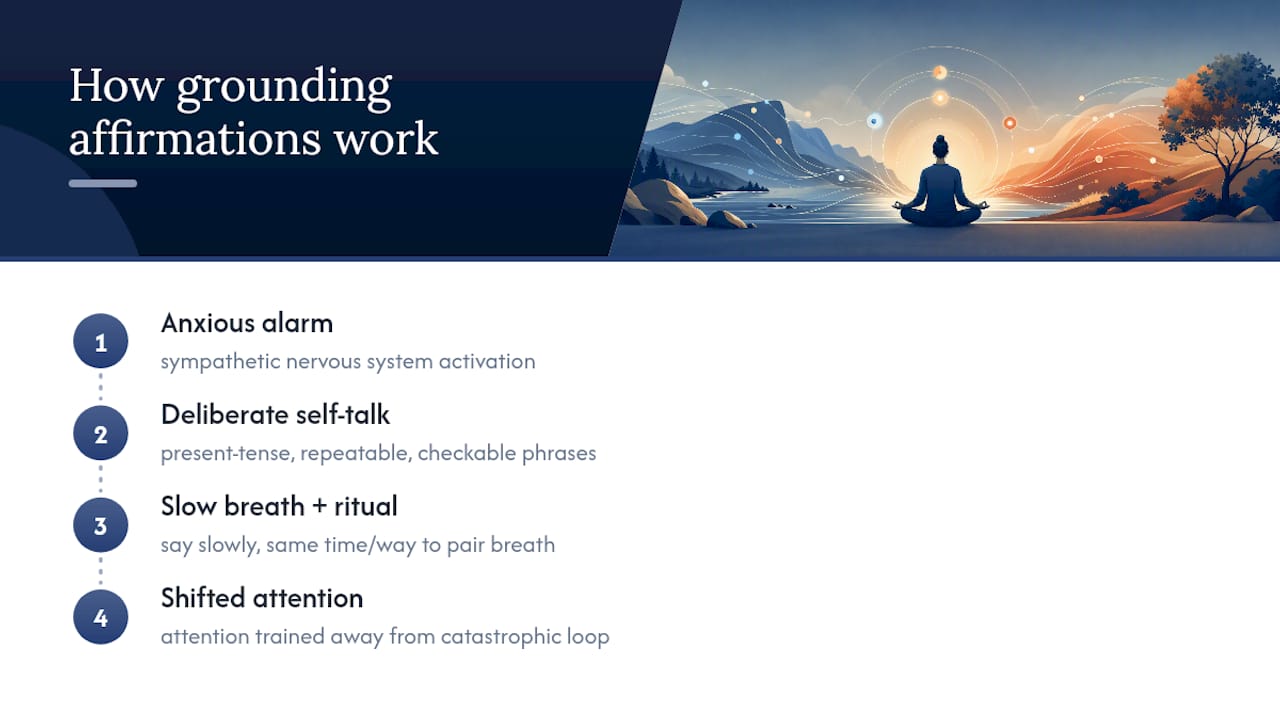
An affirmation is simply a short, self-directed statement you repeat to shift how you’re relating to a thought or feeling, not to deny it. The mechanism is less mystical than it sounds. Repetition, present-tense wording, and a bit of ritual (saying it at the same time, in the same way) train your attention to land somewhere other than the catastrophic loop anxiety wants you stuck in.
This is different from generic positive thinking, which tends to paper over discomfort with vague optimism (“everything will be fine!”). A grounded affirmation does something narrower and more useful: it names a true, specific thing you can hold onto right now. “I am safe in this moment” works because it’s checkable. You can look around and confirm it.
Research on self-affirmation suggests the practice can engage neural systems tied to reward and self-processing, and consistent daily use tends to outperform sporadic recitation. The physiological piece matters too. Slower, deliberate self-talk paired with breath can interrupt the sympathetic nervous system’s alarm response, which is why grounding phrases work best when they’re spoken slowly rather than rattled off.
Do Affirmations Work for Anxiety? Evidence, Limits, and When They Backfire
The honest answer: affirmations help, but they’re not a stand-alone treatment. Evidence points to real benefits, especially when affirmations are paired with breathing exercises, journaling, or meditation rather than used in isolation. Anxiety that’s severe or long-lasting needs more than a phrase, and affirmations work best as a supplement to professional therapy, not a substitute for it.
The most common failure mode is believability. If a statement feels “too good to be true,” your brain flags it as false, and that mismatch can actually increase distress instead of easing it. Telling yourself “I am fearless” when you’re mid panic attack tends to backfire because it contradicts what your body is telling you in real time.
The fix isn’t to abandon affirmations. It’s to scale the claim down until it’s true. “I am fearless” becomes “I have gotten through hard moments before.” That’s a fact, not a wish, and facts are easier for an anxious brain to accept.
If a phrase makes you feel worse, more agitated, more anxious, more hopeless, stop using it and try something else, or pause the practice altogether and lean on other tools like breathing or grounding techniques.
How to Craft Effective Affirmations for Anxiety
The wording matters more than most people assume. Effective affirmations share three traits: they’re written in first person, in present tense, and they’re specific enough to feel true rather than aspirational.
Start with these templates and adjust the language until it fits your own voice:
- Grounding (short, for acute anxiety): “I am safe right now.” “My feet are on the floor. I am breathing slowly.” “This feeling will pass.”
- Maintenance (daily, self-compassion): “I am allowed to take up space, even when I’m anxious.” “I’ve handled hard days before, and I can handle this one.”
- Situational (social, work, health): “I don’t need to be perfect to be liked.” “One meeting does not define my worth.” “My body sends false alarms sometimes, and that’s survivable.”
Here’s the conversion that actually matters: turning unrealistic phrasing into grounded phrasing. “I am never anxious” becomes “Anxiety visits, but it doesn’t stay forever.” “Everyone loves me” becomes “The people who matter to me know who I am.” The second version in each pair survives contact with your actual brain.
Pro Tip: Say the phrase out loud once, then notice if any part of you argues back. If it does, that’s the word to soften, not the whole sentence to discard.
Affirmations to Use Now and Affirmations to Build Resilience
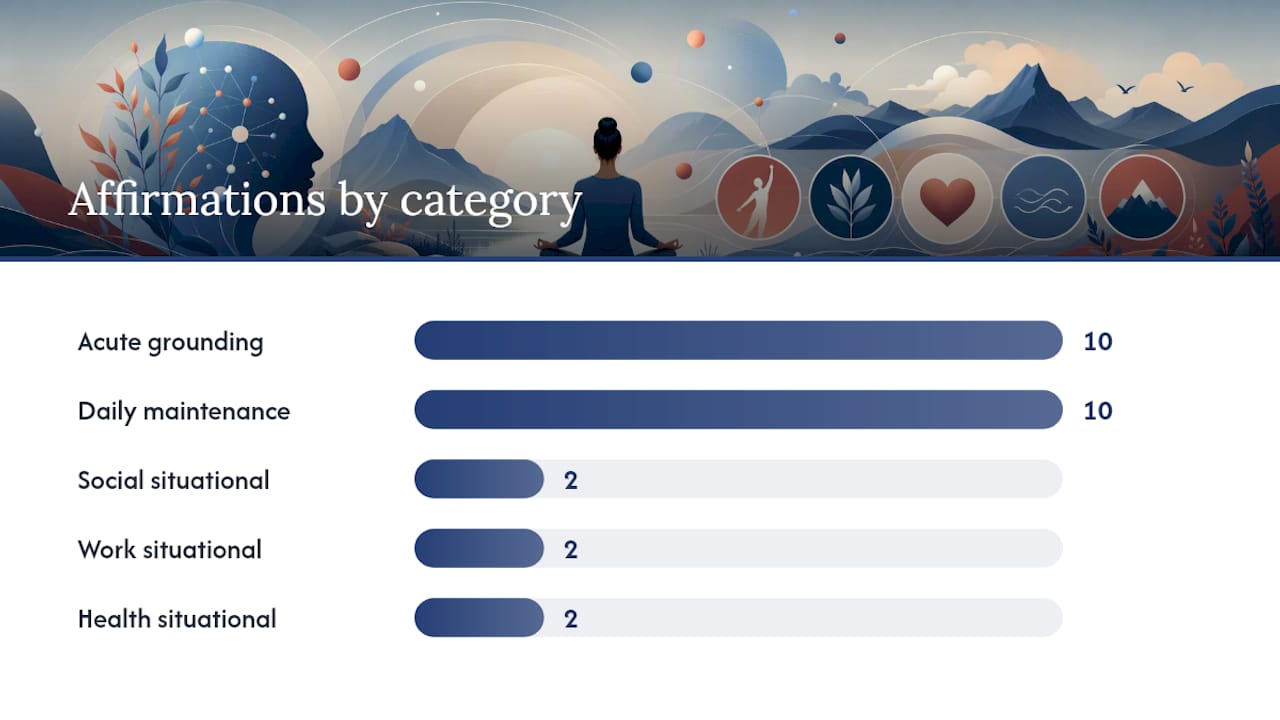
Different situations call for different phrasing. Keep the acute-anxiety list short and physical; keep the daily list longer and more self-compassionate.
For acute anxiety or panic (say slowly, 5 to 10 times):
- My feet are on the floor.
- I am breathing slowly.
- This is uncomfortable, not dangerous.
- I have survived this feeling before.
- I can wait this out.
- My body is trying to protect me, even if it’s overreacting.
- I am safe in this room, right now.
- This wave will crest and fall.
- I don’t have to fix this feeling immediately.
- One breath at a time is enough.
Daily maintenance affirmations (morning or evening ritual):
- I am allowed to feel anxious and still be capable.
- I’ve gotten through hard days before.
- My worth isn’t measured by how calm I feel today.
- I can be anxious and still show up.
- I am learning to trust myself a little more each day.
- Rest is productive, not a failure.
- I don’t need certainty to move forward.
- I am doing better than my anxious brain gives me credit for.
- Small steps still count as progress.
- I can ask for help without it meaning I’ve failed.
Situational affirmations, by context:
- Social anxiety: “I don’t need to fill every silence.” “People are usually thinking about themselves, not judging me.”
- Work anxiety: “One mistake doesn’t erase my competence.” “I can ask a clarifying question without it meaning I’m behind.”
- Health anxiety: “A symptom is information, not a verdict.” “I can notice a sensation without deciding it’s an emergency.”
Building Affirmations Into a Routine That Actually Sticks
Affirmations work better as a habit than as a rescue tactic you only remember mid crisis. For acute spikes, pair three slow breaths with one grounding phrase, repeated until your shoulders drop half an inch. That’s the whole routine.
For daily practice, therapists point to a simple pattern: short, repeated exposure beats long lists recited once in a while. A few ways to build that consistency:
- Say one affirmation out loud right after brushing your teeth, morning and night.
- Write it on a sticky note where you’ll actually see it, not buried in a drawer.
- Record yourself saying it and play it back during a commute.
- Pair the phrase with a physical anchor, like squeezing a stress ball or writing it into a journal prompt before bed.
Pro Tip: Track adherence, not mood. A quick calendar checkmark for “said it twice today” builds momentum faster than judging whether you felt calmer.
Athletes use a version of this same principle under pressure. A youth baseball mental-prep guide recommends short, present-tense self-talk before a pitch, which is the same logic applied to a mound instead of a bedroom.
When Affirmations Aren’t Enough
Affirmations are a self-help layer, not a treatment for clinical anxiety disorders. Some signs mean it’s time to bring in a professional rather than keep adjusting your wording: persistent panic attacks, anxiety that’s stopping you from working, sleeping, or leaving the house, or any thoughts of suicide or self-harm.
If a phrase leaves you more distressed than before you started, that’s a signal to stop and reassess, not to push harder. Affirmations can sit alongside therapy or medication, but they shouldn’t be the only tool for anxiety that’s disrupting your daily life. The National Institute of Mental Health offers reliable information on anxiety disorders and treatment options, and it’s a solid first stop if you’re unsure whether what you’re feeling has crossed into clinical territory.
Why Mindpanda Leans on Ritual, Not Just Words
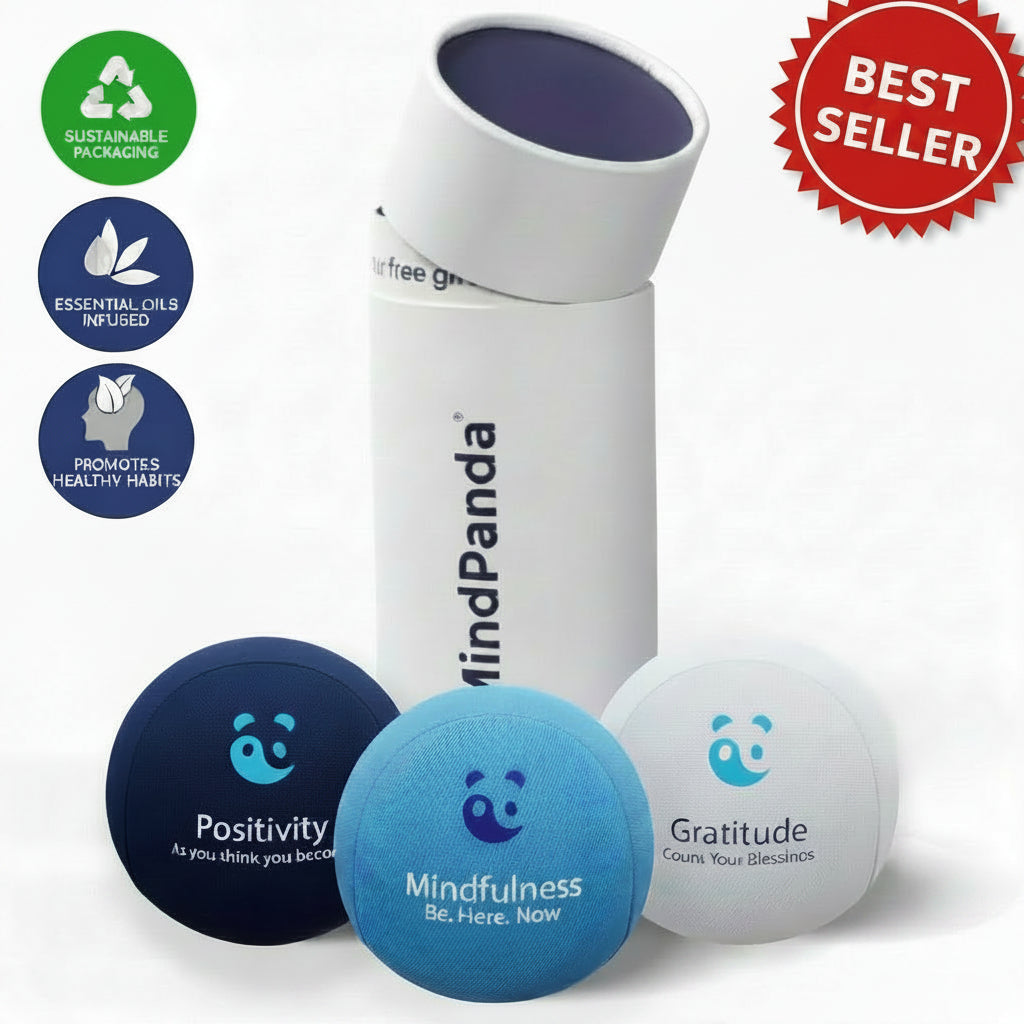
Affirmations stick when they’re tied to something you can touch. That’s the reasoning behind Mindpanda’s product mix: journals for writing affirmations down, stress balls for a physical anchor during a grounding phrase, and reminder cards for the sticky-note habit that actually gets kept. The packaging is eco-friendly by design, which matters if you’d rather your calming ritual not carry a footprint you feel guilty about.
Practical pairings we see work:
- A stress ball squeezed during the “3 breaths, 1 phrase” routine
- A journal prompt at night for the daily maintenance affirmation
- A reminder card by the mirror for the morning repetition
What I’ve Noticed About Affirmations That Actually Stick
I started keeping one phrase taped inside a cabinet door for thirty days: “This feeling will pass.” Nothing dramatic happened. What changed was smaller and slower, a few extra seconds of pause before anxiety fully took over. That’s realistic. Affirmations aren’t a switch, they’re a nudge, and nudges compound.
If you try this, give one phrase thirty days before judging it. Write down a single line most nights about whether it helped, even a little. Adjust the wording if it starts to feel hollow. The point isn’t to find the perfect sentence. It’s to keep showing up with one that’s honest enough to believe.
— Ravi
Try a Starter Bundle Built for This Exact Routine
Most people who stick with affirmations aren’t relying on willpower alone. They’ve built a small physical ritual around the words, and that’s the gap Mindpanda’s wellbeing bundle is built to close. Instead of hunting for a notebook, a stress ball, and sticky notes separately, you get a journal, a stress ball, and reminder cards in one set, each one matched to a routine described above: the journal for nightly affirmation writing, the stress ball for grounding during a spike, the cards for the morning repetition that’s easiest to skip.
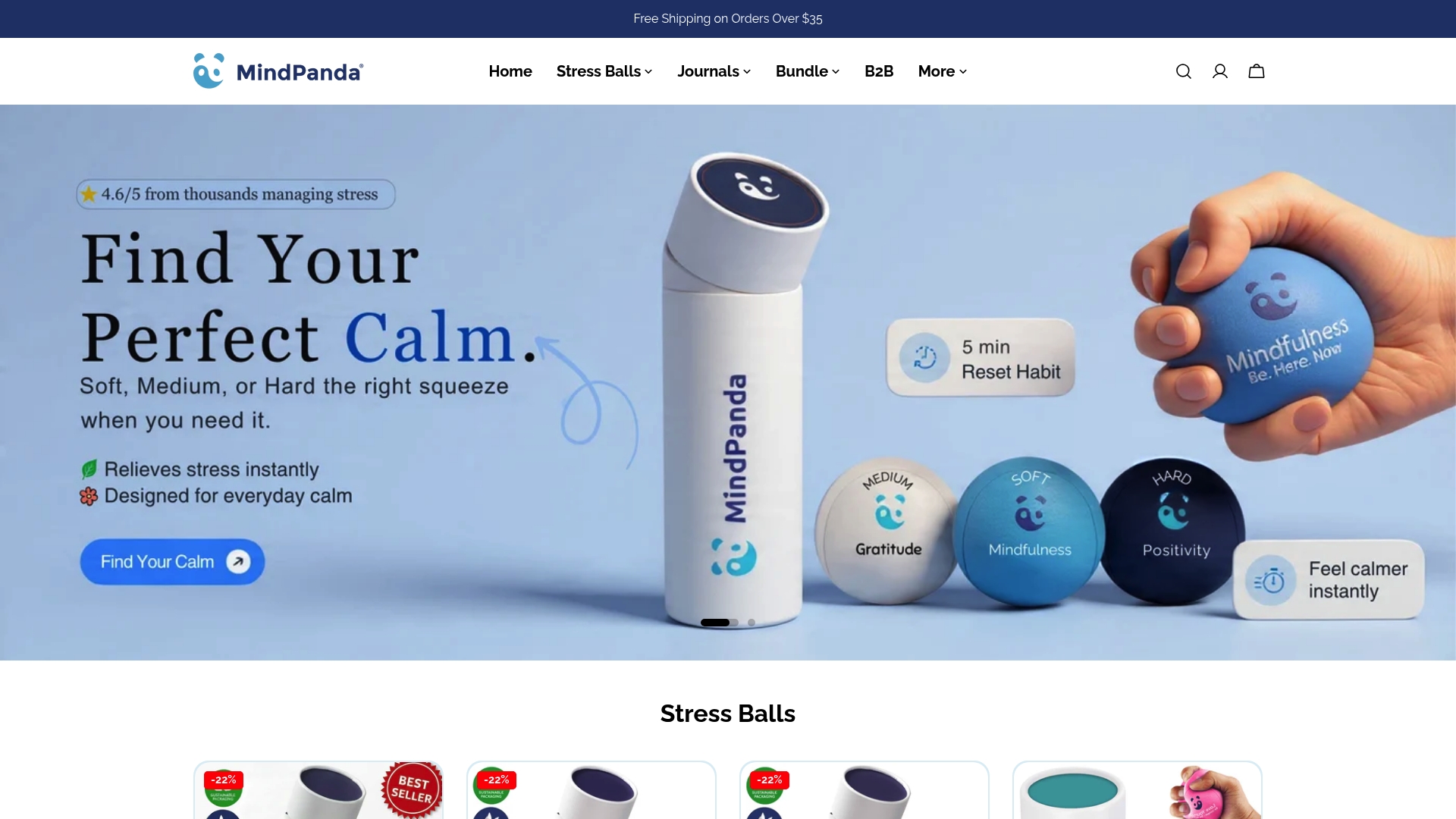
To be clear, none of this replaces therapy or medical care if your anxiety is severe or persistent. Think of it as scaffolding for the habit, not a treatment. If you want a ready-made set to start with, the Mindfulness Wellbeing Bundle is a straightforward starting point. If you’d rather pick your own pieces, you can build your own wellbeing bundle and match it to whichever affirmations you’re actually going to use.