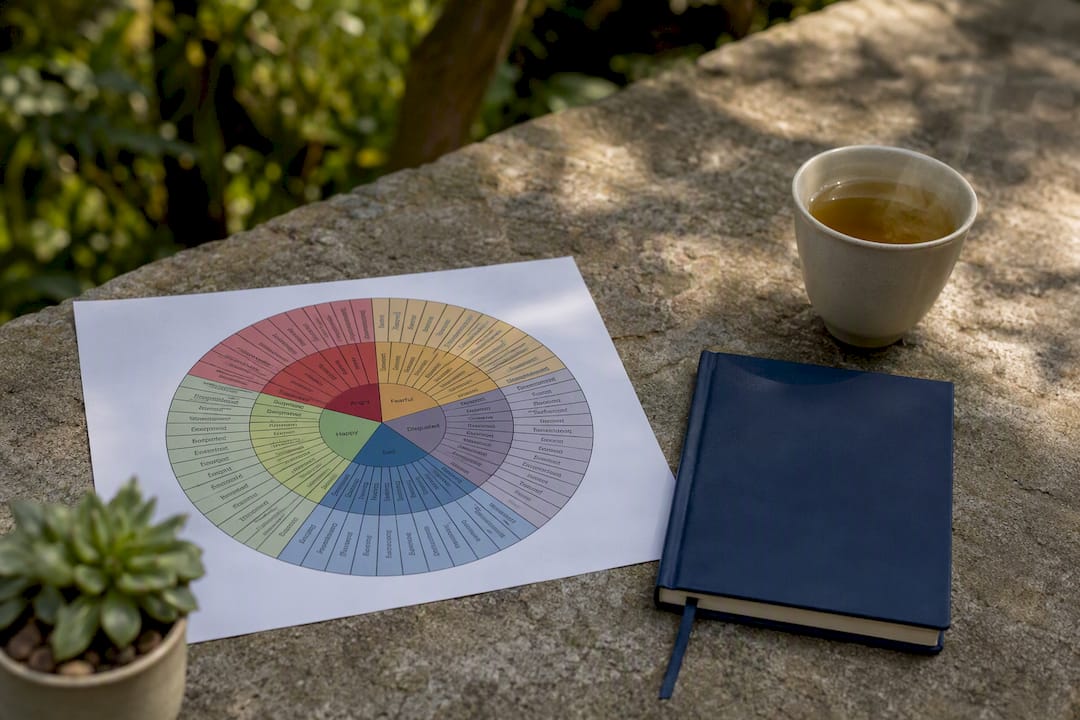
Start at the center, name the closest broad feeling, then move outward to a more specific word, and note what triggered it and how strong it feels on a scale of 1 to 10. That single move, repeated daily, sharpens your emotional vocabulary and clears the way for a better next step, whether that’s journaling, a boundary, or a short break. Keep a wheel on your phone or desk so you can reach for it the moment something stirs.
TL;DR:
- Using a specific emotion word reduces the feeling’s intensity by engaging reasoning circuits in the prefrontal cortex.
- Starting with broad feelings and moving outward helps identify nuanced emotions, with intensity guiding the next steps for regulation.
- The wheel’s structure includes concentric rings and spokes that capture compound emotions and help track feeling changes over time.
- Consistently labeling emotions improves communication, pattern recognition, and early detection of triggers before feelings escalate.
- For best results, pair the wheel with quick journaling or physical calming tools to solidify emotional awareness and regulation habits.
Table of Contents
- What Is an Emotion Wheel and Why Does It Work?
- How the Wheel Is Structured: Rings, Spokes, and Blends
- What Are the Steps to Use an Emotion Wheel?
- How Do You Adapt the Wheel to Journaling, Therapy, Work, and Kids?
- Which Emotion Wheel Variant Should You Use?
- Do Emotion Wheels Actually Work? What the Research Says
- Where Mindpanda Fits Into a Daily Emotion Practice
- A Simple Two-Step Routine Worth Trying This Week
- Pair the Wheel With a Few Simple Tools
- Sources
What Is an Emotion Wheel and Why Does It Work?
An emotion wheel is a circular chart that organizes feelings from broad categories at the center out to specific, nuanced labels at the edges. The format traces back to Gloria Willcox’s original Feelings Wheel and Robert Plutchik’s wheel of emotions, both built to expand emotional vocabulary beyond “good,” “bad,” or “fine.”
The mechanism behind why it works is more interesting than the chart itself. Naming an emotion recruits language and reasoning circuits tied to the prefrontal cortex, and that engagement can reduce the emotion’s subjective intensity. Put plainly: saying “I feel dismissed” instead of “I feel bad” gives your brain something specific to work with instead of a vague cloud of discomfort.
People reach for the wheel in a few recurring situations:
- During a therapy session, to hand a clinician a precise word instead of a shrug
- While journaling, to anchor an entry in a real feeling rather than a mood
- As a quick daily check-in, morning or evening, to spot patterns before they build
How the Wheel Is Structured: Rings, Spokes, and Blends
Most wheels use concentric rings. The innermost circle holds a handful of core emotions like joy, sadness, anger, or fear. Each outer ring refines that core feeling into something sharper. “Sad” in the center might branch into “lonely” one ring out, then “abandoned” at the edge.
Intensity often follows the same geometry. On Plutchik’s version, feelings closer to the center of a spoke tend to run hotter, while the outer edge softens into a milder variant, so “rage” sits closer in than “annoyance” even though both trace back to anger.
A few structural details make the wheel easier to read:
- Spokes divide the wheel into wedges, each representing one emotional family, and you generally travel outward within a single wedge rather than jumping across them.
- The spaces between spokes exist for a reason. Mixed emotions are normal, and those in-between zones are built to capture compound states like “remorse” or “optimism” instead of forcing a single clean label.
- Layouts vary by version. Some wheels group by valence (pleasant versus unpleasant), others by opposing pairs, so check which logic a specific wheel uses before you start.
What Are the Steps to Use an Emotion Wheel?
This is the routine worth memorizing, whether you’re mid-argument or sitting down for a five-minute evening check-in.
- Pause and breathe. Give yourself three slow breaths before you try to name anything. Rushing this step usually produces a guess, not an answer.
- Run a quick body scan. Notice where the sensation lives: a tight chest, a clenched jaw, heat in your face. Pairing the label with a physical cue makes the abstract feeling concrete and easier to trust.
- Find the broad emotion. Scan the wheel’s center and pick whichever core word feels closest, even if it’s not exact yet.
- Move outward to something specific. Follow that wedge to a sharper term, then rate the intensity from 1 to 10.
- Ask what triggered it and what you need. A conversation, a memory, a deadline. Naming the trigger is often more useful than the label itself.
- Choose one concrete action. Journal a few lines, set a boundary, take a walk, talk to someone, or reach out for professional support if it’s warranted.
Two quick examples show how the intensity number changes the plan. Low intensity: you notice a flat, restless feeling of mild intensity while working. The wheel walks you from “bored” to “understimulated,” the trigger turns out to be a repetitive task, and the action is a five-minute walk before switching tasks. High intensity: your heart is racing with strong intensity after a tense phone call. The wheel takes you from “angry” to “betrayed,” and at that intensity level the priority shifts to immediate, safety-focused steps first, such as stepping away from the situation or grounding techniques, before you try to analyze anything.
Pro Tip: Keep intensity as your decision filter. Moderate intensity feelings often respond well to breathing or a short mindfulness break, while high intensity calls for grounding or outside support before deeper reflection.
How Do You Adapt the Wheel to Journaling, Therapy, Work, and Kids?
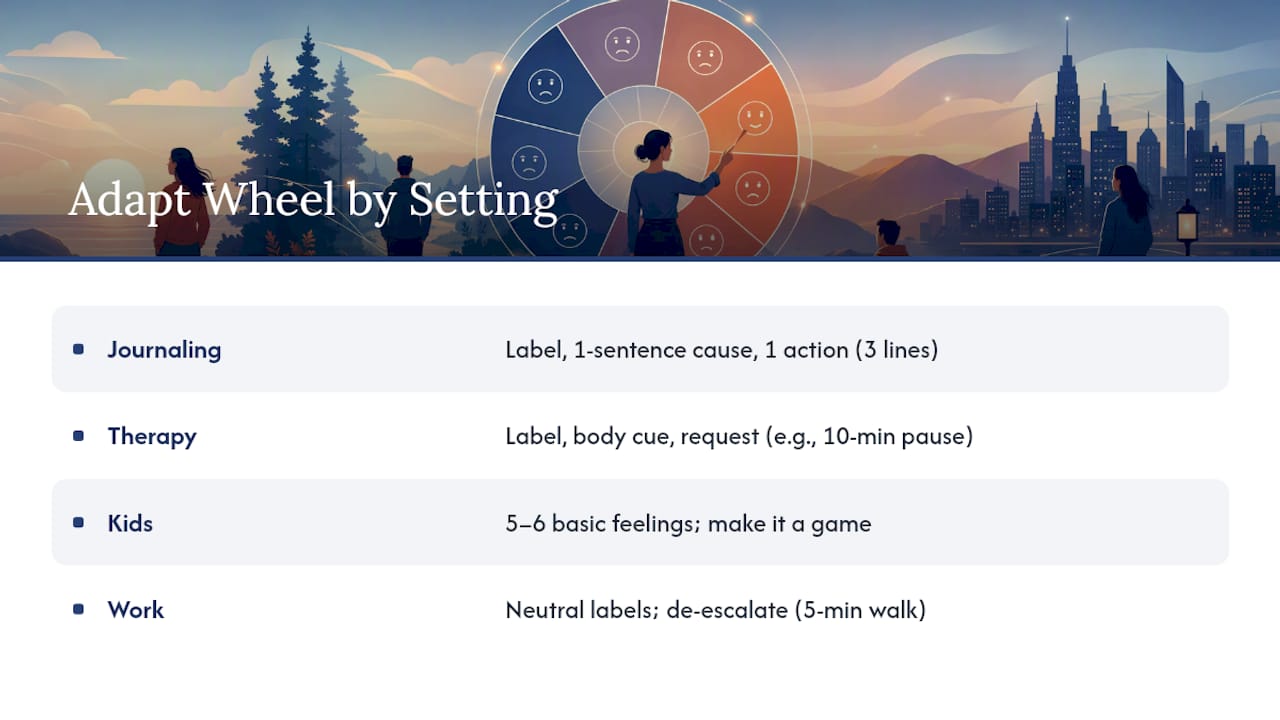
The core routine stays the same across settings; only the output changes.
For journaling, keep the entry short: write the label, one sentence about the likely cause, and one action you’ll take. Three lines is plenty most days, and the discipline of stopping there is what makes the habit sustainable.
In therapy or a peer check-in, hand the other person your label, your body cue, and a request. Something like “I feel overwhelmed, my shoulders are tight, and I need ten minutes before we keep talking” gives a clinician or partner far more to work with than a vague mood report.
With kids, simplify the wheel to five or six basic feelings and turn labeling into a game rather than a lesson. A short check-in before bedtime or before school, paired with age-appropriate mindfulness practices for children, builds the same skill without the vocabulary overload adult wheels carry.
At work, stick to neutral, professional labels (“frustrated,” “stretched thin”) and pair them with a small de-escalation step, like a five-minute walk before responding to a difficult email. A structured emotional regulation approach built for sensory-sensitive kids offers useful ideas for adults who need a similar reset, too.
Which Emotion Wheel Variant Should You Use?
Four versions cover most needs, and each solves a slightly different problem.
- Willcox’s Feelings Wheel favors vocabulary breadth. It’s the strongest choice if your main struggle is finding the right word at all.
- Plutchik’s Wheel pairs eight primary emotions in opposing sets (joy versus sadness, trust versus disgust) and models how combinations produce secondary emotions like “optimism” from joy plus anticipation. It’s the better pick for intensity tracking.
- The Geneva Emotion Wheel organizes feelings by how pleasant they are and how much control you feel over them, which suits people who want to track agency alongside mood.
- Junto’s wheel and similar kid-friendly designs strip the vocabulary down to basics, ideal for classrooms or younger children.
Pick one and commit to it for two weeks. Track whether new, more specific words start showing up in your journal entries. If they don’t, the vocabulary might not match how you actually experience feelings, and it’s worth switching versions.
Do Emotion Wheels Actually Work? What the Research Says
The core benefit has a real mechanism behind it, not just a comforting hunch. Naming an emotion recruits prefrontal circuits that help regulate the feeling itself, so putting a precise word on a state can genuinely turn the volume down.
Used consistently, the wheel tends to build a sharper emotional vocabulary, clearer communication with the people around you, and enough pattern recognition to catch a recurring trigger before it escalates.
There’s a real limit worth stating plainly: the wheel should support acceptance of the full emotional range, not become a tool for avoiding uncomfortable feelings or forcing quick positivity. Naming “anxious” isn’t meant to make it disappear. It’s meant to make it workable.
If intensity stays high for days, or the same trigger keeps reappearing without resolution despite consistent labeling and action steps, that’s a signal to loop in a therapist rather than keep cycling through the wheel alone.
Where Mindpanda Fits Into a Daily Emotion Practice
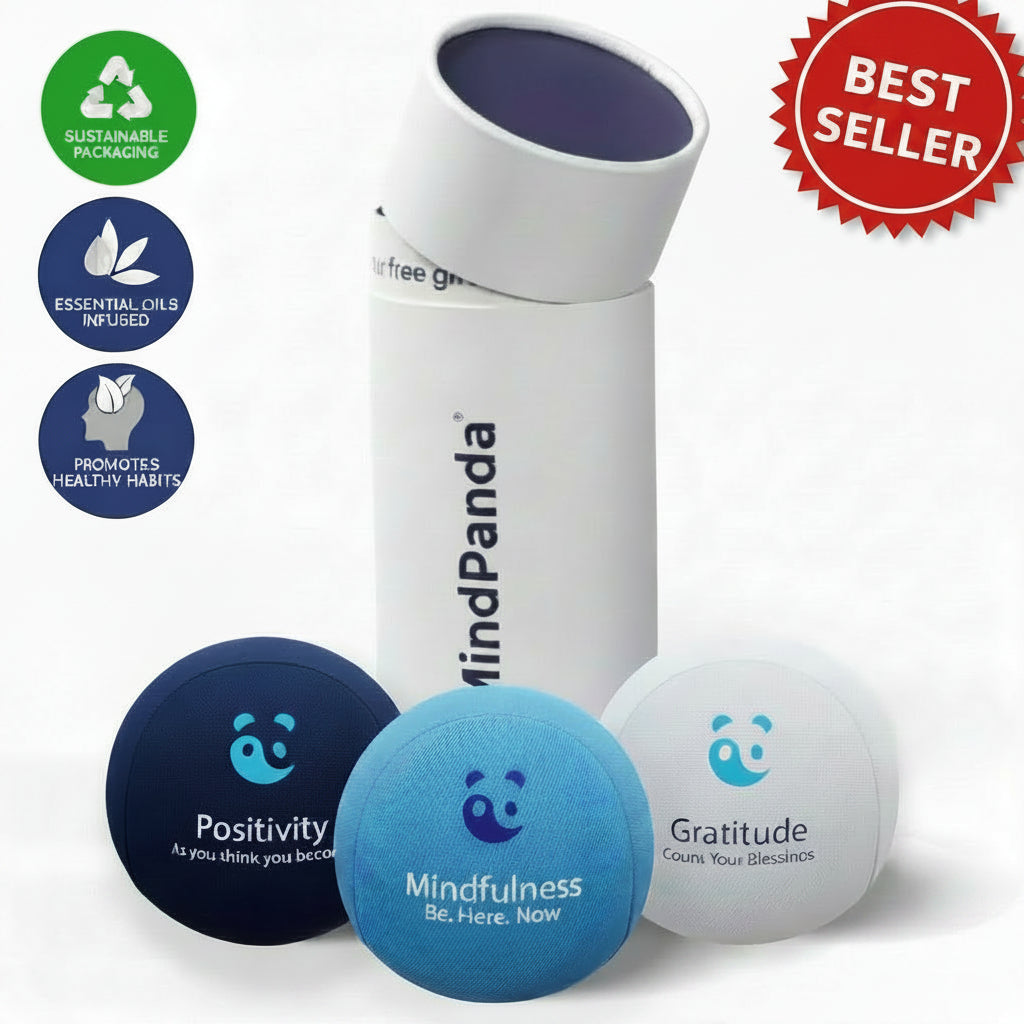
Mindpanda builds its product line around exactly this kind of daily practice, from guided journals to stress-relief tools designed to sit next to the habit rather than replace it. The wheel gives you the label; a journal gives that label somewhere to go, and a stress ball or calming object gives your hands something to do while your mind catches up. This guide was put together by Ravi, a Mindpanda contributor focused on translating mindfulness research into routines people will actually keep doing.

A Simple Two-Step Routine Worth Trying This Week
My suggestion is smaller than most advice on this topic: two minutes with the wheel, five minutes with a journal, once a day. Track four things all week: the word you land on, the trigger, the intensity number, and whatever action you took. By day five, a pattern usually shows up that a single deep, one-off reflection would never catch. Small and repeatable beats thorough and occasional almost every time.
— Ravi
Pair the Wheel With a Few Simple Tools
A wheel gets you the label. What you do in the next five minutes is what actually changes the pattern, and that’s where having something on hand helps more than people expect. Mindpanda’s Mindfulness Wellbeing Bundle pairs a guided journal with a stress-relief item, built for exactly the morning-label, evening-journal rhythm described above: name the feeling, jot three lines, then use the physical object to settle before you move on.
If you’d rather choose your own pieces, the build-your-own bundle page lets you combine a journal with a smaller calming item to match your own routine instead of a preset kit. Either way, start with one journal and one five-minute check-in tonight. That’s the whole first step.