
Set a timer for 5–15 minutes. Open to a blank page. Write your answers to these three prompts: What is my body telling me right now? Then, What is the worst realistic outcome, and what would I actually do if it happened? Finally, What is one small thing I can control in the next hour? When the timer goes off, write one sentence that starts with “I will…” and close the journal. That’s the routine. You don’t need to write beautifully or at length. You just need to get the worry out of your head and onto paper, where you can look at it instead of living inside it.
- Step 1: Pick one prompt from the list above (or from the categories below).
- Step 2: Set a timer for 5–15 minutes. Don’t go over.
- Step 3: Write without editing. Speed matters more than polish.
- Step 4: End with one forward-facing sentence: what you’ll do next, even if it’s tiny.
A Mindpanda mindfulness journal or the Mindfulness Wellbeing Bundle gives you a dedicated space for this practice, with structured pages that remove the friction of starting from a blank notebook.
Pro Tip: If you’re mid-panic, skip the analysis prompts entirely. Just write: “Right now I feel ___” and describe the physical sensations only. That single act of labeling shifts your brain from reactive to observational.
Key Takeaways
Structured, time-limited journal prompts organized by mental state reduce anxiety and rumination more reliably than open venting, and a consistent 5–15 minute daily practice is enough to produce a measurable shift.
| Point | Details |
|---|---|
| Match prompts to your state | Use grounding prompts during high anxiety; save CBT thought-records for calmer moments. |
| Keep sessions short | 5–15 minutes per session is enough; longer sessions risk tipping into rumination. |
| End with a forward action | Close every session with one concrete next step or a scheduled worry time to prevent open-loop thinking. |
| Know when to seek help | If anxiety worsens over two or more weeks of journaling, or panic attacks increase, contact a clinician. |
| Use a structured journal | A Mindpanda journal or Mindfulness Wellbeing Bundle provides built-in structure for CBT templates and daily prompts. |
Table of Contents
- What are the best journal prompts for anxiety, organized by what you need right now?
- How do you use anxiety journal prompts without making rumination worse?
- CBT thought-record templates you can copy into your journal
- Quick grounding practices to do before you start writing
- What does the research actually say about writing and anxiety?
- A 7-day starter plan for building a journaling habit
- When journaling stops helping: red flags and when to seek professional support
- How to choose the right prompts for your specific anxiety symptoms
- How to stay consistent with journaling when motivation fades
- How to integrate journaling with therapy and other anxiety tools
- What I’ve seen actually work with anxiety journaling
- Mindpanda journals and wellbeing bundles for your practice
- Sources
What are the best journal prompts for anxiety, organized by what you need right now?
The most useful anxiety journal prompts aren’t random questions. They’re matched to your current state. A prompt that asks you to analyze your childhood patterns is useless when your heart is racing. Here’s a prompt bank organized by purpose, so you can grab what fits the moment.
Grounding prompts (use when anxiety is high or physical)
These prompts pull attention away from future-catastrophizing and back into the present. Use them first, before anything analytic.
- What do I notice in my body right now? Where exactly does the tension sit?
- What are five things I can see from where I’m sitting?
- What sounds can I hear right now, near and far?
- What does the surface under my hands feel like?
- What is actually happening in this room, at this exact moment?
- What is one thing that feels stable or safe right now?
Micro-routine: Pick one prompt. Write for 3 minutes. Stop. Take three slow breaths before moving on.
Worry audit prompts (use when a specific worry is looping)
Naming a worry precisely tends to shrink it. Research on structured writing interventions shows that directed, repeated writing produces measurable reductions in anxiety and rumination. Vague dread is harder to challenge than a named concern.
- What exactly am I worried about? Write it in one sentence.
- How likely is this outcome, honestly?
- What evidence do I have that this will happen?
- What evidence do I have that it won’t?
- Have I survived something similar before? What happened?
- What would I tell a close friend who had this exact worry?
- What is the worry trying to protect me from?
- What would I need to know to feel less uncertain about this?
Micro-routine: Write the worry in one sentence. Then answer “What evidence do I have that this will happen?” for 5 minutes. Close with: “I’ve handled hard things before.”
CBT thought-challenge prompts (use when calmer, for analytic work)
These prompts are drawn from cognitive behavioral therapy’s core technique of examining the evidence behind anxious thoughts. CBT-style thought records are widely used as therapy homework for exactly this purpose.
- What thought is driving this feeling?
- Is this thought a fact or an interpretation?
- What’s the most catastrophic version of this scenario? What’s the most realistic?
- Am I mind-reading or fortune-telling here?
- What would change if this thought turned out to be wrong?
- What’s a more balanced way to frame this situation?
- What would I think about this in six months?
- If I rated my anxiety from 1–10 right now, what would move it one point lower?
Micro-routine: Write the anxious thought. Answer the “evidence for” and “evidence against” questions. Re-rate your belief. Notice the shift.
Scheduled worry-window prompts (use during your designated worry time)
Scheduled worry time is a CBT strategy that contains free-floating worry to a specific daily window, typically 15–20 minutes. Outside that window, you defer worries to the next session.
- What worries have I been carrying today that I haven’t written down yet?
- Which of these worries is within my control?
- Which is outside my control, and what would it mean to let that one go for today?
- What’s the smallest step I could take on the controllable worry?
- What do I want to feel by the end of today?
Gratitude and values prompts (use for perspective and resilience)
- What went better than expected today, even slightly?
- Who in my life makes things feel more manageable?
- What do I value most, and did today reflect that?
- What is one thing my anxious mind tends to overlook?
- What would “enough” look like today?
Future-self and resilience prompts (use for longer reflection)
- What would my calmer future self say about this moment?
- What has anxiety cost me that I want back?
- What strengths have I shown when things were hard before?
- What does a life with less anxiety look like in concrete, daily terms?
Self-compassion and closure prompts (use to end a session)
- What do I need to hear right now that I haven’t said to myself?
- What would I say to someone I love who felt exactly this way?
- What is one thing I did today that was good enough?
Pro Tip: Pick one prompt per session. One. Jumping between five prompts in a single sitting scatters attention and can deepen rumination rather than reduce it.
How do you use anxiety journal prompts without making rumination worse?
The single-sentence routine: choose a prompt, set a timer, write, then close with a reframe or a concrete action. That structure is what separates therapeutic journaling from anxious venting.
- Choose your prompt before you sit down. Deciding mid-session wastes time and invites avoidance.
- Set a hard time limit. Five to fifteen minutes is enough. Expressive writing research consistently uses 15–20 minute sessions; longer doesn’t mean better.
- Write without re-reading mid-session. Re-reading while writing pulls you back into the worry loop.
- End with a forward-facing sentence. One action, one affirmation, or a note of what you’re deferring to your next worry window. This creates psychological closure.
- Enforce the worry window. If a worry surfaces outside your scheduled session, write it on a “parking lot” list and tell yourself: I’ll address this at [time]. Then return to what you were doing.
Anti-rumination rules to follow every session:
- Stop when the timer goes off, even mid-sentence.
- Never transcribe the same worry three sessions in a row without adding a new angle or a challenge question.
- If you notice your writing circling the same sentence repeatedly, switch to a grounding prompt immediately.
- End every session with at least one sentence that looks forward, not backward.
Pro Tip: Match your technique to your arousal level. When your heart is pounding, use grounding or sensory prompts only. Save the analytic CBT prompts for when you’re calm enough to think clearly. Using a detailed thought-record during a panic spike can accidentally rehearse catastrophic thinking.
CBT thought-record templates you can copy into your journal
The classic thought record is the most evidence-supported template in anxiety journaling. Practical CBT formats like thought records are standard therapy homework for identifying and challenging anxious thinking patterns. Copy this table into your journal or a note.
| Field | What to write |
|---|---|
| Situation | Where were you? What happened? (facts only) |
| Emotion | What did you feel? Rate intensity 1–10 |
| Hot thought | What thought triggered the emotion? |
| Evidence for | What facts support this thought? |
| Evidence against | What facts contradict it? |
| Balanced thought | A more realistic version of the hot thought |
| Outcome | Re-rate the emotion 1–10 after the reframe |
Filled example (presentation worry):
For a compact version when you’re short on time, use the 3-question CBT check:
- What am I assuming will happen?
- What’s the realistic probability?
- What would I do if the worst actually occurred?
Storing and reusing templates:
- Tape or paste a printed template to the inside cover of your journal.
- In a Mindpanda journal, the structured pages already provide space for this kind of prompted reflection.
- In a notes app, save the table as a pinned template and duplicate it for each session.
Quick grounding practices to do before you start writing
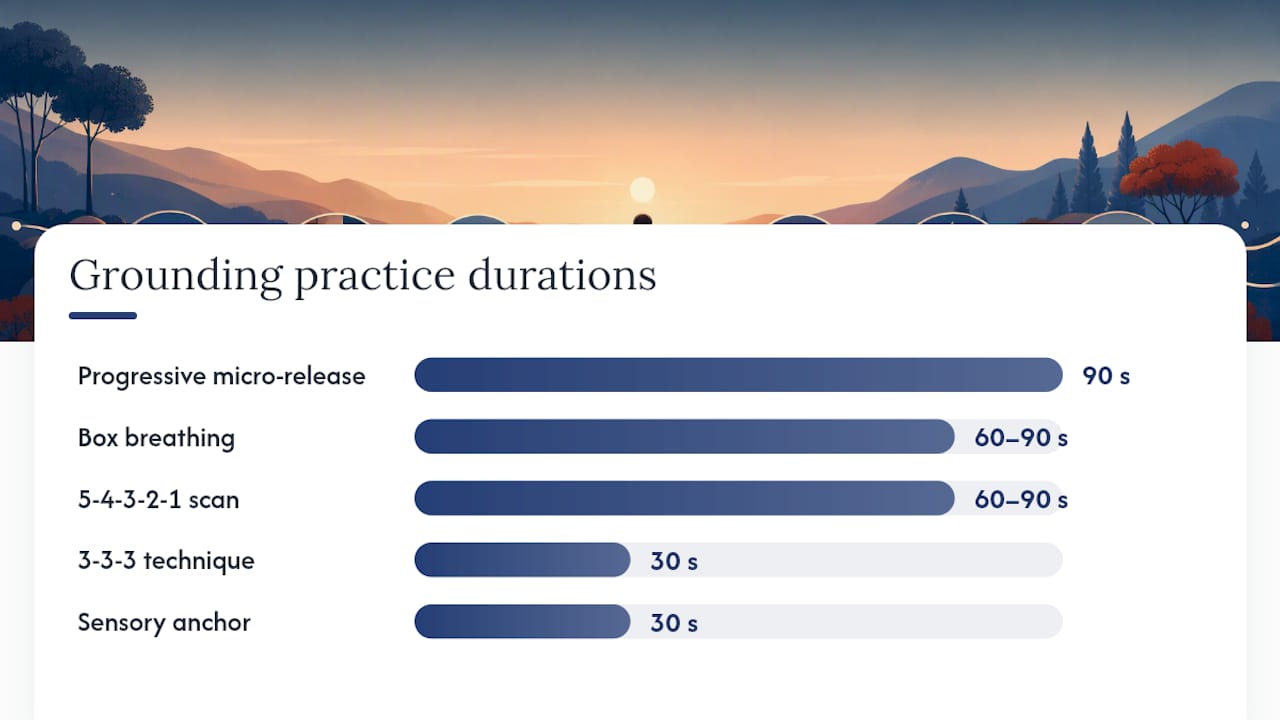
High arousal makes analytic writing counterproductive. A 30-second to 2-minute grounding exercise before a session lowers the physiological baseline so the prompts can actually work. These mindfulness activities for anxiety pair naturally with a journaling routine.
- 3-3-3 technique (30 seconds): Name three things you see, three sounds you hear, and move three parts of your body. Grounds attention in the present without requiring stillness.
- 5-4-3-2-1 sensory scan (60–90 seconds): Name five things you see, four you can touch, three you hear, two you smell, one you taste. Works well before a worry-audit session.
- Box breathing (60–90 seconds): Inhale for four counts, hold for four, exhale for four, hold for four. Repeat four times. Activates the parasympathetic nervous system and slows a racing mind.
- Progressive muscle micro-release (90 seconds): Tense your shoulders up to your ears for five seconds, then release. Repeat with your hands (make fists, then open). Two cycles is enough to notice a shift.
- Sensory anchor (30 seconds): Hold something with texture — a pen, a smooth stone, a fabric cover. Focus entirely on what it feels like for 30 seconds. Simple, and surprisingly effective for breaking a thought spiral.
Do one of these before opening your journal if your anxiety is above a 6 out of 10. At lower arousal, you can go straight to writing.
Pro Tip: Pen and paper tends to slow a worry loop more than typing does. The physical act of forming letters occupies a different part of your attention than a keyboard, which can reduce the speed at which anxious thoughts cycle. If you’re spiraling, put the phone down.
What does the research actually say about writing and anxiety?
The evidence base for anxiety journaling starts with James Pennebaker’s expressive-writing research, which showed that writing about emotional experiences for 15–20 minutes across several sessions produces measurable effects on stress markers and mood. A Harvard summary of this work notes that writing about worries can offload them and, in at least one study by Schroder and colleagues, reduced a neural error-related brainwave in people who worry a lot — suggesting that putting a worry on paper frees up cognitive resources that were being consumed by it.
The key finding: structured, directed writing produces stronger anxiety reductions than unstructured venting, according to systematic reviews of writing interventions. Repeated sessions matter more than any single long session.
The mechanism isn’t mysterious. Writing externalizes a thought, which means you can examine it rather than be inside it. It also supports cognitive restructuring (seeing a thought as a thought, not a fact), attention retraining (directing focus away from threat), and behavioral activation (ending a session with a concrete next step).
Clinical reviews draw a useful distinction: expressive writing works best for processing past events, while CBT-style structured prompts work better for current and future worries. Using the wrong format for the wrong problem can reinforce rumination rather than reduce it.
Practical implications from the research:
- Keep sessions to 15–20 minutes. Longer sessions don’t add benefit and can tip into rumination.
- Repeat the practice across multiple days rather than doing one long session.
- Use structured prompts (thought records, worry audits) for present and future anxiety.
- Reserve free expressive writing for processing events that have already happened.
- When anxiety is severe or persistent, journaling works best as a complement to therapy, not a replacement for it. Structured prompts and worry logs are commonly used as between-session homework in CBT precisely because they extend the work of therapy into daily life.
A 7-day starter plan for building a journaling habit
The goal for the first week is to make the habit feel small enough that skipping it feels stranger than doing it. Habit design research supports short daily sessions over occasional long ones: five minutes done daily beats thirty minutes done once.
- Day 1: Grounding prompt. “What is my body telling me right now?” (5 minutes) Anchor it to your morning coffee or evening wind-down.
- Day 2: Worry audit. “What exactly am I worried about today? Write it in one sentence.” (5 minutes) Follow with: “What’s one thing I can do about it?”
- Day 3: CBT check. Use the 3-question template: assumption, realistic probability, what you’d do if it happened. (8 minutes)
- Day 4: Gratitude and values. “What went better than expected yesterday, even slightly?” (5 minutes) Keep it specific — vague gratitude doesn’t move the needle.
- Day 5: Scheduled worry window. Set a 15-minute timer. Write every worry you’ve been carrying. Sort them: controllable vs. not. Pick one action for the controllable list.
- Day 6: Future-self prompt. “What would my calmer future self say about what I’m worried about this week?” (8 minutes)
- Day 7: Self-compassion and weekly review. (10 minutes)
Adaptation options:
- Busy day: one sentence only. “Today I feel ___ and I will ___.” That counts.
- High-arousal day: grounding exercise first (box breathing or 3-3-3), then one grounding prompt, then stop.
- Missed a day: don’t double up. Just start again the next day. Missing once is fine; the “never miss twice” rule keeps the habit alive.
Weekly review template (3 questions, 5 minutes):
- What worry came up most often this week?
- What helped, even a little?
- What’s one thing I want to try differently next week?
When journaling stops helping: red flags and when to seek professional support
Journaling is a tool, not a treatment. Knowing when it’s not enough is as important as knowing how to use it.
Red flags that suggest you need professional support:
- Your anxiety is worsening despite consistent journaling over two or more weeks.
- You’re sleeping significantly less or waking in a panic regularly.
- Panic attacks are increasing in frequency or intensity.
- You’re avoiding important activities (work, relationships, basic self-care) because of anxiety.
- Journaling sessions are leaving you more distressed than when you started.
- You’re having thoughts of harming yourself or others.
If a session amplifies distress:
- Stop writing immediately. Close the journal.
- Do a grounding exercise (box breathing or 5-4-3-2-1) for 60–90 seconds.
- Contact a trusted person and tell them how you’re feeling.
- If you’re in crisis, contact the 988 Suicide and Crisis Lifeline (call or text 988 in the US) or go to your nearest emergency room.
Journaling works best as a complement to therapy, not a substitute for it. If you’re already working with a therapist, bring your journal to sessions. The patterns you notice in your writing are exactly the kind of material that makes therapy more efficient. If you’re not in therapy and your anxiety is significantly affecting your daily life, that’s the signal to make an appointment.
How to choose the right prompts for your specific anxiety symptoms
Not all anxiety looks the same, and the most effective writing prompts for anxiety depend on what’s actually driving yours.
Generalized worry (constant background dread): The worry-audit and scheduled worry-window prompts are your best starting point. The goal is containment. Write the worries down during your designated window and practice deferring them outside of it.
Social anxiety (fear of judgment, embarrassment): CBT thought-challenge prompts work well here, particularly the evidence-for and evidence-against structure. Prompts like “What would I think of someone else in this situation?” help expose the double standard most social anxiety relies on.
Performance anxiety (exams, presentations, deadlines): Short expressive writing before a high-stakes event can offload worry and free cognitive resources. The 3-question CBT check is fast enough to use the morning of.
Health anxiety: Grounding prompts and the “evidence against” column of the thought record are most useful. Avoid prompts that invite you to describe physical symptoms in detail, which can amplify rather than reduce health-focused worry.
Trauma-adjacent anxiety: Stick to present-focused grounding and values prompts. Expressive writing about traumatic events should only happen with a therapist’s guidance. If a prompt pulls you toward a distressing memory, redirect to a sensory grounding exercise instead.
For readers navigating anxiety alongside major life transitions, spiritual and daily practices can complement the structured journaling approach described here.
How to stay consistent with journaling when motivation fades
Motivation is unreliable. Habit design is what keeps a journaling practice alive past the first two weeks.

Anchor the habit to something you already do. Morning coffee, the commute home, or the five minutes before bed. The journal goes where the anchor goes. No decision required.
Shrink the minimum. On hard days, one sentence is a full session. “Today I feel ___ and I will ___.” Keeping the streak alive with a tiny entry beats breaking it with a skipped day.
Keep the journal visible. A journal in a drawer gets forgotten. On the desk, on the nightstand, or in your bag means you see it and it prompts you. A Mindpanda journal with a design you actually like makes this easier than a plain notebook.
Track streaks loosely. A simple checkmark on a calendar for each day you wrote something creates a visual chain. The goal isn’t perfection; it’s noticing when you’ve missed two days and returning on the third.
Refresh your prompts every two weeks. Boredom is a real reason people stop. Rotating through new categories (try future-self prompts if you’ve been doing worry audits) keeps the practice from feeling like a chore. The personal growth techniques on the Mindpanda blog offer additional ideas for keeping a daily routine fresh.
How to integrate journaling with therapy and other anxiety tools
Journaling is most effective when it’s part of a broader approach, not a standalone fix.
With therapy: Bring your journal to sessions. The thought records and worry logs you complete between appointments give your therapist direct access to your thinking patterns, which makes sessions more productive. Many CBT therapists assign thought records as homework; your journal is where that homework lives.
With medication: Journaling doesn’t interact with medication, but it can help you track how you’re feeling over time. A brief daily mood note (one sentence, a number rating) gives you and your prescriber useful data about what’s working.
With exercise and sleep: Anxiety journaling works best when the body is also being supported. Mindfulness activities for adults that include brief movement and sleep hygiene practices reduce the physiological baseline that makes anxiety worse. A 10-minute walk before a journaling session can lower arousal enough to make the writing more effective.
With mindfulness practice: Grounding exercises and breathwork (described in the techniques section above) pair directly with journaling. Do the grounding first, write second. The Simply Psychology guide on anxiety journaling techniques recommends this sequence specifically for high-arousal moments.
The combination of journaling, movement, sleep, and professional support when needed is more effective than any single tool alone.
What I’ve seen actually work with anxiety journaling
Most people who try journaling for anxiety quit within a week. Not because it doesn’t work, but because they start with the wrong expectation: that writing will make the anxiety disappear. It doesn’t. What it does is make the anxiety manageable — smaller, more specific, less able to run in the background unchecked.
The pattern I see most consistently: people who stick with it are the ones who keep sessions short and end them with a concrete action. The ones who stop are usually writing for 45 minutes, re-reading everything, and finishing with no clear next step. That’s not journaling for anxiety relief. That’s rumination with a pen.
The research backs this up. Structured prompts reduce rumination more reliably than open venting, and ending a session with a forward-facing closure prevents the open-loop thinking that keeps anxiety alive overnight.
If you’re working with a therapist, share what you’re writing. If you’re not, and your anxiety is significantly affecting your life, journaling is a good bridge to getting there — not a reason to delay it. Journaling complements sleep, exercise, and professional support. It doesn’t replace any of them.
Mindpanda journals and wellbeing bundles for your practice
The Mindpanda Mindfulness Wellbeing Bundle gives you a physical home for the routines in this article. The bundle pairs a structured mindfulness journal with supporting wellness tools, so the CBT templates, worry logs, and daily prompts described here have a dedicated space rather than scattered sticky notes. The journal’s structured pages map directly to the thought-record format and the 7-day starter plan: there’s space for a daily prompt, a mood check-in, and a closing action sentence.
Prefer to build your own setup? The Create Your Own Wellbeing Bundle lets you pair a Mindpanda journal such as the Reflect Journal with the specific tools that fit your routine. Start with the Mindfulness Wellbeing Bundle or build a custom set, and use the CBT template from this article on day one.
Sources
- PMC article (systematic review) on writing interventions
- PMC article on writing and psychological outcomes
- Using journaling to manage anxiety: Techniques that work (2026) | Simply Psychology
- 35 Journal Prompts for Anxiety (Research-Backed) | Journal Party