
Pick one restorative act, protect it on your calendar like an appointment, then add one or two supporting activities around it. That’s the whole formula: a 60-minute reset, a 2-3 hour block, or a full day built on rest windows, not a checklist of ten things you’ll rush through. Choose fewer activities and you’ll actually finish them. Set a start time now, silence your phone for the first hour, and let the rest of this guide fill in the details.
TL;DR:
- Limiting your self-care activities to one to three focused tasks makes it more likely you will complete them without feeling overwhelmed.
- Concentrating on only two or three of the five recommended windows allows for meaningful rest without rushing, leading to better mental and physical recovery.
- Incorporating simple routines like a 30-minute Epsom salt bath or a short outdoor walk can significantly improve mood and relaxation on Sundays.
- Preparing your tools and setting an intention beforehand enhances adherence, especially when switching between windows or adapting routines for limited time.
- Focusing on quality over quantity helps sustain Sunday self-care, especially when matching activities to actual energy levels rather than an idealized full day.
Table of Contents
- How to Build a Sunday Self-Care Routine That Actually Sticks
- The Five-Window Framework for a Restorative Day
- Self-Care Sunday Ideas by Category
- Three Ready-Made Routines to Copy
- Evening Wind-Down and Why Sunday Bedtime Matters
- Why This Framework Works (and Where the Author Stands)
- The Real Mistake People Make With Sunday Self-Care
- Build Your Sunday Reset With the Right Tools on Hand
- Sources
How to Build a Sunday Self-Care Routine That Actually Sticks
Most self-care plans fail for one reason: they’re too long. A list of twelve “relaxing” tasks stops being relaxing around task four. Wellness practitioners increasingly point out that over-scheduling a Sunday recreates the same decision fatigue you’re trying to escape from your workweek.
Start by deciding your scope. A tired Sunday needs 60 minutes. A normal one can support 2 to 3 hours. A truly open day can stretch into a full restorative arc. Then pick 1 to 3 activities that touch different needs, one for your body, one for your mind, maybe one for your space, instead of five variations on the same theme.
Prep matters more than people admit:
- Block the time on your calendar the way you’d block a meeting.
- Set your phone to Do Not Disturb before you start, not after you’re tempted to check it.
- Lay out supplies the night before: Epsom salts by the tub, journal on the nightstand, walking shoes by the door.
- Pick one intention for the day in a single sentence (“I want to feel unhurried by 6 p.m.”).
Pro Tip: Write your intention on a sticky note and put it where your phone charger usually sits. It’s a small nudge that keeps you from defaulting to scrolling the second you have five free minutes.
The Five-Window Framework for a Restorative Day
Instead of a rigid hour-by-hour schedule, think of Sunday in five windows. You don’t need all five. Two or three, done without rushing, beat a full slate done half-heartedly.
- Slow morning (30-90 minutes). No alarms if you can help it. Coffee or tea in silence, light stretching, or just sitting with the window open. This window exists to delay the moment your brain starts planning the week.
- Active reset (20-45 minutes). A walk, restorative yoga, or a bike ride. Movement here isn’t exercise for fitness, it’s exercise for mood. Time in nature paired with light, low-intensity movement resets energy without leaving you depleted the way a hard workout might.
- Indulgent middle (45-90 minutes). This is your bath, your nap, your favorite meal cooked slowly. The one window most people cut first and regret cutting.
- Quiet evening (30-60 minutes). Reading, journaling, a call with someone who doesn’t drain you. Low stimulation, low pressure.
- Wind-down (30-60 minutes before bed). Screens off, lights dim, body signaling to your nervous system that the day is closing.
If you only have an hour, borrow 15 to 20 minutes from two windows instead of trying to compress all five. A slow ten-minute coffee plus a 20-minute walk plus ten minutes of journaling covers three windows in 40 minutes.
Self-Care Sunday Ideas by Category
Mix and match based on your energy level. Nobody needs to do all of these; pick what fits your window.
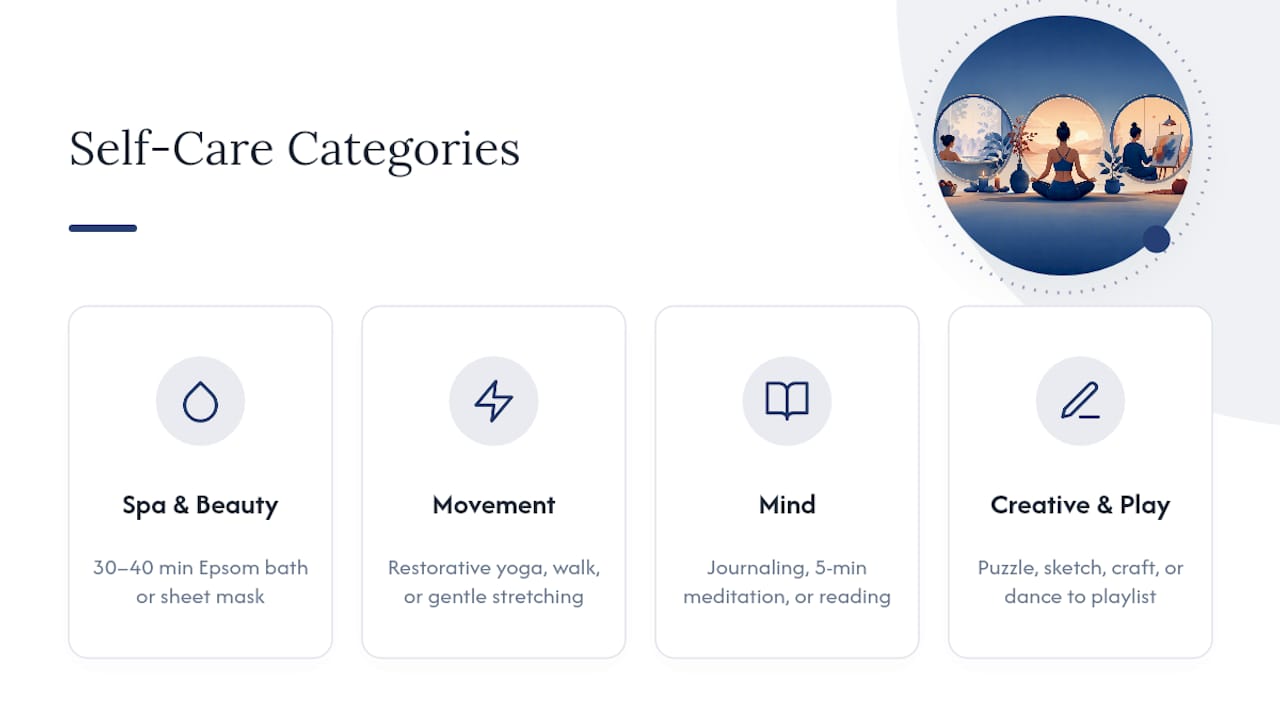
Spa and beauty A warm bath with 2 cups of Epsom salts, soaked for 30 to 40 minutes, is the anchor activity for a reason: it’s simple, cheap, and hard to mess up. Add a few drops of lavender or eucalyptus oil for the aromatherapy layer. No tub? A sheet mask and a slow five-minute face massage while you sit with a podcast delivers a scaled-down version of the same signal to your body.
Movement Restorative yoga, a phone-free walk, or gentle stretching on the living room floor. Peer-reviewed research connects movement, music, and time outdoors to measurable mood benefits, which is part of why a walk works even when you don’t feel like moving.

Mind Some minutes of journaling, a guided breathing exercise, or a chapter of a physical book. Meditation counts here too, even five minutes of it.
Creative and play A puzzle, a sketchbook, a small craft project, or just dancing around your kitchen to a playlist you haven’t heard in years. This category gets skipped most often and missed most when it’s gone.
Food and nourish Cook something simple that takes a little more care than a weekday meal. Herbal tea instead of your third coffee. Eating one meal without a screen in front of you, actually tasting it.

Space A 10-minute room refresh, a fresh pillowcase, one small load of laundry. This isn’t about productivity, it’s about not starting Monday in a space that feels chaotic.
Three Ready-Made Routines to Copy
- The 60-minute reset: Phone off for the full hour. Ten minutes of hydration and quiet. A 20-minute walk outside. Fifteen minutes of journaling. Fifteen minutes of simple skincare, wash your face slowly, apply moisturizer like it’s a ritual, not a chore.
- The 2-3 hour sweet spot: Slow morning with coffee and no agenda. A bath with Epsom salts or 30 minutes of restorative yoga. Cook one nourishing meal from scratch. Close with 20 minutes of rest or reading before you transition back to normal life.
- The full-day restorative plan: Cover all five windows. Give the indulgent middle window more room, a longer bath, a nap, a slow lunch. End with a proper wind-down instead of letting the evening dissolve into errands.
If mobility is limited, swap the walk for seated stretching or a short driveway loop. Parents and caregivers can split windows between two adults so each person gets one uninterrupted block, or shrink every window to 15 to 30 minutes rather than skipping the day entirely. Shift-workers should treat whatever day off falls on their schedule the same way, the framework doesn’t require an actual Sunday, just a full day of recovery.
Evening Wind-Down and Why Sunday Bedtime Matters
The last two hours of your Sunday decide how Monday feels. Put your phone on Do Not Disturb, or in another room, 60 to 90 minutes before bed. If anxious thoughts about the week start creeping in, try a 15-minute “Sunday scaries” checklist: write down every worry, then next to each one write one small action you can take Monday morning. It turns vague dread into a short, finite list.
Keep dinner light and warm, soup, roasted vegetables, something that doesn’t sit heavy. Hydrate earlier in the evening rather than right before bed.
- Phones out of the bedroom, not just silenced.
- A warm, non-caffeinated drink an hour before lights out.
- A few pages of a physical book instead of a screen; reading print before bed improves sleep onset compared with scrolling.
- Aim for a reasonable bedtime when your schedule allows it. Wellness writers consistently link an earlier Sunday bedtime to a smoother Monday morning, and a firm screens-off buffer paired with a simple pre-sleep ritual, warm drink, light reading, a few minutes of slow breathing, tends to work better than reaching for an over-the-counter sleep aid.
Why This Framework Works (and Where the Author Stands)
Ravi, a Mindpanda blog contributor focused on mindfulness and stress management, built this framework around a simple observation: rituals work better than routines built on willpower. Small sensory cues, a candle, a specific playlist, a textured journal, signal to your body that it’s safe to slow down. The American Heart Association frames self-care as a necessity, not a luxury, and that framing matters more than any specific product you use.
A journal on your nightstand or a stress ball in your bag doesn’t create calm by itself. It works because it gives your hands and mind something to do during the exact moments you’d otherwise default to your phone.
— Ravi
The Real Mistake People Make With Sunday Self-Care
Most advice on this topic treats Sunday like a productivity problem to solve, batch your errands, meal prep for the week, get ahead on emails. That’s not self-care, that’s just work wearing a cardigan. The five-window framework works precisely because it refuses that framing. It asks what your nervous system needs, not what your calendar needs.
Here’s what conventional wisdom gets backwards: it assumes more activities equal more recovery. In practice, the opposite happens. Three activities done slowly beat eight done quickly, every time. If you take one thing from this guide, let it be permission to do less. Pick your bath, your walk, your journal entry. Protect the time. Skip the rest.
The other overlooked piece is honesty about your actual energy level that week. A brutal work week calls for the 60-minute version, not a guilt-driven attempt at a full day you don’t have the bandwidth for. Matching the routine to your real state, not your ideal one, is what makes it sustainable past the first few Sundays.
Build Your Sunday Reset With the Right Tools on Hand
A good ritual doesn’t need much, but the right small objects make it easier to actually follow through instead of defaulting to your phone. Mindpanda’s Mindfulness Wellbeing Bundle pairs a guided journal, a sensory stress ball, and calming essentials designed for exactly this kind of slow afternoon.

Use the journal during your quiet evening window for the gratitude or Sunday scaries exercise. Keep the stress ball nearby during your bath or reading time for a tactile anchor when your mind wanders back to Monday. If you’d rather build something specific to your own routine, you can create your own wellbeing bundle and choose the pieces that match your five-window plan. For a full 60-minute reset: light a candle, set your journal and stress ball within reach, and start your Do Not Disturb hour before you check anything else. Browse the bundle and pick your starting point today.