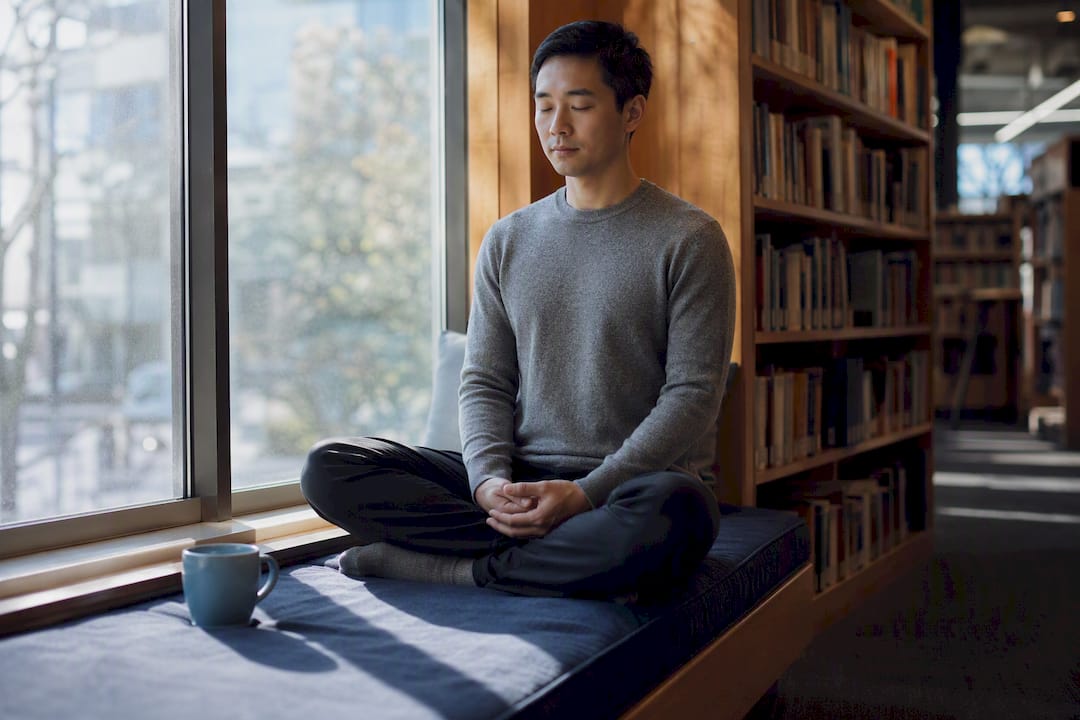
This page gives you a complete 30-day mindfulness challenge with one clear daily practice for every day of the month. Most days ask for just 5 to 15 minutes, and the first week runs even shorter, often 2 to 5 minutes. The goal isn’t a perfect meditation streak. It’s building a habit steady enough to outlast the month itself.
TL;DR:
- Most practice sessions are designed to be short, starting at 2 to 5 minutes in week one to prioritize habit formation over duration.
- Common obstacles include time pressure, restlessness, and the all-or-nothing mindset, which can be mitigated by shortening practices and avoiding strict streaks.
- Pairing meditation with journaling or sensory activities enhances habit consistency and helps overcome boredom and difficulty maintaining focus.
- After 30 days, sustain progress by selecting a daily practice length you can maintain long-term and gradually increasing the intensity or duration.
- Using tangible objects like journals or reminder tools can improve adherence by anchoring the practice in physical space, especially during busy or disrupted days.
Table of Contents
- Your 30-Day Mindfulness Challenge at a Glance
- Day-by-Day Plan: Days 1 Through 30
- Setting Up the Challenge So It Actually Fits Your Day
- Why People Quit Around Day 12, and How to Not
- What to Do After Day 30
- What the Research Actually Shows About a Month of Practice
- The Obstacles That Trip Up Almost Every Beginner
- Does 30 Days of Short Daily Practice Actually Change Anything?
- Why a Slow Build Beats a Big Push
- Give the Challenge a Physical Anchor
- Sources
Your 30-Day Mindfulness Challenge at a Glance
The plan grows in four stages, each one week long, so your brain adjusts before the difficulty increases. This progression matters more than any single day’s practice. A progressive structure that starts with 2 to 5 minute sessions and builds to 10 to 15 minutes by week four prioritizes habit formation over how long you sit, and that’s the whole strategy behind this challenge.
- Week 1: Tiny noticing practices, 2 to 5 minutes a day, just to build the habit of showing up.
- Week 2: Short formal sits, 5 to 10 minutes, introducing actual seated meditation.
- Week 3: Mindfulness applied to daily actions like eating and walking, minutes creeping up toward 10.
- Week 4: You settle on a sustainable length, usually 10 to 15 minutes, and start weaving it into normal life.
If sitting still isn’t your thing, walking meditations, one line journal entries, and mindful chores like washing dishes count just as much as a cushion session.
Day-by-Day Plan: Days 1 Through 30
Each day below gives you one practice. Some are sits, some are journal prompts, some are just paying attention to something you’d normally do on autopilot. None require more than 15 minutes, and several take less than 5.
- Sit and breathe. Set a timer for 3 minutes. Just notice your breath entering and leaving.
- Body check-in. Spend 3 minutes scanning from your feet to your head, noticing tension without trying to fix it.
- One-sentence journal. Write one sentence about how you feel right now, no editing.
- Mindful eating. Eat one meal today without your phone. Notice texture and flavor.
- Five senses pauses. Stop for 2 minutes and name one thing you can see, hear, smell, touch, and taste.
- Sound scan. Sit for 5 minutes and simply track sounds around you as they rise and fall.
- Weekly reflection. Journal for 5 minutes on what felt easy or hard this week.
- Formal sit, 5 minutes. Follow your breath. When your mind wanders, just return, no judgment.
- Gratitude prompt. Write three things you noticed today that you’d normally overlook.
- Body scan, extended. Spend 8 minutes moving attention slowly through your whole body.
- Mindful walking. Take a 10 minute walk and pay attention only to your feet hitting the ground.
- Loving-kindness mini-practice. Spend 5 minutes silently wishing wellbeing to yourself, then someone you love.
- Listening practice. During one conversation today, listen fully without planning your response.
- Weekly reflection. Note one moment this week when you felt genuinely present.
- Breath counting. Sit for 8 minutes counting each exhale up to 10, then start over.
- Mindful chore. Do one household task, dishes or folding laundry, with full attention on the motion.
- Difficult emotion check-in. Notice one uncomfortable feeling today and describe it in your journal without judging it.
- Sit, 10 minutes. Breath awareness, letting thoughts pass like clouds.
- Mindful commute. Notice three physical sensations during your drive, walk, or ride today.
- Body scan, 10 minutes. Focus especially on areas that usually hold tension, jaw, shoulders, hands.
- Weekly reflection. Journal on what’s gotten easier since day one.
- Loving-kindness, expanded. Extend the goodwill practice to someone you find difficult.
- Mindful screen break. Take one 5 minute break from your phone and just observe your surroundings.
- Sit, 10 minutes. No technique required. Just sit and notice what arises.
- Savoring practice. Choose one small pleasure today, coffee, sunlight, music, and give it your full attention for 3 minutes.
- Walking meditation, 10 minutes. Slow your pace and match your attention to each step.
- Journal prompt. Write about a moment this month you almost skipped but didn’t.
- Sit, 12 minutes. Breath awareness with an open, non-reactive attitude toward whatever comes up.
- Mindful goodbye. Notice one thing you’ll miss about the structure of daily prompts.
- Full reflection. Journal for 10 minutes on what changed, what you’ll keep, and what a sustainable version of this looks like.
Setting Up the Challenge So It Actually Fits Your Day
Pick an anchor before you pick a technique. Attach the practice to something you already do every day, right after coffee, right before brushing your teeth, right when you sit down at your desk. This one decision does more for adherence than any app or app streak.
- A phone timer works fine; guided audio or a meditation app helps on days your mind is loud.
- A notebook, even a plain one, is enough for the journal prompts scattered through the plan.
- A chair or cushion is optional. Several days in this challenge don’t involve sitting at all.
- Set a genuine minimum, even 2 minutes, so a busy day doesn’t turn into a skipped day.
Travel, work chaos, and sick kids will interrupt you at some point. When that happens, swap the day’s sit for a 2-minute noticing practice, or a short mindful activity you can do standing in line. If a new parent’s schedule is your reality, a flexible daily routine built for caregivers can help you find realistic anchor points.
Pro Tip: If you miss a day, just resume the next one at the same spot. Doubling up two days’ practices to “catch up” usually backfires and makes the challenge feel like a chore instead of a habit.
Why People Quit Around Day 12, and How to Not
Most drop-off happens in week two or three, right when the “new habit” thrill wears off and life gets in the way again. Week-three resistance is predictable enough that the smart move isn’t lengthening your sits, it’s lowering the bar further and adding accountability instead.
- Keep your minimum embarrassingly small on hard days. Two minutes still counts as a full day.
- Tell a friend or partner you’re doing this, or block time on a calendar. Outside accountability catches what willpower misses.
- Boredom or restlessness during a sit isn’t a sign you’re failing. Accept it, switch formats (walking instead of sitting), or simply shorten the session and try again later.
- If you keep dozing off, that’s your body telling you something. Swap the seated practice for a short walk or a few minutes of gentle stretching with attention on the movement.
If anxiety is what’s derailing your sits specifically, a handful of short calming practices built for exactly that moment can substitute for a formal sit without breaking your streak.
What to Do After Day 30
Day 30 isn’t a finish line. It’s the point where you decide what stays. Pick one daily length you can actually sustain long term, often shorter than what you were doing by week four, and commit to that instead of trying to keep escalating.
- Add one weekly deeper practice, a longer guided session or a slow walking meditation, instead of stretching every single day.
- Track something simple: a streak count, a one-line daily mood note, or how you’re sleeping. Small signals tell you more than they seem to.
- If you want to go deeper, increase minutes slowly over weeks, not days, and vary formats rather than just adding time.
- Consistency beats intensity every time. A daily 5-minute practice you keep for a year beats a 30-minute practice you keep for nine days.
If sleep has been part of what you’re tracking, a dedicated look at mindfulness for sleep is worth reading once the challenge itself is behind you.
What the Research Actually Shows About a Month of Practice
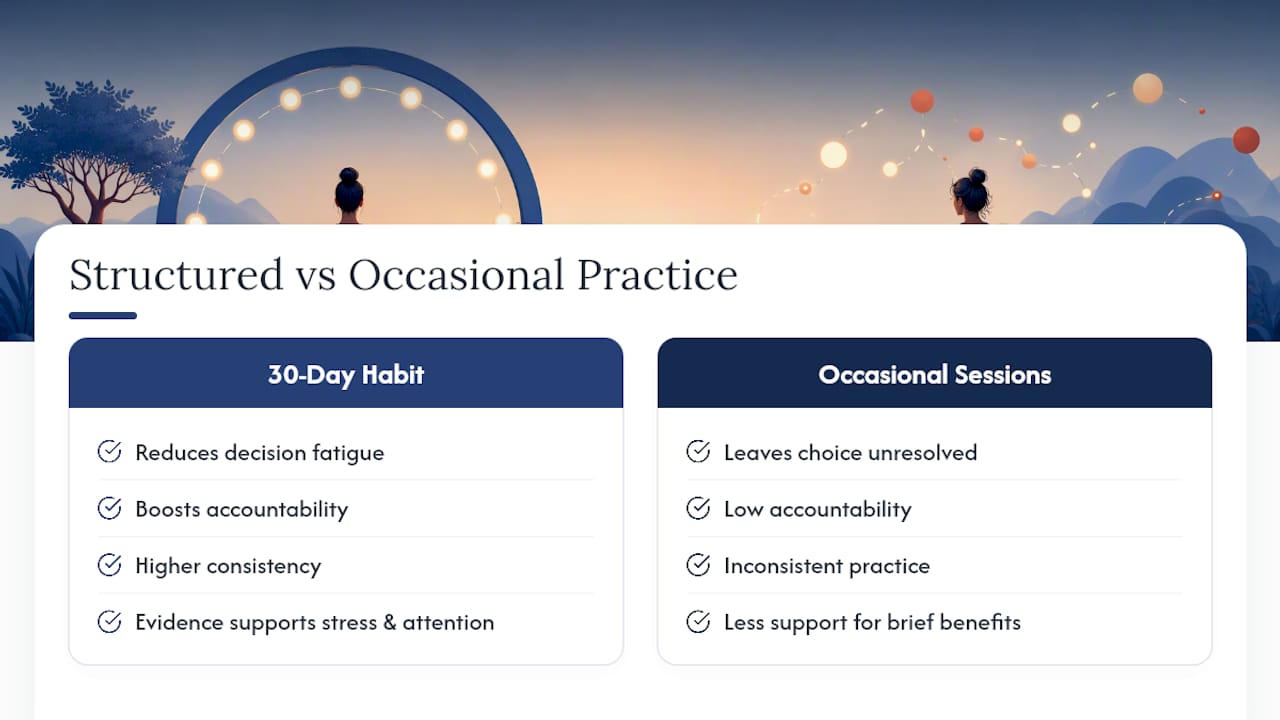
The appeal of a structured challenge isn’t just motivational. Structured programs reduce decision fatigue and boost accountability, the two biggest barriers that stop beginners from meditating consistently. Removing the “what should I do today” question is, on its own, a meaningful chunk of why these challenges work better than vague intentions to “meditate more.”
Mindfulness practice broadly carries a decent evidence base for lowering stress markers and improving attention regulation, particularly when it’s practiced consistently rather than in occasional long sessions. That’s a case for the tiny-daily-habit approach over an occasional hour-long sit, and it’s one reason mindfulness and journaling are frequently paired in stress-reduction research.
The framework echoes decades-old clinical thinking, most notably the Mindfulness-Based Stress Reduction (MBSR) model developed by Jon Kabat-Zinn, which defines mindfulness as paying attention, on purpose, in the present moment, without judgment. What a 30-day challenge does is translate that definition into a daily habit small enough to actually keep. A month of practice won’t rewire your nervous system overnight, but it’s long enough to notice real shifts, calmer reactions, better sleep, less mental noise, especially if you kept the sessions short enough to never dread them.
The Obstacles That Trip Up Almost Every Beginner
Nearly everyone hits the same three walls. The first is time pressure, the belief that mindfulness requires 20 quiet uninterrupted minutes you don’t have. It doesn’t. Several days in this plan take under 5 minutes precisely because that belief is the fastest way to quit before day 5.
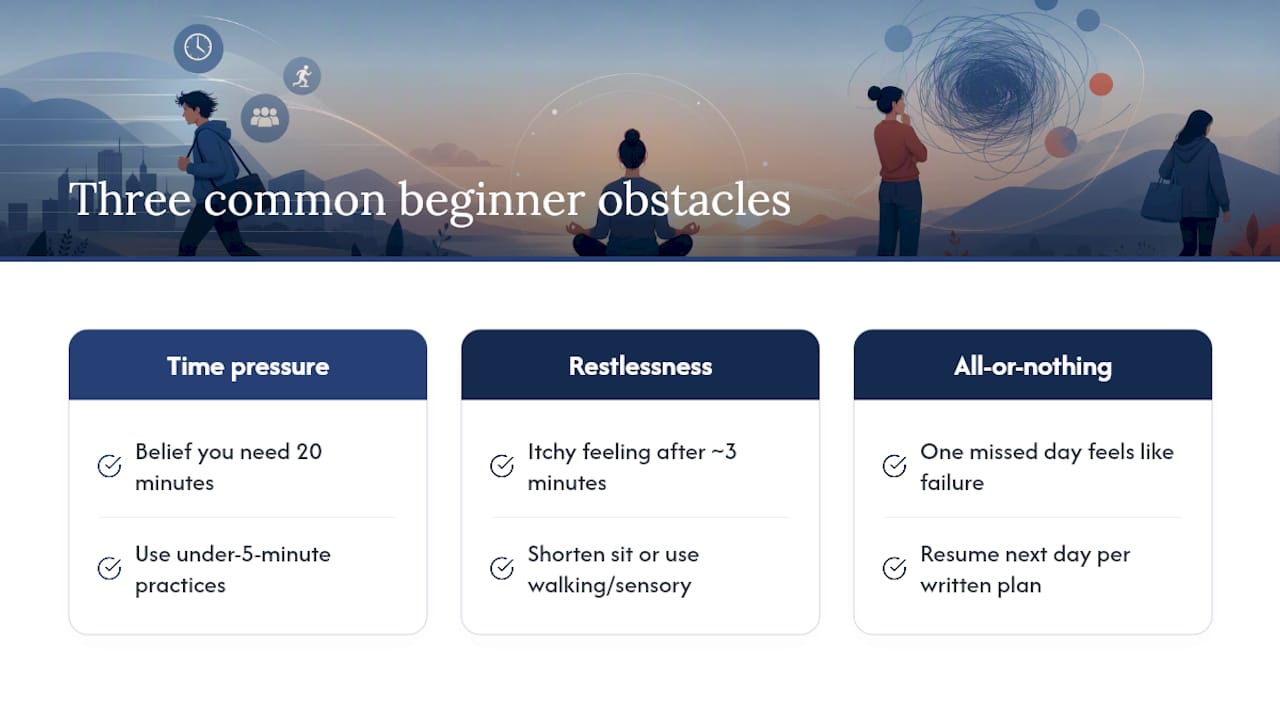
The second wall is restlessness, that itchy, irritated feeling that shows up around minute three of a sit. This is normal, not a sign you’re doing it wrong. Beginners often interpret restlessness as failure and abandon the practice entirely, when the actual fix is simpler: shorten the sit, switch to a walking or sensory practice, and come back to sitting once it feels less like a chore.
The third wall is the all-or-nothing trap. One missed day turns into a “failed challenge,” and the whole thing gets abandoned. This is where a written plan helps more than an app streak: when the plan itself tells you to just resume the next day, missing a day stops feeling like failure and starts feeling like Tuesday.
Journaling helps with all three, partly because it gives you something concrete to point to when the practice feels intangible. Sensory-based, short journal prompts work well as a genuine substitute for people who find seated meditation difficult, which is exactly why several days in this plan swap the cushion for the notebook.
Does 30 Days of Short Daily Practice Actually Change Anything?
Short-form mindfulness challenges have become common precisely because the format matches how attention research says habits form: small, frequent repetitions beat occasional long sessions for building anything that sticks, meditation included.
Public 28 to 30 day mindfulness programs consistently emphasize that showing up matters more than how long you sit, and they explicitly validate walking meditation and other informal practices as legitimate alternatives to formal seated sessions. That detail matters for anyone worried they’re “doing it wrong” by skipping a cushion in favor of a walk around the block.
Pairing is another consistent finding. A short guided practice combined with even a one-line written reflection tends to boost both awareness and how much people remember and apply from the session, compared with a silent sit alone. That’s the logic behind alternating sits with one-sentence journal days throughout this plan rather than asking you to meditate silently for 30 straight days. Thirty days won’t turn anyone into a seasoned practitioner, but it’s a realistic window for noticing whether a habit is worth keeping, which is really the only question a challenge like this needs to answer.
Why a Slow Build Beats a Big Push
Most people who fail at meditation didn’t fail because they lack discipline. They failed because they started with 20 minutes on day one, hated it, and quit by day four. Starting tiny isn’t a compromise. It’s the actual strategy.
What surprises people is how little the technique matters compared to the schedule. A 3 minute breath count done daily for a month will outperform a 30 minute session done twice. Beginners chase the “right” technique when the real lever is showing up at a low enough bar that showing up is easy. Some journals and simple tools are built around exactly that idea, because a habit needs a physical, low-friction anchor more than it needs a perfect method. Try the plan as written, but don’t be precious about it. Swap a sit for a walk, skip a day without spiraling, and treat the missed days as part of the process rather than proof it isn’t working.
— Ravi
Give the Challenge a Physical Anchor
A plan on a screen is easy to forget by day 4. A Mindfulness Wellbeing Bundle gives the challenge something to live in, a real object that sits on your desk or nightstand as a reminder that today’s practice is waiting.

Some journals and stress-relief tools are designed around small, repeatable moments like those this challenge asks for, tactile prompts you can hold instead of another app notification. If journaling days are the ones you’re most likely to skip, the Thrive & Reflect journal bundle pairs guided prompts with the reflection habit this plan leans on. None of it is required to finish the 30 days. But if you want fewer decisions and more prompts already written for you, build your own wellbeing bundle and pick the tools that match the days you’re most likely to need backup.
Sources
- The 30-Day Mindfulness Challenge: Train Your Brain to Be Present - ooddle
- Journalprompts
- Mindfulnessexercises