
A short, targeted routine, done consistently, can measurably ease nighttime anxiety and get you to sleep faster. The mix that works best combines one body-based technique (like paced breathing or progressive muscle relaxation) with one mind-based technique (like a worry dump or a slow visualization), done in a fixed order so your brain starts to recognize it as a signal to power down.
Here’s what to do right now, before you read another word of theory:
- Dim the lights and sit up in bed or in a chair (2 minutes). Put your phone in another room or face down and silent.
- Do six rounds of 4-7-8 breathing: inhale 4 seconds, hold 7, exhale 8 (3 to 4 minutes).
- Run a quick progressive muscle relaxation pass, head to feet, tensing and releasing each muscle group for 5 seconds (8 to 10 minutes).
- Spend 3 minutes on a slow visualization — a familiar, boring place with no plot and no problem to solve.
- Lie down and let your mind wander without chasing any single thought.
That’s the 10 to 20 minute version. Stretch it to 30 minutes by adding a short worry dump beforehand, which we’ll cover in detail later.
Pro Tip: If a technique makes you MORE alert instead of calmer, stop it immediately. Paced breathing occasionally backfires for people who are hyperaware of their own body, in which case skip straight to progressive muscle relaxation or get out of bed for ten minutes and try again once you feel drowsy.
Key Takeaways
Calming sleep anxiety works best through a repeatable combination of one body-based technique, one mind-based technique, and a consistent wind-down buffer practiced nightly.
| Point | Details |
|---|---|
| Start with breathing and PMR | Six rounds of 4-7-8 breathing plus a quick progressive muscle relaxation pass calms the body fastest. |
| Separate worry time from bedtime | Schedule 10 to 15 minutes earlier in the day for worry journaling so it doesn’t hijack bedtime. |
| Build a real wind-down buffer | Give yourself 30 to 60 minutes of low-stimulation activity before attempting sleep. |
| Know the CBT-I timeline | Consider CBT-I, typically 4 to 8 sessions, if self-help routines don’t help within a few weeks. |
| Watch for red flags | Frequent panic attacks, a month of severe insomnia, or any thoughts of self-harm warrant a doctor’s visit. |
| Use supportive tools | A journal or sensory object from Mindpanda’s wellbeing bundle can reinforce worry-time and grounding practices alongside these techniques. |
Table of Contents
- What Sleep Anxiety Calming Actually Addresses
- Why Anxiety Gets Louder When the Lights Go Out
- Techniques That Calm Your Body and Mind Tonight
- Building a Bedtime Routine That Lowers the Pressure
- Retraining the Anxious Thoughts Behind Sleep Problems
- When Sleep Anxiety Needs More Than Self-Help
- Your Try-Tonight Plan, Step by Step
- What I’ve Noticed About How This Actually Plays Out
- How Mindpanda Supports the Routine You Just Learned
- Sources
What Sleep Anxiety Calming Actually Addresses
Sleep anxiety is the fear or dread of not being able to fall asleep, stay asleep, or feel rested, and it often shows up as a tight loop where worrying about sleep becomes the very thing that prevents it. In its more intense form, this is sometimes called somniphobia, an actual fear of going to sleep, which can involve avoiding bed entirely or fighting sleep because of nightmares or a fear of losing control.
Most people experiencing this don’t describe it in clinical terms. They describe a racing mind that won’t shut off the second the lights go out, a heart that seems to pound louder in a quiet room, or a wired, jittery feeling that shows up right as the body should be winding down. The Sleep Foundation notes that anxiety often intensifies at night simply because there are fewer distractions competing for your attention, so worries and physical sensations that you barely noticed during the day suddenly feel impossible to ignore.
Typical nighttime presentations include:
- Lying awake replaying conversations or rehearsing tomorrow’s problems.
- A pounding or fluttering heartbeat that makes you feel like something is medically wrong.
- Checking the clock repeatedly and calculating how many hours of sleep are “left.”
- Feeling exhausted all day but suddenly alert the moment you get into bed.
- Dreading bedtime itself, hours before it arrives.
A reader with generalized anxiety might notice this pattern nightly. Someone under short-term stress, like before a big presentation or after a stressful family event, might notice it flare up for a few nights and then fade. Both patterns respond to the same core toolkit.
Why Anxiety Gets Louder When the Lights Go Out
Nighttime isn’t neutral. Several biological shifts happen right around bedtime that make anxiety more noticeable, not less. Cortisol, the hormone tied to alertness and stress response, naturally follows a daily rhythm and should be dropping as evening progresses, but chronic stress or an irregular schedule can flatten or disrupt that curve, leaving your body more physiologically “on” than it should be at 11 p.m. Add to that the simple fact that lying still in a dark, quiet room removes the sensory noise that normally distracts you from your own heartbeat and breathing, and ordinary bodily sensations start to feel alarming.
Behavior compounds the biology. Rumination, the habit of replaying the same worries on a loop, tends to spike right at bedtime because it’s often the first unstructured, quiet block of time in a person’s day. Screen use before bed keeps the mind engaged and can suppress melatonin release through blue light exposure. Caffeine late in the day, even a single afternoon coffee for some people, can still be active in your system at bedtime given its several-hour half-life. And a newer behavioral trap has emerged with wearable sleep trackers: obsessively checking sleep scores and stage data can create what researchers call orthosomnia, an anxiety-driven fixation on sleep metrics that ironically makes sleep worse.
Left unaddressed, this pattern doesn’t stay confined to nighttime. Chronic sleep anxiety fragments sleep architecture, cutting into the deep and REM stages your brain needs for memory consolidation and emotional regulation, which then feeds back into next-day irritability, poor concentration, and a lower threshold for stress. It becomes a loop that reinforces itself.
A recent national survey cited by Johns Hopkins Medicine found that roughly 44 percent of adults had at least one night of stress-related sleeplessness in the previous month. That’s not a rare complaint. It’s closer to the norm for anyone under sustained pressure.
Techniques That Calm Your Body and Mind Tonight
These are the tools to reach for the moment anxiety shows up at bedtime. Each one targets a slightly different part of the anxiety response, so it’s worth trying a few to see what your body responds to.
- 4-7-8 breathing. Inhale quietly through your nose for 4 seconds, hold the breath for 7 seconds, then exhale slowly through your mouth for 8 seconds. Repeat for 4 to 8 cycles. The extended exhale activates the parasympathetic nervous system, which is the body’s built-in brake pedal, and Cleveland Clinic notes it can measurably slow heart rate and lower blood pressure within a few rounds. For more breathing patterns worth learning, Mindpanda’s guide to breathing exercises covers several variations beyond this one.
- Progressive muscle relaxation (PMR). Starting at your feet, tense each muscle group hard for 5 seconds, then release and notice the contrast for 10 seconds. Move upward through calves, thighs, glutes, abdomen, hands, arms, shoulders, and face. A full pass takes 10 to 15 minutes; a quick version hitting just legs, hands, and shoulders takes about 5.
- Grounding through the senses. Name 5 things you can see, 4 you can feel, 3 you can hear, 2 you can smell, and 1 you can taste. This pulls attention out of racing thoughts and into your immediate physical environment, interrupting the sympathetic nervous system’s alarm state in under 2 minutes.
- Soothing visualization. Picture a specific, low-stimulation place in detail, a familiar walking trail, a childhood bedroom, a beach at low tide, and stay with the sensory details rather than any storyline. Experts point to this kind of deliberate, low-stakes mental task as an effective way to out-compete racing thoughts for your attention. Give it 3 to 5 minutes.
- Body scan. Move your attention slowly from your scalp to your toes without trying to change anything, just noticing where tension sits. This differs from PMR in that you don’t tense muscles, you simply observe. It takes 8 to 12 minutes and works well for people who find active tensing too stimulating.
Pro Tip: Stack techniques instead of picking just one. A common effective sequence is 4-7-8 breathing for 3 minutes to lower physical arousal, followed by a 3-minute visualization to occupy the mind. The breathing calms the body first; the visualization gives the now-calmer mind somewhere to go.
| Technique | Time | Best Use Case |
|---|---|---|
| 4-7-8 breathing | 3–5 minutes | Racing heart, physical tension, panicky feeling |
| Progressive muscle relaxation | 10–15 minutes | Restless body, muscle tightness, can’t lie still |
| Grounding (5-4-3-2-1) | 1–2 minutes | Sudden spike of panic, racing thoughts mid-night |
| Visualization | 3–5 minutes | Mental chatter that won’t stop, overthinking |
| Body scan | 8–12 minutes | General unease without a clear trigger |

Building a Bedtime Routine That Lowers the Pressure
Most sleep anxiety advice focuses on the moment you’re already in bed and panicking. But a lot of that panic gets built in the hour beforehand, so the wind-down period matters as much as anything you do once the lights are off.
Think of it as a buffer zone rather than a hard bedtime. Instead of demanding sleep the instant you lie down, give yourself a 30 to 60 minute runway of calming, low-stimulation activities: light stretching, reading something unengaging, a warm shower, or a few pages in a journal. This buffer removes the all-or-nothing pressure that fuels anxiety in the first place, since you’re not expecting your body to switch from alert to unconscious in zero seconds.
Your bedroom environment does real work here too. Keep the room cool, ideally somewhere in the mid-60s Fahrenheit, dark enough that you can’t see your hand in front of your face, and quiet or masked with steady white noise. Reserve the bed itself for sleep only, not for scrolling, working, or watching TV, so your brain builds a strong association between “bed” and “sleep” rather than “bed” and “alert activity.”
Evening do’s and don’ts:
- Do keep a consistent wind-down start time, even on weekends.
- Do dim household lights an hour before bed to support melatonin release.
- Don’t drink caffeine after early afternoon; it can still be active at bedtime.
- Don’t use alcohol as a sleep aid. It fragments sleep later in the night even though it feels sedating up front.
- Don’t doomscroll or check news and email once the wind-down period starts.
Pro Tip: If you use a sleep tracker, check your data once a week, not every morning. Daily obsessive checking is exactly the pattern behind orthosomnia, where anxiety about your sleep score starts causing the poor sleep you’re trying to measure. A simple pen-and-paper log of bedtime, wake time, and how rested you felt often gives you more useful information with less anxiety attached.
Retraining the Anxious Thoughts Behind Sleep Problems
Calming your body only solves half the problem if your mind is still running laps. Two daytime habits make a real difference here, and both are simple enough to start tonight; practical daytime worry scheduling and journaling practices can help reduce bedtime rumination and improve sleep quality, as outlined in How to make your good night sleep come true? - TMRG Solutions.
Worry time means setting aside a fixed 10 to 15 minute window earlier in the day, not at bedtime, to sit down and write out whatever is bothering you. When intrusive worries show up later at night, you tell yourself, honestly, “I’ve already scheduled time for this tomorrow,” and redirect your attention. Journaling those worries externalizes them onto paper instead of leaving them circling in your head, which measurably reduces bedtime rumination for a lot of people. A related trick backed by the same research: jotting down tomorrow’s to-do list before bed also reduces the tendency to lie there mentally rehearsing tasks.
Cognitive reframing targets the specific anxious predictions that show up at night, thoughts like “I’ll never fall asleep” or “I’ll be useless tomorrow if I don’t sleep now.” The exercise is simple: write the thought down, then ask what actually happened the last several times you had a bad night. Usually the answer is that you functioned, tired but functional, which is a different outcome than the catastrophic one your anxious brain predicted. Mindpanda’s piece on mindfulness for sleep walks through this kind of observation practice in more depth, and one useful shift practitioners recommend is trading the goal of “achieve sleep” for “enjoy rest,” since chasing sleep directly tends to backfire.
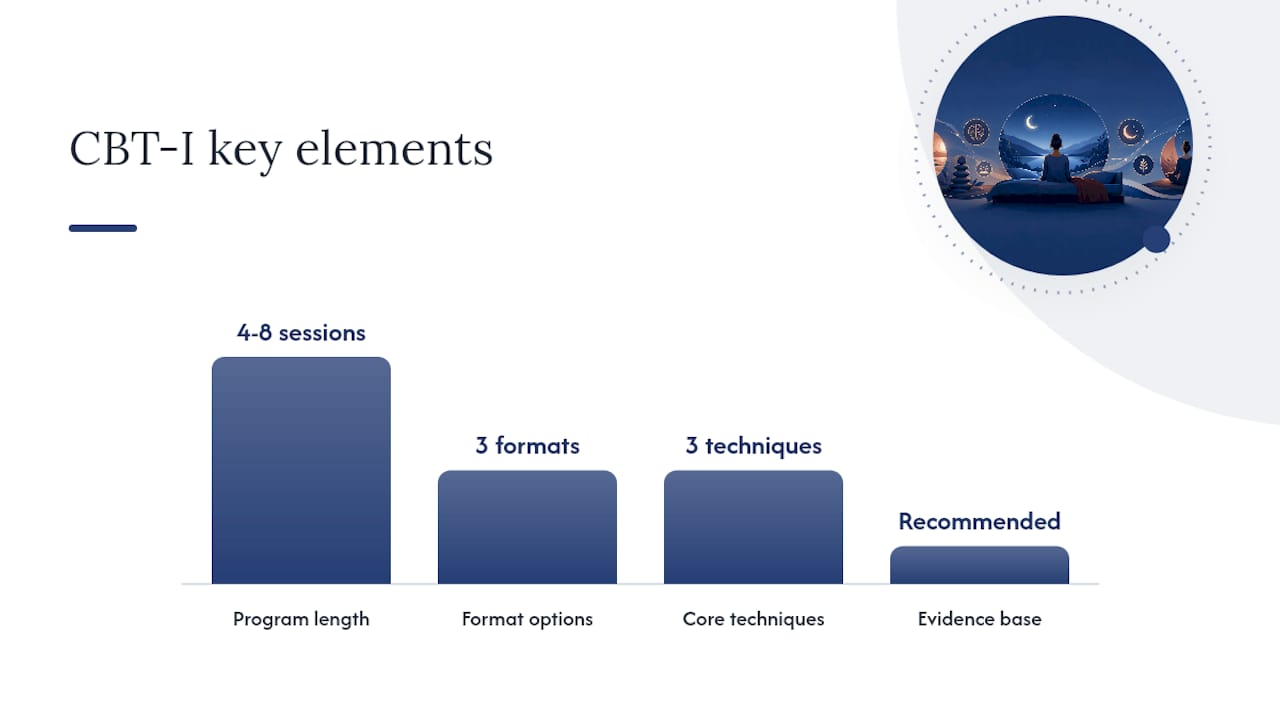
If these daytime and bedtime strategies don’t resolve things on their own, Cognitive Behavioral Therapy for Insomnia, known as CBT-I, is the evidence-based first-line treatment for sleep anxiety and chronic insomnia. It’s structured, time-limited, and directly targets both the behaviors and thought patterns keeping you stuck.
| CBT-I element | Typical detail |
|---|---|
| Program length | About 4 to 8 sessions |
| Format options | In-person with a sleep specialist, primary care referral, or structured digital programs |
| Core techniques | Sleep restriction, stimulus control, cognitive restructuring |
| Evidence base | Recommended over long-term hypnotic medication as a first-line approach |
One of the core behavioral rules inside CBT-I is worth adopting on its own even before you see a specialist: if you haven’t fallen asleep within about 20 minutes, get up. Do something quiet and low-stimulation, like reading under dim light, until you feel drowsy again, then return to bed. This breaks the association your brain builds between “lying in bed” and “being anxiously awake.”
When Sleep Anxiety Needs More Than Self-Help
Most nighttime anxiety responds well to the techniques above, given a few weeks of consistent practice. But some patterns are a signal to bring in a professional rather than keep troubleshooting solo.
Watch for these red flags:
- Frequent nocturnal panic attacks that wake you gasping or with a racing heart, especially if they happen more nights than not.
- Severe insomnia lasting a month or longer that hasn’t improved despite trying wind-down routines and calming techniques.
- Daytime impairment serious enough to affect work, driving safety, or relationships.
- Any thoughts of self-harm or suicide, which require immediate attention, not a wait-and-see approach.
- Physical symptoms at night, like chest pain or shortness of breath, that could indicate something other than anxiety.
If any of those apply, a good next step is a conversation with your primary care doctor, who can rule out medical causes and refer you to a sleep clinic or mental health provider. If you’re in crisis or having thoughts of self-harm, contact a crisis line or emergency services right away rather than waiting for a routine appointment.
Pro Tip: Before a clinician visit, spend a week keeping a simple sleep diary: bedtime, approximate time you fell asleep, number of wake-ups, and how you felt the next day. Bring a list of current medications and supplements too. That single week of data often shortens the diagnostic process significantly, since it gives the clinician a real pattern to work with instead of your best guess from memory.
Your Try-Tonight Plan, Step by Step
Pick one of these two routines based on how much time and energy you have. Neither requires anything you don’t already have in your bedroom.
The 10-minute quick calm:
- Dim the lights and silence your phone (1 minute).
- Six rounds of 4-7-8 breathing (4 minutes).
- Quick PMR pass hitting just legs, hands, and shoulders (4 minutes).
- Lie down and let your mind settle without chasing thoughts (1 minute).
The 25 to 30 minute full routine:
- Ten minutes earlier in the evening, do a quick worry dump: write down anything on your mind, no editing (10 minutes, done before your wind-down period starts).
- Warm shower or light stretching as your wind-down buffer (10 minutes).
- Full-body PMR pass, head to toe (10 minutes).
- Slow visualization once you’re lying down (3 to 5 minutes).
If either routine leaves you more alert instead of calmer:
- Get out of bed rather than lying there frustrated.
- Do something quiet and low-engagement in dim light, like reading a physical book.
- Try the grounding exercise (5-4-3-2-1) instead, since it interrupts panic faster than breathing does for some people.
- Return to bed only once you feel genuinely drowsy.
Give a chosen routine at least 5 to 7 consecutive nights before deciding it’s not working. Anxiety-driven sleep patterns took time to build, and a single rough night doesn’t mean the technique failed. If after two weeks nothing has shifted, that’s your cue to try a different combination from the list above or bring the pattern to a doctor.
What I’ve Noticed About How This Actually Plays Out
People rarely fix sleep anxiety in one night, and expecting to is often part of the problem. In practice, the clients who make real progress are the ones who treat the first week or two as data collection rather than a test they need to pass. They try the breathing, notice it helps a little, try PMR the next night, notice it helps more, and slowly build a personal toolkit instead of hunting for one perfect fix.
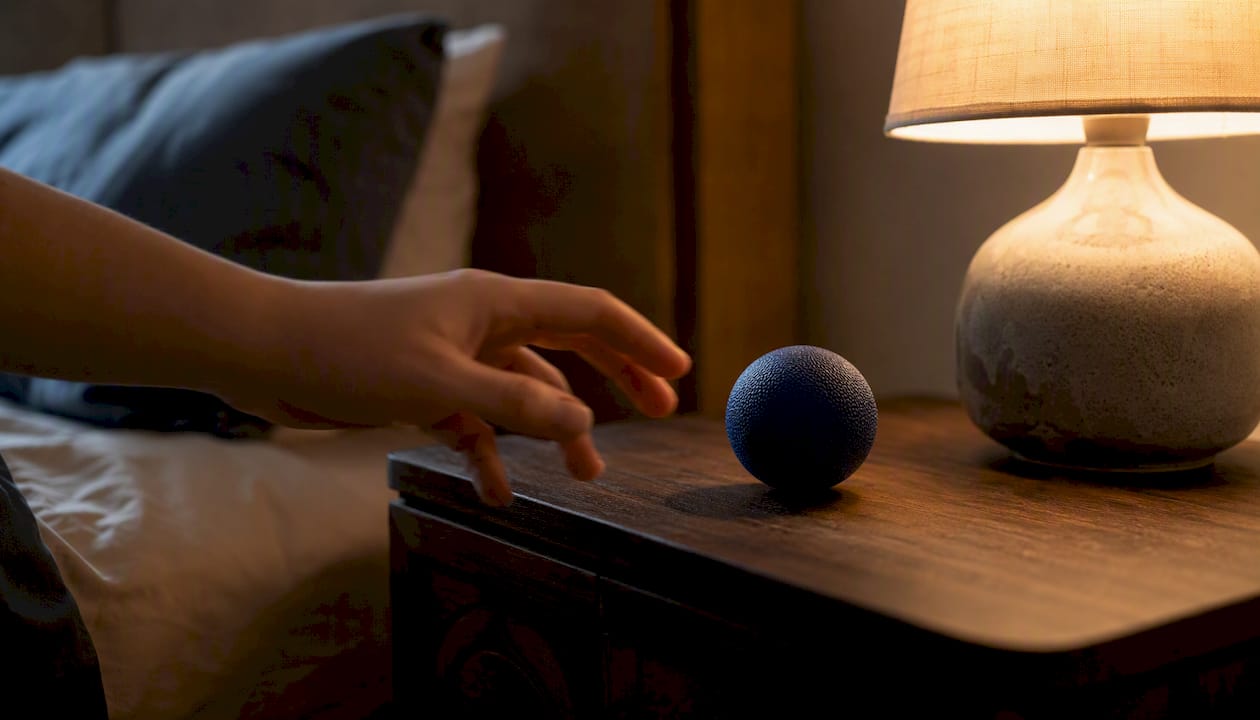
One detail that surprises people: it’s often the smallest, least “clinical” tool that ends up mattering most. I’ve heard more than one account of someone keeping a smooth stone or a small stress object on their nightstand, something to hold during a 3 a.m. panic spike when turning on a light or reaching for a phone would only make things worse. The tactile weight of it gives the anxious brain something concrete to focus on, low effort, no screen, immediate. It’s not a cure. But it buys enough calm to remember the breathing pattern or the grounding exercise, and that’s often all it takes to get back to sleep.
Progress here tends to look uneven. A good week followed by one bad night doesn’t erase the gains. The goal isn’t perfect sleep, it’s a nervous system that recovers faster when it does get knocked off balance.
How Mindpanda Supports the Routine You Just Learned
Mindpanda won’t replace CBT-I or a conversation with your doctor, and none of these products are medical treatments, but a few tangible tools can make the routine above easier to stick with. A dedicated journal gives your worry-time practice an actual home instead of a scrap of paper you’ll lose by Thursday. A tactile stress ball or sensory object works exactly like the grounding tool described above, something to reach for mid-panic without touching a screen. And a calming bundle built around wind-down time gives you a consistent physical cue that it’s time to shift out of alert mode.

These are adjunctive supports, not substitutes for therapy or medical care, but small physical anchors do help routines stick. If you want a starting point, the Mindfulness Wellbeing Bundle pairs a journal with sensory tools suited to worry-time and grounding, or you can build your own combination if you already know which pieces of the routine you want to reinforce. Either way, pick one tool, add it to tonight’s routine, and see how it feels.
Sources
- Sleep Anxiety: What It Is, Causes, Symptoms & Treatment
- How To Calm Your Anxiety at Night
- Beat anxiety, insomnia: get back to sleep
- Sleepless Nights? Try Stress Relief Techniques
- Anxiety at night: causes and tips for relief
- Pubmed
This article is general information, not a substitute for advice from a qualified doctor. Consult a qualified healthcare professional about your own circumstances before acting on anything here.