Press your feet flat into the floor and name five things you can see. That single move, backed by Cleveland Clinic’s clinical guidance on grounding, pulls your nervous system out of a spiral and back into the room you’re standing in. That’s what grounding does: it interrupts a racing or dissociating mind by anchoring attention to something real, physical, and happening right now.
Here are eight techniques that work in under a minute, no equipment required:
- 5-4-3-2-1 sensory scan — Name several things you see, a few you can touch, several you hear, some you smell, and one you taste.
- Cold water or ice — Run cool water over your wrists or hold an ice cube for 20 to 30 seconds.
- Feet-to-floor press — Push both feet into the ground and notice the pressure for 10 seconds.
- Box breathing — Inhale 4 counts, hold 4, exhale 4, hold 4. Repeat four times.
- Category naming — Pick a category (dog breeds, cities, fruits) and list as many as you can in 30 seconds.
- Muscle clench-release — Squeeze your fists tight for 5 seconds, then release and notice the difference.
- Orientation statement — Say out loud: “My name is ___. Today is ___. I am in ___.”
- Counting backward by 7s — Start at 100 and subtract 7 repeatedly until your mind slows down.
Try each one for 30 to 60 seconds. Pick two that feel natural and practice them daily, even when you’re calm, so they’re automatic when you actually need them. The National Center for PTSD’s clinical toolkit recommends exactly this kind of rehearsed, low-effort grounding for handling flashbacks and acute distress in the moment they happen.
Key Takeaways
Grounding works by anchoring attention to a verifiable, external, present-moment detail, which shifts both mental focus and physical arousal away from panic or dissociation.
| Point | Details |
|---|---|
| Start with 5-4-3-2-1 | Name 5 things you see, 4 you touch, 3 you hear, 2 you smell, 1 you taste. |
| Practice before you need it | Rehearse two or three techniques daily so they’re automatic during acute distress. |
| Match technique to symptom | Use counting patterns for racing thoughts and orientation statements for dissociation. |
| Watch for breath-focus backfire | Switch to a physical or sensory technique if breathing exercises worsen panic. |
| Know grounding’s limits | Seek professional support for ongoing dissociation, suicidal thinking, or crisis situations. |
| Build a small practice kit | A textured object, mints, and a journal support daily practice, and Mindpanda’s wellbeing bundle covers all three in one order. |
Table of Contents
- Physical grounding techniques: touch, temperature, and movement
- Mental grounding techniques: cognitive anchors and thought patterns
- Sensory and soothing grounding: taste, scent, and sound
- Breathing and body-awareness grounding scripts
- Movement-based grounding and posture adjustments
- Ready-to-use scripts for one-minute grounding routines
- When grounding helps, and when to seek more support
- Building your own short grounding plan and practice schedule
- What the evidence actually says about grounding
- Why grounding works better as a habit than an emergency plan
- Small tools that make grounding practice easier to keep up
- Sources
Physical grounding techniques: touch, temperature, and movement
Touch and temperature work because they force your brain to process something concrete and external instead of the internal loop of anxious thoughts. A PMC review of somatic approaches found that physical orientation and movement help regulate arousal during stressful states, which is part of why “put your hands under cold water” isn’t just a folk remedy. It’s a real physiological reset.
Here are ten physical techniques worth keeping in rotation:
- Ice cube hold. Hold an ice cube in your palm until the cold becomes the only thing you’re thinking about.
- Cool water splash. Splash cold water on your face or run your wrists under the tap for 20 seconds.
- Feet-to-floor press. Sitting or standing, push your feet flat into the ground and notice the texture beneath them.
- Progressive muscle release. Tense your shoulders, jaw, or fists for 5 seconds, then let go and feel the contrast.
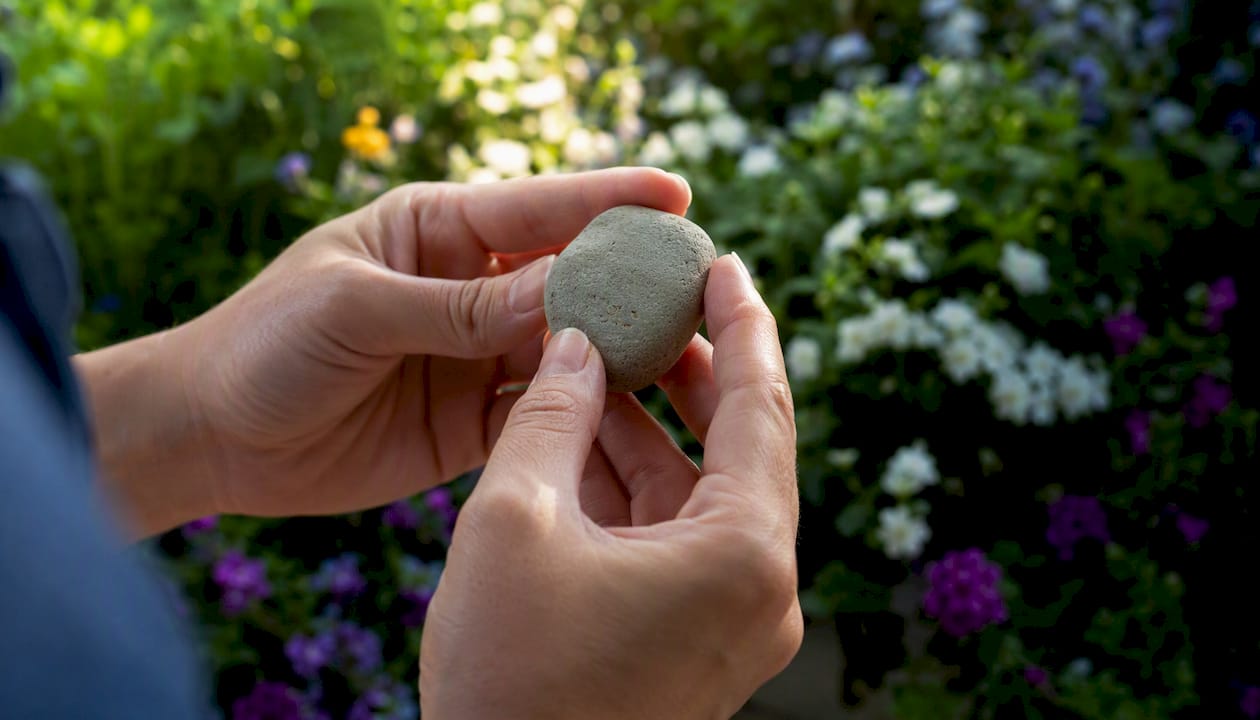
- Grounding object. Carry a smooth stone, textured fabric, or stress ball and squeeze it when anxiety spikes.
- Weighted lap item. A folded blanket or heavy book on your lap can create a calming, contained sensation.
- Hair pull or scalp tap. Gently tug a section of hair or tap your scalp with your fingertips.
- Wall push. Press both palms flat against a wall and push as hard as you comfortably can for 10 seconds.
- Temperature contrast. Alternate holding something warm (a mug) and something cool (a glass) in each hand.
- Textured fidget. Rub a textured object like corduroy, a pinecone, or a stress ball between your fingers.
Most of these adapt easily. If you’re in a wheelchair or have limited mobility, swap “feet-to-floor” for pressing your palms into the armrests, and swap the wall push for pressing your hands together in your lap. If standing is uncomfortable, the ice cube and cool water methods work exactly the same seated.
Pro Tip: Keep a small textured object, like a smooth stone or a stress ball, in your bag, car, or desk drawer specifically for this purpose. An item you’ve never used for anything else becomes a stronger anchor because your brain doesn’t associate it with anything but calm.
Mental grounding techniques: cognitive anchors and thought patterns
Mental grounding interrupts rumination by giving your brain a structured task it can’t do on autopilot. Counting backward by 7s, for instance, requires enough working memory that anxious thoughts can’t run in the background at the same time. That’s the whole mechanism: replace an open-ended spiral with a bounded, effortful task.

These techniques fall into a few categories. Orientation statements ground you in time and place. Counting patterns occupy working memory. Categorization tasks pull you into retrieval mode. And the 5-4-3-2-1 method, one of the most widely recommended structured approaches according to Verywell Mind’s coverage of the technique, combines several of these at once.
Ten mental techniques worth memorizing, with quick scripts for each:
- 5-4-3-2-1 sensory scan. Say aloud or silently: 5 things I see, 4 I can touch, 3 I hear, 2 I smell, 1 I taste.
- Count backward by 7s. Start at 100: 93, 86, 79… continue until your thoughts slow.
- Name months backward. December, November, October… all the way to January.
- Category listing. Pick “types of trees” or “countries starting with M” and list as many as you can.
- Orientation script. “My name is [name]. I am [age]. Today is [day, date]. I am currently in [location].”
- Alphabet game. Name an animal, food, or city for each letter of the alphabet, A to Z.
- Object description. Pick one object nearby and describe its color, shape, texture, and weight in detail.
- Math ladder. Multiply 3 by increasing numbers: 3, 6, 9, 12… as high as you can go quickly.
- Memory retrieval. Recall the details of a recent, ordinary event, like what you ate for breakfast.
- Five-senses check-in. Silently note one thing for each sense without needing exactly five, four, three items.
Racing thoughts respond best to counting patterns and math ladders because they demand continuous mental effort. Dissociation and that “checked out” feeling respond better to orientation statements and object description, since they pull attention back into the physical present rather than just occupying working memory. A Cal Poly campus health resource on grounding notes that pairing a physical cue, like pressing your feet down, with a cognitive script, like stating the date, tends to work faster for flashbacks than either approach alone.
Sensory and soothing grounding: taste, scent, and sound
Sometimes you don’t need to interrupt a spiral so much as slow one down, and that’s where soothing sensory techniques earn their place. These work differently than the sharp, attention-grabbing methods above. They’re designed to calm the nervous system gradually rather than jolt it into the present.
- Mint or strong flavor. Suck on a peppermint or a piece of hard candy and focus entirely on the taste as it changes.
- Herbal tea sip. Slowly sip a warm cup of chamomile or ginger tea, noticing temperature and taste with each sip.
- Familiar scent. Keep a small vial of lavender or citrus essential oil and inhale it slowly for a few breaths.
- Personal playlist. Play one song you know well and focus only on the bassline or the lyrics.
- White noise or nature sounds. Use a fan, rain sounds, or a white-noise app to create a steady auditory anchor.
- Weighted or firm touch. A weighted blanket, firm hug, or self-hug with crossed arms applies calming pressure.
- Soft texture. Wrap yourself in a soft blanket or hold a piece of fleece fabric against your skin.
- Chewing gum. The repetitive motion of chewing gives your mouth and jaw a simple, rhythmic task.
Keep these portable when possible: lip balm with a strong scent, a small tin of mints, or a folded scarf all travel well in a bag or desk drawer. One caution worth taking seriously: if you have food allergies, check labels on any candy or gum before relying on it as a grounding tool, and skip essential oils entirely if you have asthma, are pregnant, or have a known sensitivity, since some oils can trigger reactions rather than calm.
Breathing and body-awareness grounding scripts
Breathing techniques work by directly influencing your autonomic nervous system, the part of your body that controls fight-or-flight responses. A PMC article on attention and body-awareness mechanisms explains that slower, controlled breathing supports emotion regulation partly by shifting your physiological state toward calm, not just your mindset.
Here are five scripts to practice, in order of complexity:
- Box breathing. Inhale for 4 counts, hold for 4, exhale for 4, hold for 4. Repeat for 4 to 6 cycles.
- 4-4-6 paced breathing. Inhale for 4 counts, hold for 4, exhale slowly for 6 counts. This longer exhale activates a calming response more than equal-count breathing.
- Hand-on-heart check. Place one hand on your chest and one on your stomach. Breathe so only the stomach hand moves.
- Counted exhale. Breathe in normally, then exhale while silently counting to 10. Repeat 5 times.
- Body scan breath. With each exhale, mentally scan one body part (shoulders, jaw, hands) and consciously relax it.
Aim for multiple cycles per script, roughly a short mindful session. Longer sessions aren’t necessarily better here. The goal is a quick reset, not a meditation retreat.
One real safety note: for some people, especially those with a history of panic attacks, focusing intently on breath can backfire and make breathing feel labored or trigger hyperventilation. If counting breaths starts to feel like it’s making things worse rather than better, stop and switch to a physical or sensory technique instead, like the ice cube hold or the 5-4-3-2-1 scan. There’s no rule that breathing has to be your anchor. For more structured practices to build on this foundation, Mindpanda’s guide to mindfulness activities for anxiety covers additional daily routines.
Movement-based grounding and posture adjustments
Restlessness and overwhelm often need an outlet, not just a mental redirect, and short bursts of movement do that job efficiently. These routines take 30 to 90 seconds and don’t require any equipment or much space.
- Paced walking with counting. Walk slowly and count each step, resetting to 1 after every 10 steps.
- Shoulder rolls. Roll your shoulders backward 5 times, then forward 5 times, focusing on the sensation of movement.
- Stomping feet. Stomp each foot alternately for 10 seconds, feeling the impact through your legs.
- Standing stretch sequence. Reach overhead, then bend to touch your toes, then twist gently side to side.
- Chair yoga micro-sequence. Seated, roll your neck, stretch your arms overhead, and press your palms together at your chest.
- Hand and wrist shake. Shake out your hands vigorously for 10 seconds like you’re flicking off water.
If you’re in a small space like a bathroom stall or a crowded office, shoulder rolls, hand shakes, and seated stretches work without drawing attention. For anyone managing mobility constraints, every routine above adapts to a seated version by focusing on upper body movement alone.
Pro Tip: Pair movement with a counting pattern for a faster reset. Walking while counting steps in sets of ten, for example, combines a physical outlet with a cognitive anchor, which tends to work faster than either one on its own for restlessness or racing thoughts.
Ready-to-use scripts for one-minute grounding routines
Three scripts below cover the three main categories: sensory, cognitive, and breathing. Each takes about 60 seconds and works whether you say it aloud or just follow it silently.
- The Sensory Minute. Look around and name 5 things you see. Touch 4 different textures near you. Listen for 3 distinct sounds. Notice 2 smells in the air. Identify 1 taste in your mouth right now.
- The Cognitive Minute. State your name, the day, and your location out loud. Count backward from 50 by 3s: 50, 47, 44… Stop once your thoughts feel steadier.
- The Breathing Minute. Inhale for 4 counts. Hold for 4. Exhale for 6. Repeat this pattern 5 times, placing one hand on your chest to feel the rhythm.
A simple mnemonic makes these easier to recall under stress: S-C-B, sensory, cognitive, breathing. If your mind goes blank in the moment, that three-letter cue alone can point you to a starting place. Save all three scripts as a phone note titled “Grounding” so they’re one tap away, or text them to yourself so a friend can send them back to you during a hard moment.
When grounding helps, and when to seek more support
Grounding works best for acute, short-term distress: panic spikes, sudden anxiety, racing thoughts, or mild dissociation where you feel spaced out or disconnected from your surroundings. It’s designed to be a fast reset, not a cure. Research from the National Center for Complementary and Integrative Health notes that evidence for long-term symptom change from grounding alone is limited. Most sources recommend it as one tool within a broader plan, not a replacement for treatment.
Here’s where grounding has real limits:
- Grounding can help you get through a panic attack, but it won’t resolve an underlying anxiety disorder on its own.
- If dissociation is frequent, severe, or lasts hours rather than minutes, that pattern needs a therapist’s evaluation, not just more grounding practice.
- Grounding is not designed for active suicidal thinking, psychosis, or a mental health crisis. Those situations need immediate professional support.
- If you have food allergies, check ingredients before using candy, gum, or flavored items as a taste-based technique.
- If breath-focused techniques make you feel worse or trigger hyperventilation, stop and switch to a physical or sensory method instead.
If grounding techniques aren’t reducing your distress after a few honest attempts, that’s useful information, not a personal failure. Talk to a therapist about building a broader coping plan, and if you’re in the United States and in crisis, the 988 Suicide & Crisis Lifeline is available by call or text at any hour. This article offers general information and isn’t a substitute for care from a licensed mental health professional.
Building your own short grounding plan and practice schedule
The techniques that work best are the ones you actually remember to use, which means picking a handful and practicing them before you’re in crisis. Trying every technique once during a calm afternoon tells you far more than reading about them ever will.
Start with this simple worksheet approach:
- Pick one physical technique (ice cube, feet-to-floor, muscle release).
- Pick one mental technique (5-4-3-2-1, counting backward, orientation statement).
- Pick one breathing script (box breathing, 4-4-6 paced breath).
- Practice each for 1 to 5 minutes daily, even when you’re not anxious.
- Rate each one out of 5 for how much it actually helped, and drop anything scoring below a 3 after a week.
Context matters here. A technique that works at home might not work at your desk or on a crowded train, so test each one in the settings where you’re actually likely to need it. A counting script works anywhere silently. An ice cube hold needs privacy and access to a freezer. Know which tools fit which moments before you need them urgently.
A short checklist of physical items can make practice easier to start:
- A textured object or smooth stone for tactile grounding
- Mints or gum for taste-based techniques
- A small towel or washcloth you can run under cold water
- A stress ball or squeezable item for muscle-release techniques
- A journal for tracking which techniques worked and when
Mindpanda’s stress balls and aromatherapy items are built specifically around this kind of daily, tactile practice, and a wellness journal makes the weekly effectiveness rating easier to keep consistent instead of relying on memory alone.
What the evidence actually says about grounding
Grounding sits at an interesting intersection of clinical practice and everyday self-help, and the research backing it is real but bounded. A peer-reviewed study indexed on PubMed supports brief attention-based and mindfulness-related practices as helpful for reducing certain anxiety-related symptoms, which lines up with why structured sensory tasks like 5-4-3-2-1 show up across so much clinical guidance.
The mechanism isn’t mysterious. A full-text review on attention and body-awareness explains that these practices support emotion regulation by shifting physiological arousal, not just by distracting the mind. That’s a meaningful distinction: grounding isn’t just a mental trick, it changes what your body is actually doing in real time.
Where the evidence gets more cautious is duration and scope. The NCCIH’s overview of meditation and attention training notes real variability across individuals and limited evidence for lasting symptom change from brief practices alone. Structured, outward-focused tasks like 5-4-3-2-1 tend to be more usable during acute panic than open-ended mindfulness, according to Insight Timer’s technique library, because they give the brain something concrete and verifiable to latch onto rather than an abstract instruction to “just breathe” or “just relax.”
Grounding gives your nervous system a verifiable, external fact to hold onto when everything internal feels unreliable. That’s the whole value: not fixing the underlying cause, but buying you enough stability to think clearly for the next few minutes.
None of this replaces therapy, medication, or a structured treatment plan for anyone dealing with chronic anxiety, PTSD, or dissociative disorders. Grounding is the fast, in-the-moment tool. It’s not the whole toolbox.
Why grounding works better as a habit than an emergency plan
Most people find grounding techniques the way they find a fire extinguisher: after the fire’s already started, when it’s too late to read the instructions calmly. That’s backwards, and it’s the single biggest reason grounding fails for people who’ve genuinely tried it.
The techniques listed here work best when they’re already familiar. Counting backward by 7s under acute panic feels almost impossible if you’ve never practiced it while calm. The same script, rehearsed daily for even 60 seconds, becomes almost automatic when you actually need it. That’s not a minor tip. It’s the difference between a technique that works and one that gets abandoned after one bad experience.
It’s also worth normalizing something rarely said out loud: not every technique will work every time, even ones that worked well last week. Anxiety and dissociation don’t respond identically to the same input every single time, and that inconsistency isn’t a sign you’re doing it wrong. It’s a sign to have two or three techniques ready, not just one. Treat this list as a rotation to experiment with, not a single fix to master perfectly.
Small tools that make grounding practice easier to keep up
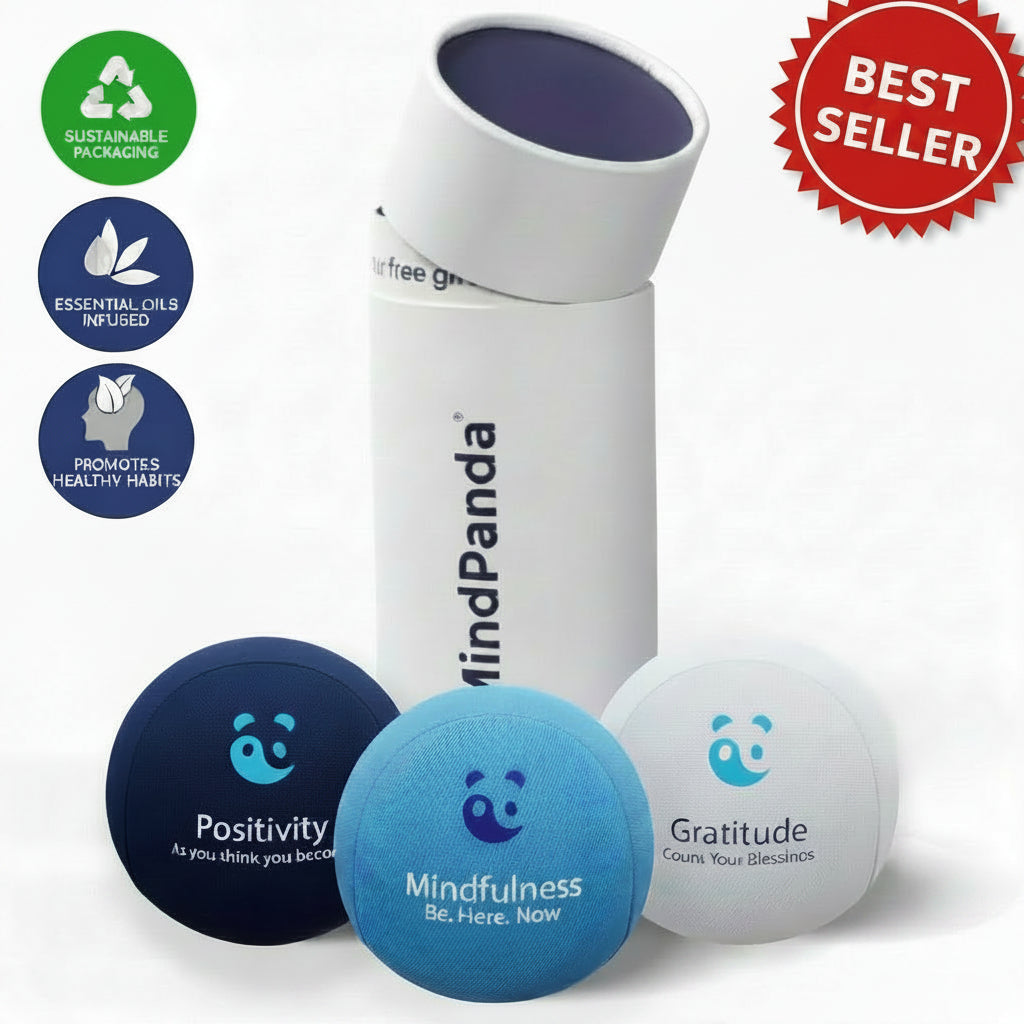
A textured object or a scent you reach for consistently works better than one you improvise in the moment, and that’s exactly where a few well-chosen items earn their place. Mindpanda’s Mindfulness Wellbeing Bundle pairs a stress ball, aromatherapy item, and journal together, which covers the physical, scent-based, and tracking pieces of the practice plan outlined above in one purchase instead of hunting down each item separately.
If you’d rather build a kit around your own preferences, the Create Your Own Wellbeing Bundle page lets you choose the specific textured objects, scents, or journal style that match the techniques you found most useful in your own practice week. None of this is required to use grounding effectively. Every technique in this article works with items you already have at home. But if you’re starting from scratch or want a dedicated set that lives in your bag or desk specifically for this purpose, that’s exactly what these bundles are built for. Pick one, or build your own, and give it a week before deciding what stays in the rotation.
Sources
- Grounding techniques — Cleveland Clinic
- Managing strategies — PTSD: National Center for PTSD (VA)
- PubMed-indexed study relevant to attention-based interventions
- NCBI PMC article on attention and body-awareness mechanisms
Grounding is genuinely useful as a short-term tool, but it works best as one piece of a broader plan that includes therapy, medical care, or other professional support when anxiety or dissociation is frequent and severe. Use it to get through the next five minutes. Build something bigger for the long term.
This article is general information, not a substitute for advice from a qualified doctor. Consult a qualified healthcare professional about your own circumstances before acting on anything here.