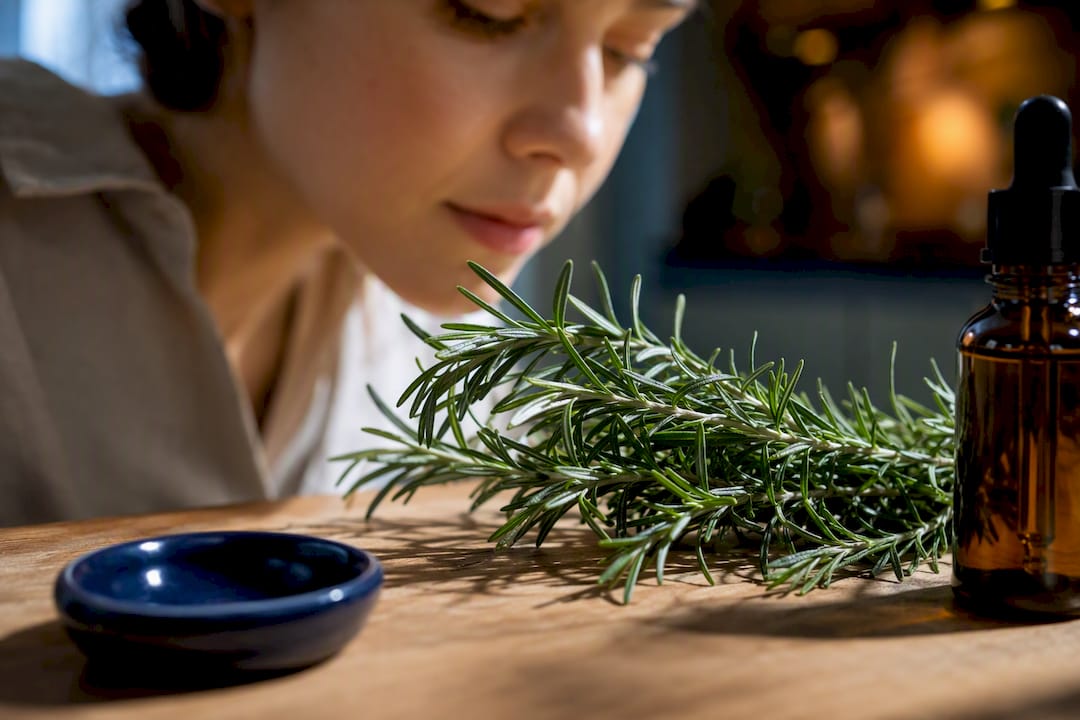
Rosemary, peppermint, and bergamot have the strongest human research behind them for supporting focus, and the fastest way to test them is a 10 to 20 minute diffuser or personal inhaler session during a work block. Dilute any oil before it touches skin, and check with a clinician first if you take blood pressure or blood-thinning medications. Everything else, from cedarwood to citrus blends, is worth trying, but these three are where the evidence actually starts.
TL;DR:
- Rosemary is most effective when diffused during focused work, but high doses do not improve and may worsen cognitive performance.
- Peppermint inhalation increases alertness and reduces fatigue during sustained attention tasks, making it suitable for short focus boosts.
- Bergamot reduces autonomic arousal signals like heart rate and blood pressure, especially when diffused before high-pressure tasks.
- Many other oils, such as citrus and vetiver, have lighter or anecdotal evidence, so match oils to specific focus or stress-related challenges.
- Use essential oils deliberately through diffusion or inhalers in short sessions, and always consider safety, quality, and individual response before regular use.
Table of Contents
- Research-Backed Essential Oils for Focus
- Other Oils People Recommend for Concentration
- How to Use Essential Oils for Focus, Step by Step
- Diffuser and Roller Blends for Different Focus Needs
- Why Scent Affects Concentration in the First Place
- Safety, Interactions, and How to Judge Oil Quality
- A Two-Week Test to Find What Works for You
- Aromatherapy Works Best as Part of a Routine, Not a Fix on Its Own
- Pair Your Focus Routine With Tools Built for It
- Studies Worth Reading on Essential Oils and Focus
- Sources
Research-Backed Essential Oils for Focus
Most oils marketed for concentration rely on tradition and anecdote. A smaller group has actual human trials behind them, and that’s where you should start if you want results you can trust rather than just a pleasant smell.
Rosemary has the best data of the bunch. A placebo-controlled study found that both ingesting rosemary and simply smelling its aroma improved memory speed and performance on cognitive tasks, including visual processing and serial subtraction. Researchers point to 1,8-cineole, a compound in rosemary’s essential oil, as a likely driver. A separate clinical trial found rosemary extracts improved short-term memory markers, but also noted something worth remembering: higher doses didn’t help more, and in some cases performed worse than moderate doses. More rosemary is not better rosemary.
Peppermint works through a different channel. Small trials link peppermint scent to increased alertness and reduced fatigue during tasks that demand sustained attention, which is exactly the kind of afternoon slump most people reach for coffee to fix.
Bergamot takes the indirect route. A Taiwan study had teachers inhale bergamot oil for just 10 minutes a week and measured lower heart rate and blood pressure afterward, a sign of reduced autonomic arousal. Less internal noise from stress often means more attention left over for the task in front of you.
- Rosemary: diffuse during study or deep work sessions; avoid high doses if ingesting anything rosemary-derived
- Peppermint: personal inhaler for a quick alertness reset between meetings
- Bergamot: diffuse before high-pressure tasks where anxiety is the real obstacle to focus
Other Oils People Recommend for Concentration
Beyond the research-backed three, a handful of oils show up constantly in aromatherapy blends. The evidence behind them ranges from solid to mostly anecdotal, so it helps to know which is which before you build a routine around one.
- Lemon and citrus oils: observational studies and small trials tie citrus scents to improved mood and alertness, making them a reasonable pick for a morning diffuser session, even though the evidence is lighter than rosemary’s.
- Cedarwood: grounding and woodsy, used more for calming restlessness than sharpening attention. Better for anxious energy than for a mental fog problem.
- Cinnamon: associated with alertness in traditional use, but human data is thin. Treat it as a flavor note in a blend, not a standalone focus tool.
- Lemongrass: bright and energizing, often paired with citrus for a wake-up effect. Mostly anecdotal support.
- Vetiver: earthy and calming, popular in blends for people whose distraction comes from restlessness rather than low energy.
- Basil: traditionally used for mental clarity; evidence is largely practitioner-based rather than clinical.
The pattern that matters here: energizing oils (citrus, peppermint, cinnamon) fit low-energy focus problems, while grounding oils (cedarwood, vetiver) fit anxious or scattered focus problems. Match the oil to the actual obstacle, not just the reputation.
How to Use Essential Oils for Focus, Step by Step
The delivery method matters almost as much as the oil itself. Here’s a practical sequence for building this into a workday.
- Diffuse in short cycles. For a room around 200 to 300 square feet, run a diffuser 30 to 60 minutes on, then 30 to 60 minutes off. Constant, all-day diffusion dulls your sense of smell and may reduce the effect.
- Use a personal inhaler for quick sessions. Two or three drops on a cotton wick in a small inhaler tube gives you a 10 to 20 minute focus sprint you can carry between rooms or use at a desk with no diffuser.
- Dilute before topical use. Adults generally use a 2 to 3% dilution (roughly 12 to 18 drops per ounce of carrier oil like jojoba or fractionated coconut oil). Avoid mucous membranes and test on your inner forearm first.
- Time it deliberately. Use focus blends at the start of a work block or before a demanding task, not as background noise running for eight hours straight.
Pro Tip: Pair scent with a consistent trigger, like starting your diffuser the moment you open your planner for the day. The brain associates the smell with “focus mode” faster than you’d expect.
Diffuser and Roller Blends for Different Focus Needs
Ratios below assume a standard 200 to 300 mL diffuser filled with water, or a 10 mL roller bottle topped with carrier oil for topical blends.
- Deep study blend: 3 drops rosemary, 2 drops peppermint, 1 drop lemon (diffuser). Roller version: 2 drops rosemary, 1 drop peppermint, top with carrier oil.
- Creative work blend: 3 drops bergamot, 2 drops cedarwood, 1 drop lemongrass (diffuser).
- Calm alertness blend: 3 drops bergamot, 2 drops vetiver, 1 drop rosemary (diffuser), ideal before high-pressure tasks with an anxiety component.
- Morning wake-up blend: 3 drops lemon, 2 drops peppermint, 1 drop basil (diffuser).
Practitioner blends sold by specialty aromatherapy retailers often combine this same core group, rosemary, peppermint, citrus, basil, which lines up with what these recipes use. For a personal inhaler, cut every ratio in half. For rooms over 400 square feet, add one or two extra drops of the dominant note. Cut all drop counts by a third for scent-sensitive users, and skip essential oil diffusion entirely around infants, and check with a doctor before use during pregnancy.
Why Scent Affects Concentration in the First Place
Essential oils reach the brain through the olfactory system, which connects directly to the limbic system, the region handling emotion and memory formation. That direct wiring is why a smell can shift your mood or mental state faster than most other senses.
Volatile compounds like 1,8-cineole appear to interact with neurotransmission, which may partly explain rosemary’s effects on memory and alertness. A 2023 review describes aromatherapy as working through this combination of physiological and psychological mechanisms, scent chemistry on one side, learned association and mood shift on the other. The same review is explicit that aromatherapy functions best as a supportive practice, not a replacement for evidence-based treatment of attention or anxiety disorders.

Safety, Interactions, and How to Judge Oil Quality
Essential oils are concentrated plant compounds, not inert background scents, and that means real precautions apply.
- Some oils can affect blood pressure or interact with blood-thinning medications; case reports and clinical literature document essential oil drug interactions clearly enough that anyone on prescription medication should talk to a clinician before regular use.
- Patch-test any oil on your forearm 24 hours before broader use, and stop immediately if you notice redness, itching, or a rash.
- Avoid internal use entirely unless directed by a qualified professional, and use extra caution with children, older adults, and during pregnancy.
- If you experience difficulty breathing, swelling, or a severe skin reaction, stop use and seek medical attention.
Quality varies enormously between brands. Look for suppliers who publish third-party GC/MS testing results, since that verifies what’s actually in the bottle rather than relying on label claims alone. A blind dose response also seems to run both directions: low to moderate exposure appears to help, while excessive exposure can blunt or reverse the benefit, which is one more reason to stick with short, intentional sessions instead of nonstop diffusion.
A Two-Week Test to Find What Works for You
Skip the guesswork and run a short experiment instead.
- Days 1 to 4: track your focus with no oils, just a simple 1 to 5 rating a few times a day, so you have a real baseline.
- Days 5 to 14: pick one oil or blend and use it consistently at the same time each day, tracking the same rating alongside a quick note on distractions.
- Review: compare your average rating during the test window against baseline. Change one variable at a time, keep the rest of your routine identical, so you know the scent is actually doing something.
Pro Tip: If your sleep, mood, or medication response changes at all during the test, stop and check with a doctor before continuing. Focus is one signal; it’s not the only one worth watching.
Aromatherapy Works Best as Part of a Routine, Not a Fix on Its Own
Essential oils help most when they’re anchored to something you’re already doing, opening your planner, sitting down for a work block, starting a meditation, rather than floating on their own as a standalone habit. Pair a rosemary diffuser session with a structured daily routine or a few minutes of guided meditation, and the scent becomes a cue your brain learns to trust. That’s a more realistic use of aromatherapy than expecting a bottle to do the attention work for you.
— Ravi
Pair Your Focus Routine With Tools Built for It
Essential oils give you a cue. A planner gives you the structure to act on it once your attention actually shows up. Balance by MindPanda: The Daily Productivity Planner is built to sit next to your diffuser or inhaler, with daily prompts that turn a scent-triggered focus window into actual completed work instead of a nice smell and nothing to show for it.
If you want a broader setup, the Create Your Own Wellbeing Bundle lets you combine a planner with stress-relief tools so your routine covers more than just the first ten minutes of a work block. Start with the planner, add a bundle once you know what your focus routine actually needs, and build from there.
Studies Worth Reading on Essential Oils and Focus
For readers who want to check the primary evidence directly:
- Rosemary and cognitive performance: the placebo-controlled study behind the memory and task-speed claims.
- Bergamot inhalation and autonomic response: the Taiwan study on heart rate and blood pressure.
- Mechanisms of aromatherapy: the 2023 review covering neurotransmitter and limbic-system pathways.
- Essential oil interactions and cautions: the case literature behind the medication-interaction warnings.
This article is general information, not a substitute for advice from a qualified doctor. Consult a qualified healthcare professional about your own circumstances before acting on anything here.
Sources
- PubMed: Study on rosemary and cognitive performance (2011)
- PMC: Bergamot inhalation study (2011)
- PMC review on mechanisms of aromatherapy (2023)
- IJS: Case reports and review noting essential oil interactions and cautions